How Do I Make My Sales Page More Persuasive Without Adding More Copy?
TL;DR
You can make a sales page more persuasive without adding more copy by improving the message, not increasing its length.
A stronger headline, clearer benefits, more relevant proof and a better sequence of information can make an existing sales page more convincing.
The aim isn't to pressure visitors into buying. It's to help suitable customers understand why the offer matters, whether it addresses their problem and what they can expect.
Sometimes removing unnecessary words and strengthening the ones that remain can achieve more than adding another section.
IN SHORT
When a sales page isn't converting as well as you'd like, adding more information can seem like the obvious solution.
You might introduce another explanation, include more product features or write several extra paragraphs describing the benefits.
But a longer page isn't automatically a more persuasive one.
If visitors already have enough information but struggle to recognise the value of your offer, adding more words may make the decision harder.
A better approach is to review the message you've already written.
Are the most important benefits easy to recognise? Does the headline address something your audience cares about? Is the supporting evidence relevant? Does the page answer the questions that matter before asking for a purchase?
Improving those elements can strengthen your sales message without making the page longer.
WHY THIS WORKS
Start With A Stronger Headline
Your headline is often the first opportunity to explain why someone should pay attention to your offer.
It doesn't need to be dramatic or clever.
It needs to communicate something relevant.
For example, imagine you're selling a guide to creating digital products.
Your existing headline reads:
"The Complete Digital Product Training Programme"
That describes the product, but it doesn't explain why someone might want it.
A more useful alternative could be:
"Learn How To Turn Your Knowledge Into A Digital Product You Can Sell"
The second headline gives readers a clearer understanding of the intended outcome.
It connects the product with something the visitor may already want to accomplish.
You haven't added another section or made the sales page significantly longer.
You've simply made the opening message more relevant.
The important thing is to avoid promising results the product cannot reasonably deliver.
A headline should communicate the offer's value without exaggerating what customers can expect.
Replace General Claims With Specific Benefits
Many sales pages rely on statements that sound positive but don't explain very much.
Words such as powerful, amazing, revolutionary and game-changing may create enthusiasm, but they don't necessarily help someone understand the product.
Specific benefits are usually more useful.
For example:
"This powerful course will transform your email marketing."
Compare that with:
"Learn how to plan a simple email sequence that welcomes subscribers and introduces relevant offers."
The second statement explains what the training helps someone do.
It gives the reader something concrete to evaluate.
This is closely connected with offer positioning.
If your sales message doesn't clearly explain who the product is for and what problem it addresses, even well-written copy may struggle to persuade.
Our article How Do I Improve My Offer Positioning? explores how to connect an offer more closely with the needs of its intended audience.
A useful exercise is to review every major claim on your page.
Ask whether it describes a genuine benefit or simply uses enthusiastic language.
Where possible, replace vague claims with specific explanations.
Put The Most Important Information First
A sales page can contain all the right information and still fail to communicate effectively.
Sometimes the problem is the order in which that information appears.
Imagine a visitor arrives because they want help improving their email marketing.
Instead of immediately explaining how your product addresses that problem, the page begins with a lengthy introduction about the creator's background.
The information may be relevant later, but it doesn't answer the visitor's immediate question.
A stronger approach is to introduce the problem, explain the proposed solution and establish why the offer deserves consideration.
Supporting details can follow once readers understand the central message.
You don't necessarily need to remove every section.
You may simply need to rearrange the information.
Our article How Do I Structure A High-Converting Sales Page? explores how different sections can work together to guide readers through a purchasing decision.
The principle is straightforward.
Present information in the order readers need it, rather than the order you happened to write it.
Make Your Existing Proof More Relevant
Trust is an important part of persuasion.
Visitors want to know whether the product is credible, whether the claims are reasonable and whether they're likely to receive what has been promised.
Social proof can help, but only when it's genuine and relevant.
For example, a testimonial saying "Brilliant product!" expresses satisfaction but provides little detail.
A more informative testimonial might explain which part of the training helped the customer and what they were able to do afterwards.
That gives prospective buyers something more meaningful to consider.
However, testimonials should be authentic, used with appropriate permission and presented without misleading edits.
If you don't have testimonials, there are other ways to provide useful evidence.
You might show a genuine product preview, explain the contents clearly or demonstrate how a particular worksheet works.
The objective is to support your claims with information visitors can evaluate.
Our article What Makes Social Proof Persuasive? explores why relevant evidence can be more useful than enthusiastic but vague endorsements.
You don't need to fill the page with testimonials.
One relevant example may provide more reassurance than several generic statements.
Turn Features Into Reasons To Buy
Product features are important because customers need to understand what they're purchasing.
However, features become more persuasive when you connect them with practical benefits.
Suppose your digital course includes downloadable templates.
You could simply write:
"Includes 15 downloadable templates."
That tells visitors what they'll receive.
But it doesn't explain how those templates might help them.
A stronger version could be:
"Use 15 downloadable templates to prepare your marketing materials without starting every document from scratch."
The feature remains the same.
You've simply explained its purpose.
This approach works particularly well for digital products, training programmes, memberships and software.
Customers often want to understand how the contents will help them solve a problem or complete a task.
However, avoid turning every feature into an exaggerated promise.
A checklist may help someone organise a process, but that doesn't mean it guarantees business success.
Persuasive copy should make the value easier to recognise without overstating the results.
Remove Unnecessary Repetition
Sales pages sometimes repeat the same argument several times using slightly different wording.
You explain that a product saves time.
A few paragraphs later, you describe how it helps people work faster.
Then another section explains that customers can complete tasks more efficiently.
These statements may all be true, but they may not provide much additional information.
Repetition can be useful when reinforcing an important point.
However, unnecessary repetition makes the page longer without helping readers make a decision.
Review your copy and identify places where several paragraphs communicate essentially the same benefit.
Could you combine them into one stronger explanation?
Could you replace a repeated claim with a useful example?
Could you remove a section without losing anything important?
The objective isn't to make every sales page short.
It's to ensure that the information earns its place.
A longer sales page may be appropriate for a complex or expensive offer, but length should serve the customer's need for information.
Address The Objections That Actually Matter
Potential customers often have questions before purchasing.
They may wonder whether the product is suitable for beginners, whether they need additional tools or whether they'll have enough time to use it.
These concerns can affect the buying decision.
However, adding a lengthy list of hypothetical objections isn't always necessary.
Instead, concentrate on the questions your audience genuinely asks.
For example, if customers frequently ask whether your training requires previous experience, you could add a concise explanation near the product description.
If people are uncertain about the format, clarify whether the purchase includes videos, written lessons or downloadable resources.
Sometimes a single sentence can remove a significant misunderstanding.
Our article How Do I Handle Customer Objections On A Sales Page? explores how to address common concerns without making the message unnecessarily complicated.
The key is to provide reassurance through accurate information rather than pressure.
Strengthen The Call To Action
A call to action should make the next step clear.
However, many sales pages use generic wording that doesn't connect particularly well with the offer.
For example, a button labelled "Submit" tells visitors very little.
"Get Instant Access To The Training" may be more informative when the product genuinely provides immediate access.
The second version explains what happens next.
You can also improve the supporting information around the button.
If customers need to know whether the purchase is a one-time payment, whether delivery is digital or whether a guarantee applies, make those details clear where appropriate.
A persuasive call to action doesn't need to create artificial urgency.
It needs to help someone who is ready to purchase understand how to proceed.
Avoid using misleading countdown timers, invented scarcity or exaggerated promises.
The goal is to make a suitable purchase easier, not to pressure someone into a decision they may regret.
Improve The Flow Between Sections
A sales page should feel like one connected explanation.
Each section needs to prepare the reader for what follows.
For example, you might begin by describing a problem, explain why common approaches don't always work and then introduce your product as one possible solution.
After that, you can explain the benefits, show what's included, provide relevant evidence and answer important questions.
If these sections appear in a confusing order, the message may feel disconnected.
You don't necessarily need more copy.
You may need better transitions.
A short sentence connecting two ideas can make the page easier to follow.
For example:
"Now that we've looked at the problem, here's how the training approaches it."
That simple transition helps readers understand why the next section matters.
This is particularly useful when you're working with a traditional sales letter.
A well-structured sales message guides readers through a logical argument rather than presenting disconnected claims.
If you're interested in exploring how sales letters can be used to promote information products, One Letter From Retirement introduces that approach.
The underlying principle is that persuasion comes from the strength and relevance of the message, not simply the number of words used.
PRACTICAL EXAMPLE
Imagine you're selling a £47 digital training programme about creating an online information product.
Your sales page receives 800 visitors each month.
At a 1.5% conversion rate, that produces 12 sales and £564 in revenue.
You want to improve the results but don't want to rewrite the entire page.
After reviewing the copy, you identify three weaknesses.
First, the headline describes the training rather than the outcome it helps customers work towards.
Second, the benefits section contains several vague claims about saving time and building a successful business.
Third, the call to action doesn't clearly explain what happens after purchasing.
You make three focused changes.
You rewrite the headline to communicate the product's purpose more clearly.
You replace vague claims with specific explanations of what the lessons help customers do.
Finally, you update the call to action and supporting information to explain how customers receive the training.
You haven't added more sections.
In fact, the revised page is slightly shorter.
Suppose the conversion rate increases from 1.5% to 2% while visitor numbers remain unchanged.
That would produce 16 sales and £752 in monthly revenue.
The difference is £188.
These figures are illustrative rather than a prediction.
The example shows how improving the clarity and relevance of an existing message can create an opportunity to increase sales without producing substantially more copy.
REAL TALK
There's a common assumption that a sales page needs more words when it isn't converting.
You start wondering whether another testimonial, another benefit or another explanation might finally persuade visitors to buy.
Sometimes additional information is necessary.
A complicated offer may require detailed explanations, comparisons and reassurance.
But adding more copy isn't automatically the answer.
If your existing message is weak, making it longer can simply give readers more weak copy to work through.
A stronger headline, a more relevant benefit or a clearer explanation may do more than several additional paragraphs.
The important thing is to understand what your visitors need before making a decision.
If they're confused, make the message clearer.
If they're uncertain, provide relevant evidence.
If they don't understand the value, explain the benefits more effectively.
And if the offer doesn't address a worthwhile problem, better copy alone won't fix it.
Persuasion should help suitable customers make informed decisions.
It shouldn't be about overwhelming people until they give in.
COMMON MISTAKES
Mistake: Adding more copy without identifying the problem.
You assume that a longer sales page will automatically produce more purchases.
Fix: Review the existing message and identify what's unclear, unconvincing or missing before making changes.
Mistake: Using enthusiastic language instead of specific benefits.
You describe the product as amazing or revolutionary without explaining what it helps customers accomplish.
Fix: Replace vague claims with practical, accurate explanations.
Mistake: Including generic testimonials.
You add praise that doesn't help prospective customers understand the product's value.
Fix: Use authentic, relevant evidence that supports specific claims.
Mistake: Repeating the same benefit throughout the page.
You make the sales message longer without providing additional information.
Fix: Combine repetitive sections and concentrate on the strongest explanation.
Mistake: Using pressure instead of persuasion.
You introduce artificial urgency or exaggerated promises to encourage purchases.
Fix: Help customers evaluate the offer through clear benefits, credible evidence and straightforward purchasing information.
FAQ QUICK FIX
Want to make your sales page more persuasive without adding more copy?
Start with these five improvements.
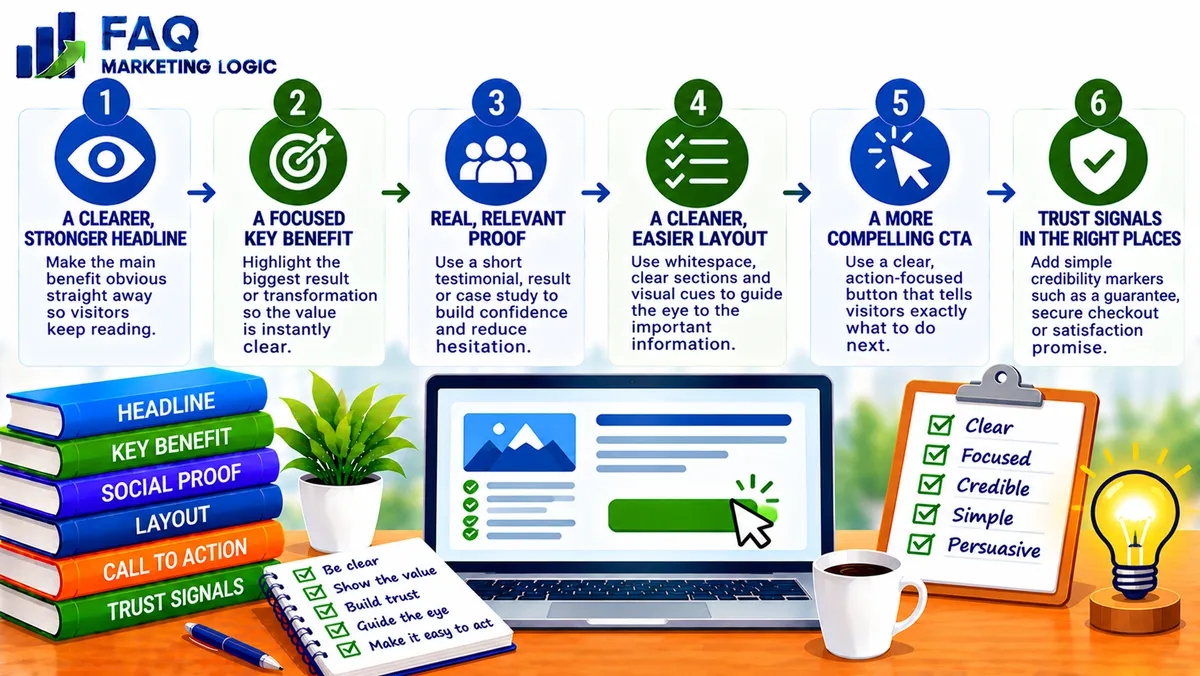
1. Review the headline.
Does it communicate something your intended audience genuinely wants or needs?
2. Strengthen the main benefits.
Replace vague claims with specific explanations of what the product helps customers accomplish.
3. Check the supporting evidence.
Make sure testimonials, examples and product demonstrations are relevant and genuine.
4. Remove unnecessary repetition.
Combine sections that communicate the same information without adding value.
5. Improve the call to action.
Make the next step clear and explain what customers can expect after purchasing.
You don't need to change everything at once.
Choose the improvement most likely to address a genuine weakness in your existing message.
FAQ
Can A Short Sales Page Be More Persuasive Than A Long One?
Yes. A shorter page can work well when the offer is straightforward and visitors already understand its value. More complex or expensive products may require additional information. The right length depends on what customers need to make an informed decision.
What's The Most Important Part Of A Persuasive Sales Page?
There isn't one element that guarantees results. However, a relevant headline, clear benefits, credible evidence and a straightforward call to action all contribute to helping visitors evaluate an offer.
Should I Remove Information To Improve Conversions?
Only when the information is unnecessary, repetitive or distracting. Don't remove important details that customers need to understand the product, its limitations or the purchasing terms.
Do Testimonials Make A Sales Page More Persuasive?
Relevant, authentic testimonials can provide useful reassurance. However, generic praise or misleading claims may offer little value and can undermine trust.
Can I Improve A Sales Page Without Changing The Product?
Yes. You may be able to improve how the product is positioned, explained and presented. However, copywriting improvements won't necessarily solve problems with product quality or market demand.
How Do I Know Which Part Of My Sales Page To Improve First?
Start by reviewing visitor behaviour, customer questions and available conversion data. Look for areas where readers may be confused, uncertain or unable to recognise the offer's value.
TRY THIS TODAY
Open one of your existing sales pages.
Don't start rewriting it immediately.
Instead, read the page from beginning to end and identify the central message.
Ask yourself:
Does the headline communicate a relevant benefit?
Is it clear who the product is intended for?
Does the opening explain the problem being addressed?
Are the main benefits specific and believable?
Have I explained why the product's features matter?
Is the supporting evidence genuine and relevant?
Are important customer concerns answered?
Do any sections repeat the same information?
Does the message follow a logical sequence?
Is the call to action clear and appropriate?
Now choose one section that could communicate its message more effectively.
Rewrite it without increasing the word count.
You might replace a vague claim with a specific benefit, simplify an explanation or remove unnecessary repetition.
Compare the original and revised versions.
Does the new version make the offer easier to understand? Does it give customers a more useful reason to consider purchasing?
If possible, test the change and monitor the results.
The objective isn't to produce the shortest possible sales page.
It's to make every section contribute something worthwhile.
Want To Explore Sales Letters Further?
A persuasive sales page doesn't need to overwhelm readers with information.
It needs to present a relevant offer, explain its benefits and guide potential customers through a clear purchasing decision.
This is one of the principles behind effective sales letter writing.
A well-structured sales letter can communicate the value of an information product and continue presenting that message to suitable prospects without requiring a completely new explanation for every visitor.
If you'd like to explore this approach, One Letter From Retirement introduces the idea of using a sales letter as part of an information publishing business.
→ Discover One Letter From Retirement
RELATED ARTICLES
→ What Should Be Above The Fold On A Landing Page?
→ What Builds Trust Fastest Online?
→ What Makes A Simple Offer Convert Better?
QUICK RECAP
Making a sales page more persuasive doesn't always mean adding more words.
Strengthen the headline so it communicates a relevant benefit.
Replace vague claims with specific explanations.
Put important information in a logical order.
Use genuine, relevant evidence to support your message.
Connect product features with practical benefits.
Remove unnecessary repetition.
Address the customer concerns that actually matter.
Make the call to action clear and straightforward.
Improve transitions between sections.
Test meaningful changes rather than assuming more copy is better.
A persuasive sales page helps suitable customers understand the offer and make an informed decision.
Sometimes the most effective improvement isn't adding another paragraph.
It's making the existing message work harder.
Better persuasion comes from stronger communication, not simply more copy.
NEXT STEP
Once you've improved the message on your sales page, the next challenge is understanding whether those changes are producing worthwhile results.