
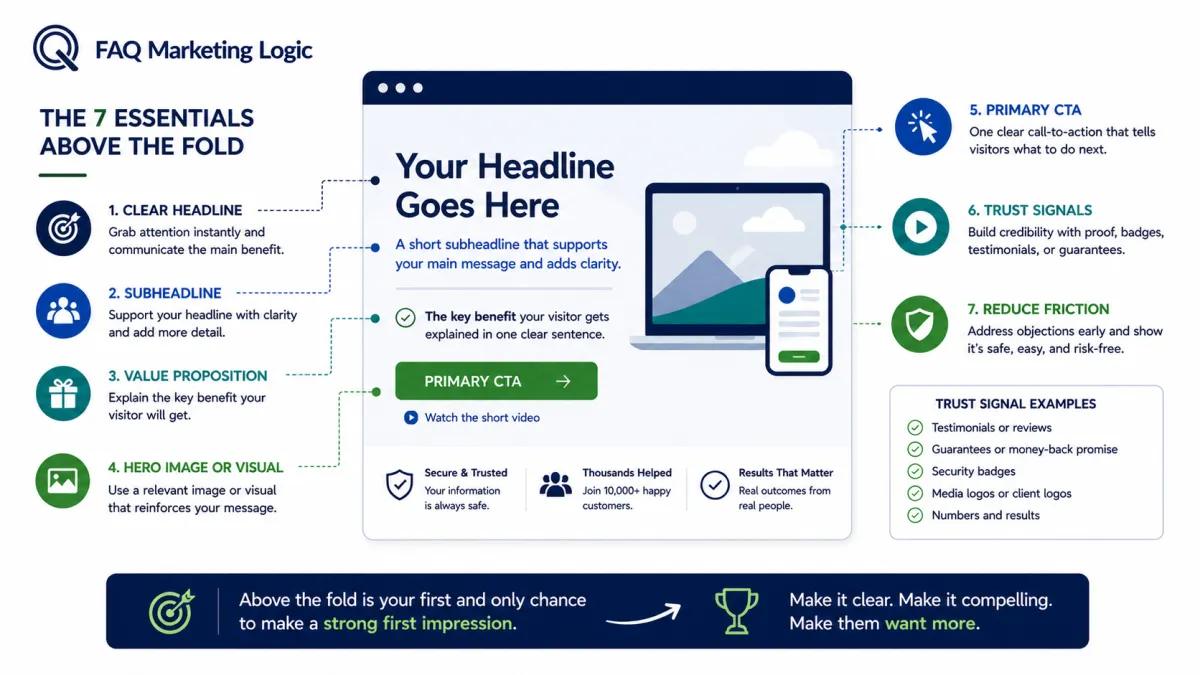
What Should Be Above The Fold On A Landing Page?
TL;DR
The section above the fold should immediately tell visitors what you offer, who it's for, why it matters, and what they should do next.
IN SHORT
When someone lands on your page, you have only a few seconds to capture their attention.
If visitors cannot quickly understand:
What you're offering
How it helps them
Why they should trust you
What action to take
they're likely to leave.
The area above the fold is your opportunity to make a strong first impression.
REAL TALK
Many landing pages fail before visitors even start reading.
Why?
Because the first screen is cluttered with unnecessary information.
Fancy graphics.
Long introductions.
Company history.
Multiple calls to action.
None of these answer the visitor's first question:
"Am I in the right place?"
Clarity should always come before creativity.
Definition
Above the fold refers to the section of a webpage that visitors see immediately without scrolling.
Its purpose is to quickly communicate the value of your offer and encourage visitors to continue reading or take action.
Start With A Clear Headline
Your headline should immediately explain:
What you're offering
Who it's designed for
The main benefit
Avoid clever wording that forces visitors to guess.
Simple headlines are usually more effective.
Support The Headline
A short supporting sentence should expand on the promise.
It should answer questions like:
What problem does this solve?
Why is it different?
What result can I expect?
Think of it as removing uncertainty.
Include One Clear Call To Action
Don't overwhelm visitors with choices.
Instead, provide one obvious next step.
Examples include:
Download the guide
Start your free trial
Join the newsletter
Buy now
The easier the decision, the higher the chance of conversion.
Build Immediate Trust
Visitors also need reassurance.
Simple trust signals might include:
Customer testimonials
Number of customers served
Money-back guarantee
Security badges
Industry experience
Trust reduces hesitation.
Example
Imagine you're searching for help with email marketing.
The first landing page you visit opens with a vague headline, several navigation links, and no explanation of what you'll receive.
You leave within seconds.
The second page clearly says:
"Build an Email List That Generates More Sales."
Below that is a short explanation, a testimonial from a customer, and a single button inviting you to download a free guide.
Without scrolling, you already understand the offer and what to do next.
Common Mistake
Mistake: Filling the top of the page with unnecessary information.
Fix: Focus on communicating your offer clearly before anything else.
Visitors should understand your value within seconds.
FAQ Quick Fix
To improve the area above the fold:
Write a clear headline.
Add a supporting sentence.
Include one primary call to action.
Add trust signals.
Remove distractions.
RELATED ARTICLES
→ What Makes a Landing Page Convert?
→ Why Are Visitors Leaving My Page Without Taking Action?
→ How Do I Identify Conversion Bottlenecks?
QUICK RECAP
A strong above-the-fold section includes:
A clear headline
A supporting message
One call to action
Immediate trust signals
First impressions influence conversions.
NEXT STEP
Once visitors understand your offer, the next step is structuring the rest of your page to guide them towards taking action.
Read: