
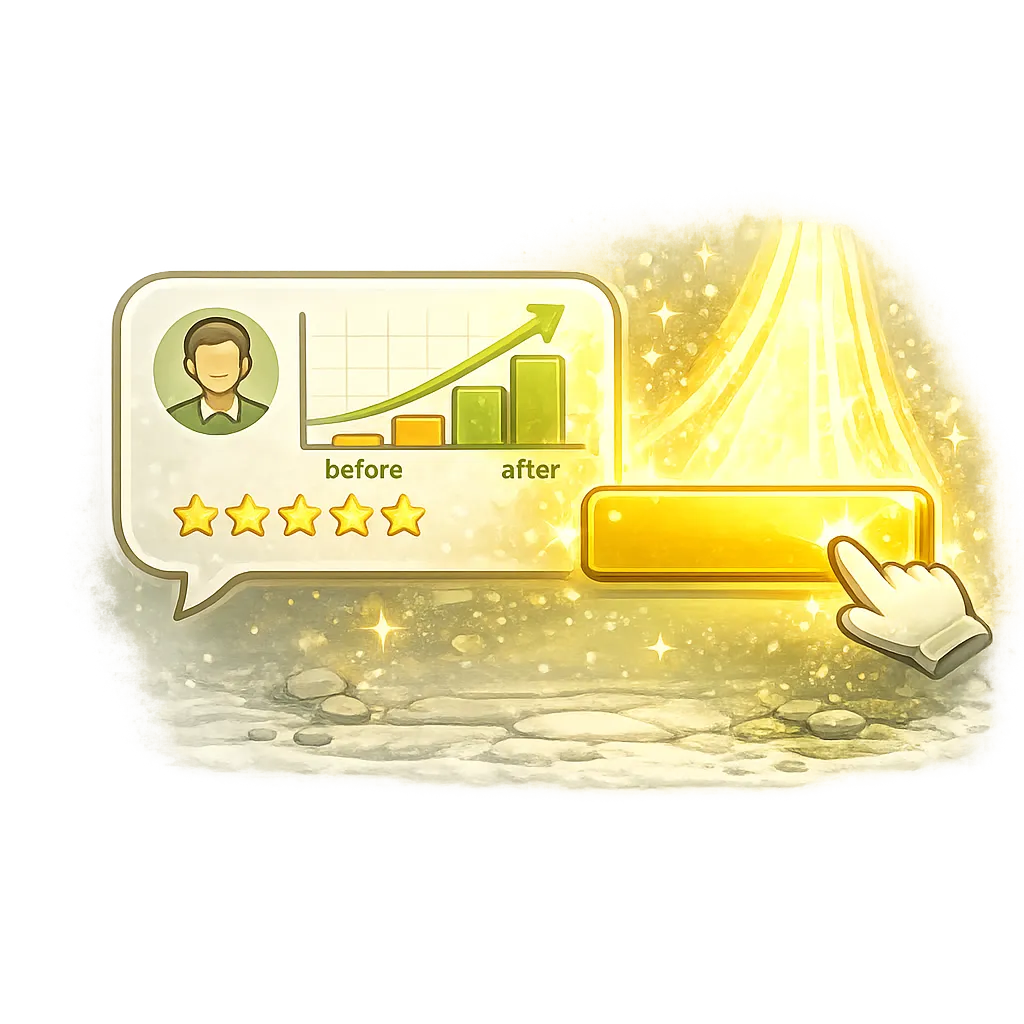
What Makes Social Proof Persuasive?
TL;DR
Social proof persuades when it reduces uncertainty.
Vague praise builds comfort.
Specific results build confidence.
IN SHORT
Persuasive social proof:
Is specific
Shows transformation
Matches the target audience
Demonstrates measurable results
Reduces perceived risk
Generic testimonials feel safe.
Detailed proof converts.
WHY THIS WORKS
Visitors hesitate because of doubt.
They wonder:
Will this work for me?
Is this credible?
Is this worth the investment?
Cause → They see others like them succeed.
Effect → Risk perception decreases.
Result → Conversion increases.
Social proof transfers trust.
The 5 Types of High-Converting Social Proof
1. Transformation Testimonials
Strong:
“I went from zero inbound leads to 12 per month in 60 days.”
Weak:
“This was great.”
Before → After creates credibility.
2. Specific Metrics
Numbers increase believability.
Revenue growth
Time saved
Leads generated
Conversion rate increase
Specificity reduces scepticism.
3. Audience Match Proof
If you sell to consultants, show consultant results.
Mismatch reduces persuasion.
People look for:
“Someone like me.”
4. Process-Based Proof
Show:
Screenshots
Workflow steps
Behind-the-scenes examples
Transparency increases trust.
5. Authority Signals
Include:
Recognised clients
Media mentions
Certifications
Industry credibility
Authority lowers resistance.
REAL TALK
Most testimonials are collected too late and written too vaguely.
If you don’t guide what clients share, you get:
“Highly recommend.”
That does not convert.
Ask better questions.
How to Collect Stronger Testimonials
Ask clients:
What problem were you facing?
What changed after working together?
What specific results did you see?
What surprised you most?
Who would this help most?
Structure improves output.
Placement Matters
Place proof:
Near the top (early reassurance)
After objections
Near CTA
Proof should support decision points.
Not sit randomly.
The Risk Reduction Principle
Social proof works best when:
The offer feels risky
The investment is significant
The audience is cautious
Higher price → Greater need for proof.
COFFEE CUP TIP ☕
If your testimonial does not include a before-and-after, rewrite it.
STORY TIME
An online course had:
14 testimonials
No measurable results
2.3% conversion rate
We replaced:
8 vague testimonials
With 5 detailed case examples
Conversion increased to 4.7%.
Fewer testimonials.
Stronger proof.
FAQ QUICK FIX
To improve social proof:
1. Replace vague testimonials
2. Add specific metrics
3. Match audience examples
4. Place near CTA
5. Highlight transformation
Proof should remove doubt.
QUICK RECAP
Specific beats generic
Transformation increases trust
Metrics increase believability
Audience alignment strengthens persuasion
Placement affects impact
COMMON MISTAKES
Mistake: Using generic praise
Fix: Ask structured testimonial questions
Mistake: Burying proof at bottom
Fix: Place near decision points
Mistake: Showing irrelevant case studies
Fix: Match target audience
FAQ
Q: How many testimonials should I include?
Quality matters more than quantity.
Q: Are video testimonials stronger?
Often yes — if authentic and specific.
Q: Should I include negative feedback?
Balanced transparency can increase credibility.
Q: What if I’m new and lack testimonials?
Use case studies or early beta results.
TRY THIS TODAY
Take your strongest testimonial.
Rewrite it to emphasise:
Before state
After state
Specific measurable result
Clarity increases persuasion.
NEXT STEP
Now we intensify urgency mechanics:
→ Should I Use Scarcity or Urgency?
Because timing influences decisions.
RELATED ARTICLES