
How Do I Handle Customer Objections On A Sales Page?
TL;DR
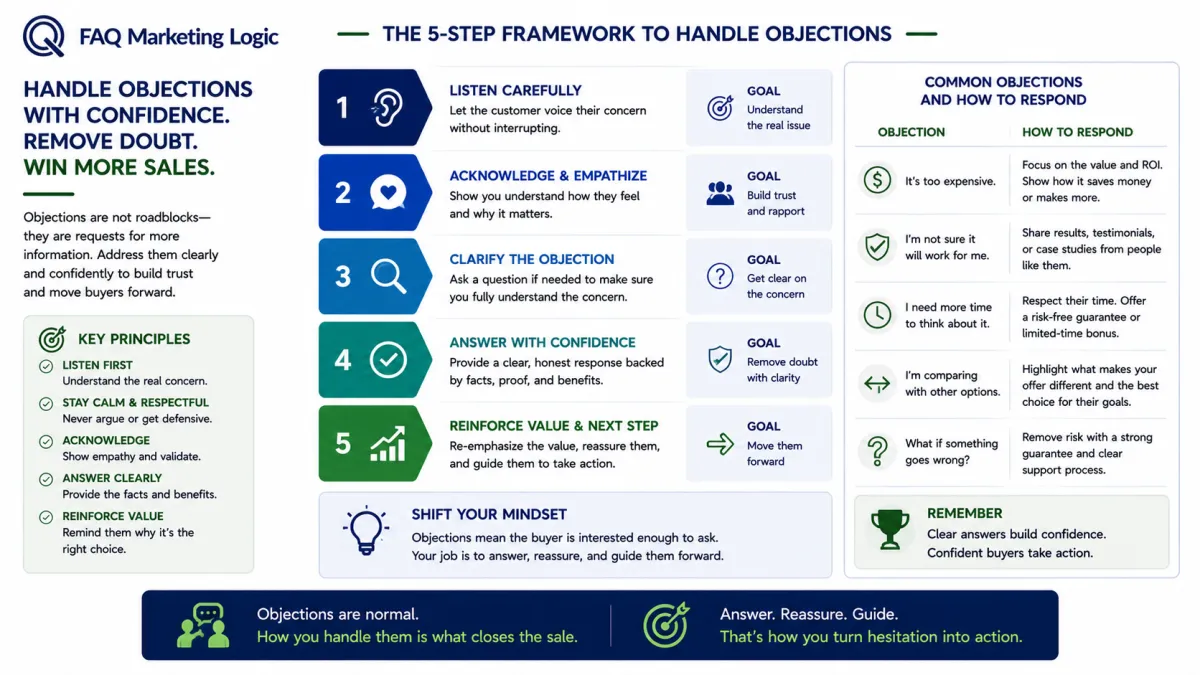
You handle customer objections by answering the questions and concerns that naturally arise before someone decides to buy.
IN SHORT
Every potential customer has questions.
Some wonder:
Is this worth the money?
Will it work for me?
What if I fail?
Can I trust this business?
If your sales page doesn't answer these concerns, visitors may leave without taking action.
Addressing objections isn't about arguing with your audience—it's about helping them make an informed decision.
REAL TALK
Objections aren't always a sign that people dislike your offer.
More often, they simply need reassurance.
Think about your own buying habits.
Before making an online purchase, you've probably asked questions like:
Is this the right choice?
Am I getting value for money?
What happens if it isn't what I expected?
Your visitors are no different.
A good sales page anticipates these concerns before they become reasons not to buy.
Definition
A customer objection is a concern or uncertainty that prevents someone from making a purchase.
Successful sales pages identify the most common objections and answer them clearly before visitors feel the need to ask.
Identify The Most Common Concerns
Most objections fall into a handful of categories.
For example:
Price
Trust
Time
Results
Complexity
Once you know what worries your audience, you can address those concerns throughout your page.
Answer Questions Naturally
Don't wait until the bottom of the page to explain important details.
Instead, answer objections as they arise.
For example:
If visitors are worried about the price, explain the value.
If they question the results, include testimonials or case studies.
If they're unsure what's included, describe exactly what they'll receive.
Good sales pages remove uncertainty step by step.
Use Proof Instead Of Promises
Anyone can make claims.
Visitors trust evidence.
Helpful proof includes:
Customer testimonials
Reviews
Success stories
Case studies
Demonstrations
Evidence builds confidence more effectively than bold promises.
Be Honest About Limitations
Not every product is right for everyone.
Explaining who your offer is—and isn't—for demonstrates honesty.
This builds credibility and helps attract the right customers.
Trust grows when businesses are transparent.
Example
Imagine someone is considering buying your online course.
They're interested but hesitate because they're unsure whether it's suitable for beginners.
Rather than leaving them guessing, your sales page clearly explains that no previous experience is required, outlines exactly what they'll learn, and includes testimonials from beginners who successfully completed the course.
By answering the objection before it's asked, you've removed one of the biggest barriers to purchase.
Common Mistake
Mistake: Assuming visitors will contact you if they have questions.
Fix: Answer the most common objections directly on your sales page.
Every unanswered question increases the chance that someone will leave.
FAQ Quick Fix
To handle customer objections effectively:
List your audience's biggest concerns.
Answer them clearly.
Support your claims with evidence.
Be honest and transparent.
Review objections regularly as your business grows.
RELATED ARTICLES
→ Why Do People Hesitate Before Buying?
→ What Makes Social Proof Persuasive?
→ How Do I Structure A High-Converting Sales Page?
QUICK RECAP
Strong sales pages:
Anticipate objections
Answer questions
Provide proof
Build trust
Reduce uncertainty
Confidence helps people move forward.
NEXT STEP
Once you've answered your visitors' concerns, the next step is learning what builds trust fastest online.
Read: