
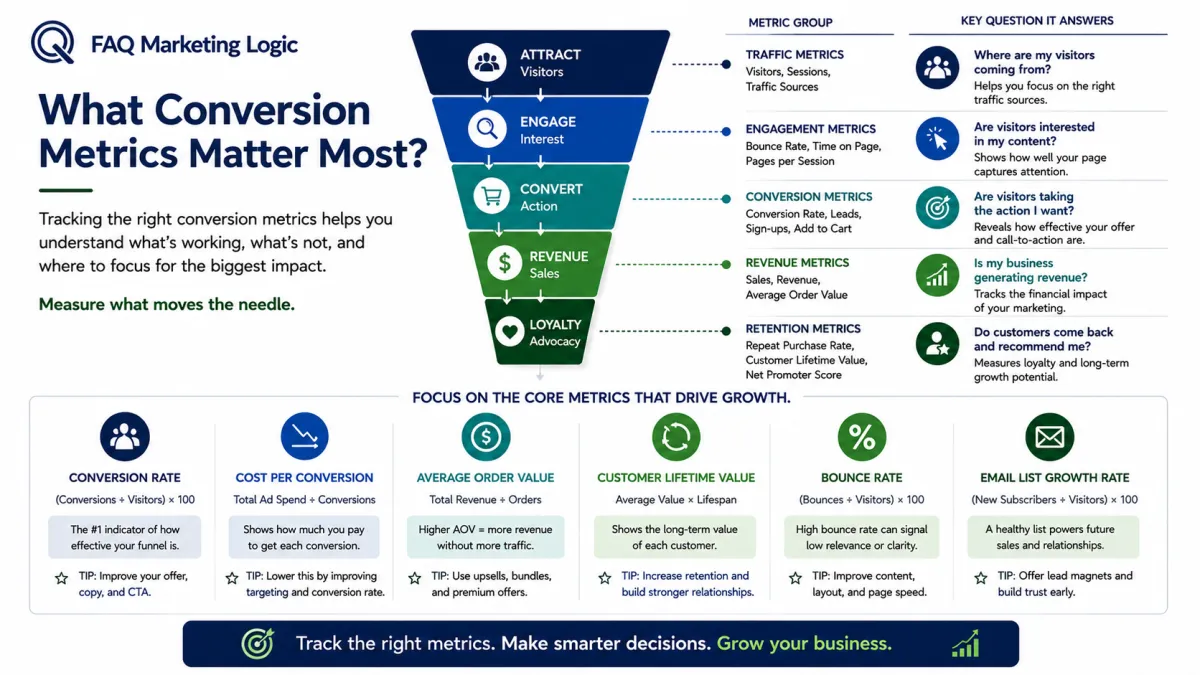
What Conversion Metrics Matter Most?
TL;DR
The most important conversion metrics are the ones that show where people stop progressing through your marketing process.
IN SHORT
Modern marketing produces lots of numbers.
Page views.
Clicks.
Followers.
Likes.
But not every metric helps you grow your business.
Focus on the numbers that directly influence conversions.
REAL TALK
Many business owners become distracted by impressive-looking statistics.
High traffic means very little if nobody joins your email list.
Thousands of subscribers mean very little if nobody buys.
Growth comes from measuring what actually moves your business forward.
Definition
A conversion metric measures how successfully people complete a desired action, such as subscribing to your email list, clicking a link, or making a purchase.
These metrics help you understand how effectively your marketing turns visitors into customers.
Focus On The Customer Journey
Each stage has its own important metric.
For example:
Website visitors
Landing page conversion rate
Email open rate
Click-through rate
Sales conversion rate
Together they show where improvements are needed.
Which Metrics Matter Most?
For most beginners, these are the key numbers:
Landing page conversion rate
Email signup rate
Email click-through rate
Sales conversion rate
Average order value
These metrics directly influence business growth.
Avoid Vanity Metrics
Some numbers look impressive but provide little business value.
Examples include:
Social media likes
Follower counts
Random page views
These may increase visibility, but they don't always increase revenue.
Prioritise metrics connected to real business outcomes.
Measure Trends
One day's data rarely tells the full story.
Instead, monitor trends over time.
Ask yourself:
Are conversions improving?
Are more people joining your list?
Are sales increasing?
Patterns provide better insights than isolated numbers.
Example
Imagine your website traffic stays exactly the same for three months.
However, your landing page conversion rate improves from 20% to 35%.
Without attracting any additional visitors, your email list grows much faster.
Sometimes improving one metric creates more growth than increasing traffic.
Common Mistake
Mistake: Focusing on vanity metrics instead of conversion metrics.
Fix: Track the numbers that directly influence subscribers, customers, and revenue.
Meaningful metrics create meaningful decisions.
FAQ Quick Fix
To track better conversion metrics:
Measure every stage of the customer journey.
Ignore vanity metrics.
Focus on conversion percentages.
Review trends regularly.
Improve one metric at a time.
RELATED ARTICLES
QUICK RECAP
The most valuable metrics measure:
Progress
Conversions
Revenue
Growth
Better decisions come from better data.
NEXT STEP
Now that you know what to measure, the next step is learning how to structure your landing page so more visitors take action.
Read: