How Do I Structure A High-Converting Sales Page?
TL;DR
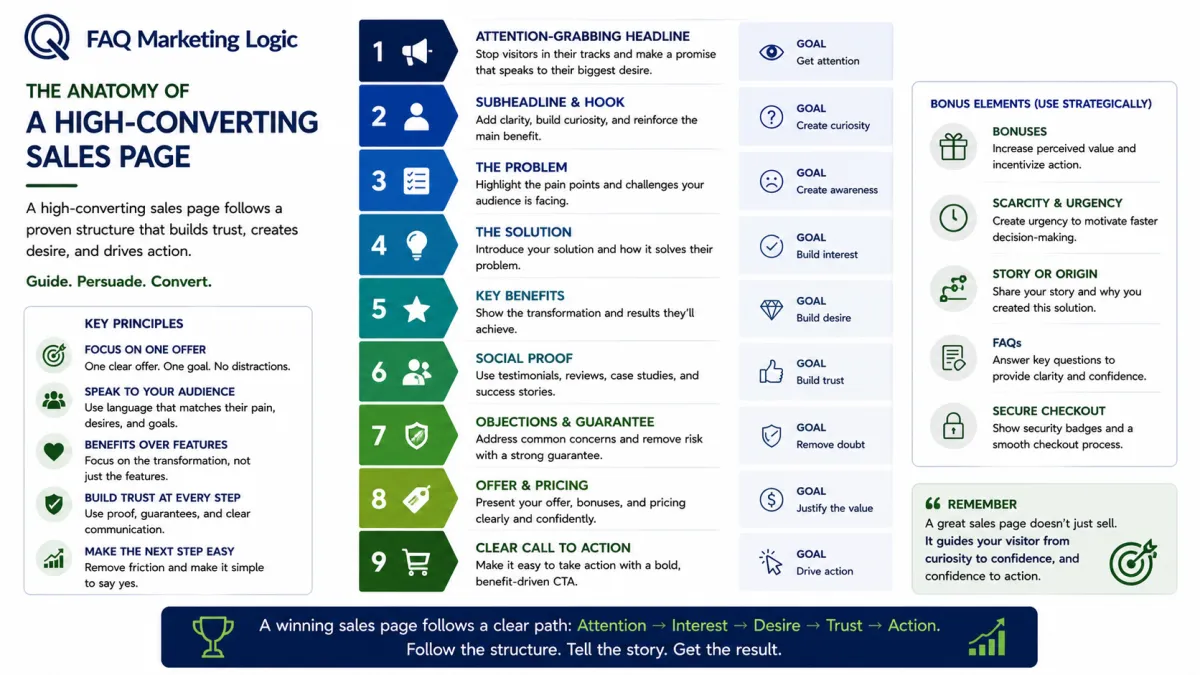
A high-converting sales page should take the reader through a clear sequence from problem to solution to decision.
Start by making the offer and its main benefit easy to understand. Then explain the problem, show how your solution helps, provide enough detail and proof to build confidence, answer likely objections and finish with a clear call-to-action.
You don't need dozens of clever sales techniques.
You need the right information presented in the right order, with as little confusion as possible.
IN SHORT
A sales page isn't simply a collection of persuasive sections.
It's a journey.
Someone arrives knowing very little about your offer.
Before they're ready to buy, they may need to understand:
What you're offering
Whether it's relevant to them
What problem it solves
How it works
What they'll receive
Why they should believe you
Whether it's worth the price
What happens if it isn't right for them
What they need to do next
A good sales page answers those questions in a logical order.
That's what structure does.
REAL TALK
You can have a brilliant product and still make it difficult to buy.
Sometimes the problem isn't the product.
It's the page.
The headline is vague.
The offer doesn't appear until halfway down.
Benefits are buried underneath features.
Important objections aren't answered.
The price suddenly appears without enough context.
There are five different calls-to-action competing for attention.
Then we wonder why visitors leave.
A high-converting sales page doesn't need to be clever.
It needs to make the buying decision easy to understand.
Key Definition: What Is A High-Converting Sales Page?
A high-converting sales page is a page structured to help suitable prospects understand an offer, evaluate its value, overcome reasonable concerns and take the intended action.
The structure typically moves through four broad stages:
Attention → Understanding → Belief → Action
You attract attention.
You help the reader understand the problem and solution.
You give them reasons to believe the offer can help.
Then you make it easy to act.
The exact number of sections can vary.
What matters is that each section helps move the reader towards an informed buying decision.
1. Start With A Clear Headline
Your headline has one immediate job:
Give the right person a reason to continue reading.
It should communicate something meaningful about the problem, benefit, result or opportunity.
Avoid headlines that sound impressive but leave the visitor wondering what the page is actually about.
For example:
Discover The Revolutionary New System Changing Everything
creates curiosity but very little understanding.
Compare that with:
Create Your First Five-Email Welcome Sequence Without Starting From A Blank Page
Now the reader has considerably more information.
They know:
What they'll create
What type of product this may be
What problem it helps remove
Clarity usually beats cleverness.
2. Use A Supporting Subheadline
The subheadline gives you room to expand on the headline.
It might explain:
Who the offer is for
How the solution works
What makes it different
The main benefit
An important qualification
Think of the headline and subheadline as a pair.
The headline gets attention.
The subheadline helps the visitor decide:
"Yes, this looks relevant to me."
3. Make The Above-The-Fold Section Easy To Understand
The area visitors see before scrolling is valuable.
Don't try to cram your entire sales argument into it.
Instead, answer the most immediate questions:
What is this?
Is it for me?
Why should I keep reading?
Depending on the offer, that could include:
Headline
Subheadline
Product image
Short supporting copy
Primary CTA
A visitor shouldn't have to scroll through several screens before understanding what you're selling.
4. Show That You Understand The Problem
Once you've established relevance, expand on the problem.
Describe the situation your intended customer recognises.
The purpose isn't to frighten people or exaggerate their pain.
It's to demonstrate:
"This offer was created for a problem I actually have."
Specificity helps.
Instead of:
"Marketing can be difficult."
you might say:
"You sit down to write your weekly email, stare at the blank screen and spend the next hour wondering what to say."
That's a recognisable situation.
5. Explain Why The Problem Continues
Sometimes readers know they have a problem but don't understand what's causing it.
This is where useful explanation can strengthen the sales argument.
For example:
Perhaps the problem isn't that they're bad at writing emails.
Perhaps they're trying to write every email from scratch without a repeatable structure.
That distinction matters.
You've moved from:
Problem
to:
Reason the problem exists
which creates a natural opening for the solution.
6. Introduce Your Solution
Now explain how your offer addresses the problem.
Don't immediately dump every feature onto the page.
Start with the central idea.
For example:
"Instead of starting every email from a blank page, this template system gives you a repeatable structure for the most common emails you'll need."
The reader can see the connection:
Problem → Solution
That's more persuasive than presenting an unexplained list of files.
7. Explain The Benefits Before Drowning The Reader In Features
Features matter.
But people usually need to understand why those features are useful.
Suppose your product includes:
20 email templates.
That's a feature.
Now explain the benefit:
Use proven starting structures instead of spending hours deciding how each email should begin.
Feature:
Step-by-step video tutorials.
Benefit:
See exactly how to use the system rather than trying to work everything out from written instructions alone.
A strong sales page frequently connects the two:
Here's what you get → here's why it matters.
8. Show What's Included
Once the reader understands the value, give them the details.
Depending on the product, this might include:
Modules
Lessons
Templates
Guides
Software
Bonuses
Support
Community access
Updates
Make the offer tangible.
If somebody is considering paying you, they should know what they'll receive.
But avoid adding meaningless items purely to make the offer look bigger.
Ten genuinely useful resources can be more appealing than fifty bonuses nobody wants.
9. Build Trust
At this stage, the reader may understand the offer but still wonder:
"Can I believe this?"
Trust can come from several places.
You might use:
Testimonials
Customer feedback
Demonstrations
Screenshots
Relevant experience
Product previews
Specific explanations
Guarantees
Transparent limitations
You don't need every form of proof.
Use the evidence appropriate to the offer.
And keep claims realistic.
A believable sales page doesn't need to pretend every customer will achieve extraordinary results.
10. Help The Reader See Themselves Using The Product
Good sales copy doesn't merely describe what exists inside the product.
It helps the reader imagine using it.
Instead of:
"Includes a 30-page planning workbook."
you might explain:
"Use the workbook to map your offer, identify the customer problem and organise your sales message before you start writing the page."
Now the reader can picture the resource doing something useful.
That makes the product more concrete.
11. Answer The Important Objections
Interest doesn't automatically produce a purchase.
The reader may still be thinking:
"Will this work for a beginner?"
"What if I don't have much time?"
"Do I need special software?"
"Is this relevant to my type of business?"
"Why does it cost this much?"
"What happens if it isn't right for me?"
Don't pretend objections don't exist.
Address reasonable concerns directly.
This is one of the places where a longer sales page can earn its length.
If you'd like to see how a sales letter can systematically build the argument, answer objections and guide the reader towards the offer, you can explore the sales letter approach here.
12. Present The Price In Context
Price shouldn't feel as though it appeared from nowhere.
Before presenting it, the reader should understand:
The problem
The solution
What they receive
Why it matters
Then make the price clear.
Avoid making people hunt around the page trying to discover how much something costs.
If there are payment options, explain them simply.
If there are ongoing charges, make that clear too.
Transparency reduces unnecessary uncertainty.
13. Reduce The Perceived Risk
Buying involves uncertainty.
The customer may wonder:
"What if I make the wrong decision?"
Depending on the product and your terms, a guarantee can reduce some of that concern.
If you provide one, explain:
What it covers
How long it lasts
Any genuine conditions
How someone uses it
Don't hide important conditions in tiny text.
Risk reduction works best when it increases confidence rather than creating another puzzle.
14. Use A Clear Call-To-Action
After explaining the offer, tell the reader what to do.
A CTA might say:
Get Instant Access
Join The Membership
Start The Course
Get The Guide
Choose Your Plan
Avoid vague buttons such as:
Continue
if the reader doesn't know what continuing actually means.
The CTA should describe the next step clearly.
15. Repeat The CTA Where It Makes Sense
A long sales page doesn't need only one button at the very bottom.
Different readers become ready at different stages.
Someone already familiar with the product might be ready near the top.
Someone encountering it for the first time may need the complete explanation.
So you can repeat the same primary action at logical points.
That's very different from giving visitors several competing actions.
Three buttons leading to the same purchase are repeated CTAs.
Buttons asking people to buy, subscribe, follow you, download something else and book a call are competing CTAs.
The first can help.
The second can create confusion.
How Long Should A High-Converting Sales Page Be?
As long as necessary to support the decision.
Not longer.
Not shorter.
A simple $10 product probably doesn't need the same amount of explanation as a $2,000 programme.
Length can also depend on:
How familiar the audience is with you
Complexity of the product
Price
Perceived risk
Number of objections
How much explanation the solution requires
Don't aim for a word count.
Aim for completeness without unnecessary repetition.
Should The Sales Page Have A Navigation Menu?
Sometimes removing unnecessary navigation can reduce distractions on a dedicated sales page.
But context matters.
A normal ecommerce product page may reasonably include the site's navigation.
A dedicated campaign landing page may be more focused.
The important principle is:
Don't surround the buying decision with unnecessary exits and competing actions.
That doesn't mean hiding essential information such as contact details, terms, privacy information or other appropriate business information.
What Order Should A Sales Page Follow?
There isn't one compulsory structure for every offer.
But a useful starting framework is:
Headline
↓
Problem
↓
Desired Outcome
↓
Solution
↓
Benefits
↓
What's Included
↓
Proof
↓
Objections
↓
Offer + Price
↓
Risk Reduction
↓
Call-To-Action
You can adapt that sequence.
The important part is that the reader isn't repeatedly forced backwards because essential information appeared too late.
Practical Example
Imagine you're selling a $47 beginner course about creating a first digital product.
A simple sales page might flow like this:
Headline
Create Your First Simple Digital Product Without Spending Months Building It
Problem
Explain why beginners often overcomplicate product creation.
Desired Outcome
Show what having a simple finished product could allow them to do.
Solution
Introduce your step-by-step course.
Benefits
Explain how the process helps them choose, plan, create and prepare the product for sale.
What's Included
Show the modules, worksheets and resources.
Proof
Provide appropriate customer feedback or demonstrate the process.
Objections
Address questions about experience, technical ability and time.
Offer
Present the course and price.
Risk Reduction
Explain the guarantee, if offered.
CTA
Give the reader one obvious way to get access.
Notice what's missing.
There are no random sections simply because another marketer used them.
Every section has a job.
Common Mistakes
Mistake: Starting with the product instead of the customer.
Fix: Establish the problem and desired outcome before overwhelming the reader with product details.
Mistake: Using a clever but unclear headline.
Fix: Make relevance and benefit easier to understand.
Mistake: Listing features without explaining their value.
Fix: Connect important features to useful customer benefits.
Mistake: Making unsupported claims.
Fix: Use specific, credible explanations and appropriate evidence.
Mistake: Ignoring objections.
Fix: Address the reasonable questions that can prevent suitable customers from buying.
Mistake: Using too many different calls-to-action.
Fix: Keep the page focused on one primary conversion goal.
Mistake: Assuming shorter pages always convert better.
Fix: Use enough copy to support the decision without unnecessary padding.
FAQ QUICK FIX
If your existing sales page isn't converting as well as you'd hoped, don't immediately rewrite every word.
Check the structure first.
Ask:
Can visitors quickly understand what I'm selling?
Is it obvious who the offer is for?
Have I clearly explained the problem?
Does my solution logically follow that problem?
Have I explained benefits as well as features?
Is there enough reason to trust the offer?
Have I answered the biggest objections?
Is the price clear?
Is the primary CTA obvious?
Is anything distracting people from the decision?
Sometimes the problem isn't weak copy.
It's that the right copy is in the wrong place.
FAQ
What Should Be At The Top Of A Sales Page?
Usually a clear headline, supporting message and enough information for the visitor to understand what the offer is and why it may be relevant. Depending on the offer, you may also include a product image and CTA.
Should I Put The Price Near The Top?
It depends on the offer and audience. A familiar, straightforward product may need little explanation before the price. A more complex or unfamiliar offer may benefit from establishing value first.
How Many CTAs Should A Sales Page Have?
You can use several CTA buttons on a longer sales page if they lead towards the same primary action. The bigger problem is usually multiple competing calls-to-action.
Do I Need Testimonials On A Sales Page?
Not every page requires testimonials, but suitable proof can reduce uncertainty. If you don't have testimonials yet, concentrate on clear explanations, demonstrations and other credible evidence rather than inventing social proof.
Should I Put FAQs On My Sales Page?
FAQs can be particularly useful for answering practical questions and objections that don't fit naturally into the main sales copy.
Can A Short Sales Page Convert Well?
Yes. If the offer is simple, familiar and low-risk, a short page may contain everything the reader needs. More complex decisions usually require more explanation.
TRY THIS TODAY
Open one of your existing sales pages.
Don't edit the copy yet.
Instead, write the purpose of each section beside it.
For example:
Headline → Attention
Problem → Relevance
Benefits → Value
Testimonials → Proof
FAQ → Objections
Guarantee → Risk Reduction
CTA → Action
If you can't explain why a section exists, question whether it belongs there.
If an important purpose is missing entirely, you've found something worth improving.
This turns sales-page optimisation from:
"What should I rewrite?"
into:
"What does the reader need next?"
What If Your Sales Page Could Do More Of The Selling?
A well-structured sales page doesn't simply display a product.
It builds an argument.
It takes the reader from recognising the problem through understanding the solution, seeing the value, resolving concerns and deciding whether the offer is right for them.
One Letter From Retirement explores how a carefully structured sales message can do more of that selling work for you.
→ Discover The Power Of A Strong Sales Message
RELATED ARTICLES
→ What Makes A Landing Page Convert?
→ What Should Be Above The Fold On A Landing Page?
→ Why Do People Hesitate Before Buying?
QUICK RECAP
A high-converting sales page needs a logical structure rather than a collection of random persuasive elements.
Start with a clear headline.
Make the offer understandable quickly.
Establish the customer's problem.
Introduce the solution logically.
Translate features into benefits.
Explain what's included.
Build trust with appropriate proof.
Answer important objections.
Present the price clearly.
Reduce unnecessary risk.
Give the reader a clear CTA.
Repeat the same primary CTA where useful.
Remove distractions that don't support the decision.
The objective isn't to force somebody into buying.
It's to give the right prospect the information they need to understand the offer and make a confident decision.
NEXT STEP
Once the structure is in place, look at whether your sales page contains enough information to answer the questions a potential customer is likely to have.