
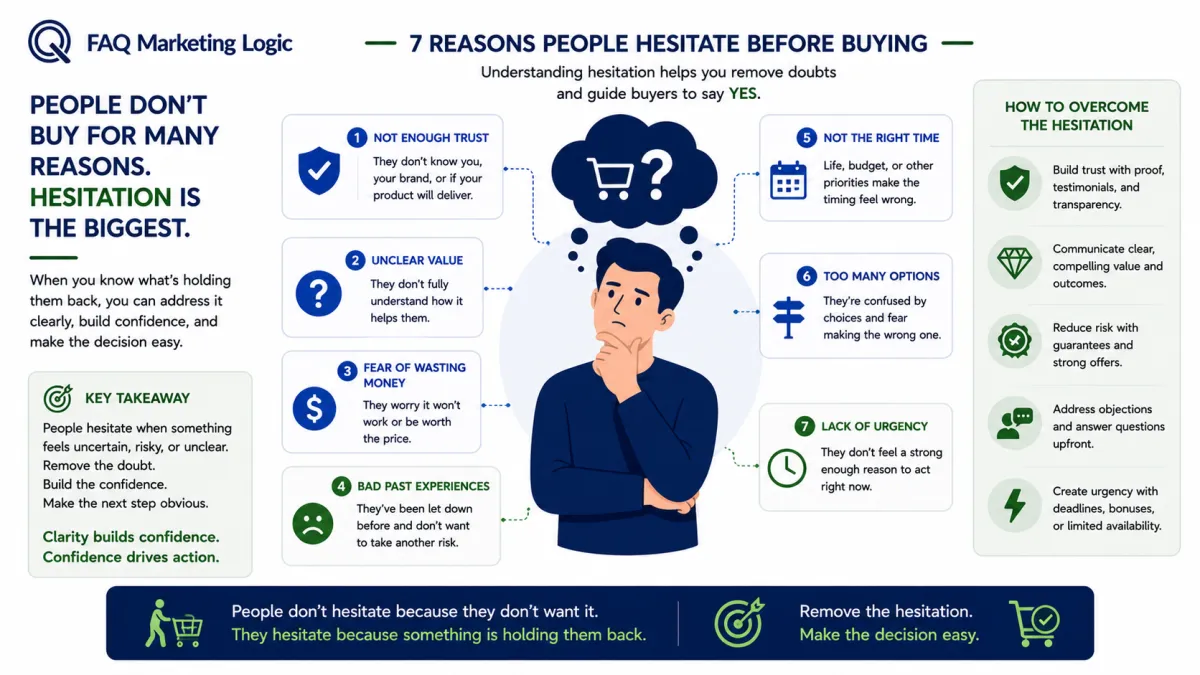
Why Do People Hesitate Before Buying?
TL;DR
People hesitate before buying because they aren't yet confident that the value of saying yes outweighs the risk of making the wrong decision.
They may be uncertain about the product, price, outcome, business or what happens after they buy. Sometimes the problem isn't the offer itself. The sales page simply hasn't given them enough clarity, proof or reassurance to make the decision comfortably.
The answer isn't necessarily more persuasion. Often, it's less uncertainty.
IN SHORT
Buying something online always involves a degree of risk.
Before making a purchase, visitors may be asking themselves:
Will this actually solve my problem?
Is it worth the money?
Can I trust this business?
Will it work for someone like me?
What happens after I pay?
What if I make the wrong decision?
Is there a better alternative somewhere else?
Every unanswered question creates a little more friction.
One concern may not stop the sale. Several unresolved concerns together often will.
That's why reducing buying hesitation starts with understanding what the customer is uncertain about.
REAL TALK
Very few people arrive on a sales page determined to buy whatever you're selling.
Most are evaluating.
They're comparing what they'll gain against what they might lose. They're considering the price, looking for evidence, questioning whether they really need the product and deciding whether they trust the person or business selling it.
Your job isn't to pressure them past those concerns.
It's to give them enough information to make a confident decision.
Sometimes that decision will still be no.
That's fine.
Good conversion optimisation isn't about convincing everybody to buy. It's about preventing suitable customers from walking away simply because your page left important questions unanswered.
Key Definition: What Is Buying Hesitation?
Buying hesitation is the uncertainty or resistance someone experiences before committing to a purchase.
It can happen when a prospective customer isn't sufficiently confident about:
The value of the offer
The likely outcome
The price
The seller
The product
Their own ability to use it
The risk involved in buying
Buying hesitation doesn't necessarily mean somebody isn't interested.
Quite often, it means they're interested but not convinced enough to act yet.
Why Do Customers Hesitate Before Buying?
There isn't one universal reason.
Different customers can hesitate over the same offer for completely different reasons.
However, most buying hesitation can be traced back to a handful of common uncertainties.
They Don't Completely Understand The Offer
Confusion creates friction.
If visitors can't quickly understand what they're getting, who it's for or what it will help them accomplish, asking them to buy becomes difficult.
You may understand your offer perfectly because you've spent weeks or months developing it.
Your visitor hasn't.
They need to understand:
What the product is
Who it's for
What problem it addresses
What they receive
How it works
What happens after purchase
Clarity needs to come before persuasion.
They Aren't Convinced Of The Value
A customer doesn't evaluate price in isolation.
They're comparing the amount you're asking them to pay with the value they expect to receive.
A $100 product can feel expensive when its benefits are vague.
A considerably more expensive product can feel reasonable when the customer clearly understands the problem it solves and why that outcome matters.
This is why simply reducing your price doesn't necessarily solve buying hesitation.
Sometimes the real problem is poorly communicated value.
They Don't Trust The Business Yet
A prospective customer may like the product but still wonder whether they can trust the person selling it.
This is particularly important online because the customer may have never encountered your business before.
Trust can be strengthened through things such as:
Clear contact information
Genuine testimonials
Transparent pricing
Professional presentation
Sensible guarantees
Clear policies
Useful content
Consistent messaging
Realistic claims
Trust isn't created by writing "You can trust us."
It's created by giving people reasons to reach that conclusion themselves.
They Don't Believe The Product Will Work For Them
There's an important difference between:
"Does this product work?"
and:
"Will this product work for me?"
A visitor might believe your testimonials and still think their circumstances are different.
This is where examples, demonstrations, explanations and relevant proof can help.
Show prospective customers enough information to understand how the solution relates to their situation.
The Purchase Feels Too Risky
Every purchase involves some form of perceived risk.
The customer could lose:
Money
Time
Effort
Confidence
Convenience
Reputation
The larger the perceived risk, the more reassurance they'll usually need.
A guarantee can sometimes help, but risk reduction goes beyond guarantees.
Clear expectations, transparent pricing, honest limitations and explaining exactly what happens after purchase can all make the decision feel safer.
They're Worried About Making The Wrong Choice
Sometimes the customer isn't deciding between buying and doing nothing.
They're choosing between you and several alternatives.
They may be comparing:
Products
Features
Prices
Providers
Guarantees
Reviews
Different ways of solving the problem
Trying to hide alternatives won't remove this behaviour.
Instead, make it easy for the right customer to understand who your offer is for and why they might choose it.
They're Not Ready Yet
Not every hesitation is a sales-page problem.
Someone might genuinely need more time.
Perhaps the timing is wrong, they don't have the budget, the problem isn't urgent enough or they're still researching.
This matters because trying to eliminate every possible hesitation can lead to bloated sales pages and excessive pressure.
Your goal isn't to make every visitor buy immediately.
It's to remove unnecessary reasons for delaying a suitable purchase.
Why Does Price Make People Hesitate?
When somebody says something is "too expensive", price may be the problem.
But not always.
They could actually mean:
"I'm not convinced I'll get enough value for that price."
or:
"I'm worried I'll spend the money and regret it."
or:
"I don't understand why this costs more than the alternative."
Before responding to price hesitation with a discount, look at how clearly you've communicated:
The outcome
The benefits
What's included
Why those things matter
How the offer compares with the customer's alternatives
Reducing the price is easy.
Increasing the customer's understanding of the value can be considerably more powerful.
How Do You Reduce Buying Hesitation?
Start by identifying the uncertainty rather than immediately adding more sales copy.
Ask:
What might someone reasonably need to know before saying yes?
Then make the answer easy to find.
Make The Offer Easy To Understand
Someone shouldn't have to decipher your sales page.
Explain the offer in straightforward language and make the important information obvious.
Show Evidence
Claims become more credible when supported by appropriate evidence.
Depending on the offer, that might include testimonials, demonstrations, examples or other proof.
Answer Important Objections
If customers repeatedly ask the same question before buying, there's a good chance your sales page should answer it.
Don't leave predictable objections until after someone has abandoned the page.
If you'd like to see how a sales letter can anticipate these concerns and handle more of the selling for you, you can explore the sales letter approach here.
Reduce Perceived Risk
Explain guarantees, cancellation terms, delivery and what happens after purchase clearly.
Uncertainty about the process can create just as much hesitation as uncertainty about the product.
Make The Next Step Obvious
Once somebody decides they want the offer, don't create another obstacle.
The call-to-action should make it obvious what happens next.
Build Confidence Throughout The Page
Trust shouldn't be confined to one testimonial section near the bottom.
Confidence develops throughout the entire customer journey.
Your:
Headline
Offer explanation
Benefits
Proof
Pricing
Guarantee
FAQs
Calls-to-action
should work together.
If the headline makes a huge promise but the rest of the page provides little evidence, confidence falls.
If the pricing is hidden until the last possible moment, uncertainty can increase.
If the CTA says "Get Started" but doesn't explain what happens after clicking it, some visitors may pause.
Small uncertainties accumulate.
So do small reassurances.
Remember The Emotional Side Of Buying
People don't evaluate purchases using logic alone.
They may also want to feel:
Safe
Confident
Understood
Optimistic
In control
That doesn't mean manipulating emotions.
It means recognising that a buying decision has consequences for the person making it.
The prospect isn't merely evaluating your list of features.
They're imagining what might happen after they say yes.
Good sales messaging helps them understand that outcome while giving them enough factual information to justify the decision.
Practical Example
Imagine two businesses selling similar online courses for the same price.
The first page lists:
10 training modules
25 videos
Downloadable worksheets
$97 price
That's useful information, but it leaves several questions unanswered.
The second page explains the problem the course addresses, who it's designed for, what students will learn, how the training works and what happens immediately after purchase.
It also provides genuine testimonials, answers common questions and includes a clear 30-day money-back guarantee.
The second course isn't necessarily better.
But its sales page has removed more of the uncertainty surrounding the purchase.
That's often the difference between:
"This looks interesting."
and:
"I'm comfortable buying this."
Common Mistakes That Increase Buying Hesitation
Mistake: Assuming visitors already trust you.
Fix: Give them evidence and information that allows trust to develop naturally.
Mistake: Responding to hesitation by immediately lowering the price.
Fix: Establish whether the real problem is price, value or perceived risk first.
Mistake: Hiding important information until late in the buying process.
Fix: Be transparent about the things customers reasonably need to know before deciding.
Mistake: Adding more hype when people aren't buying.
Fix: Look for unanswered questions and uncertainty before increasing the strength of your claims.
Mistake: Trying to eliminate every possible objection.
Fix: Concentrate on the concerns that matter most to your ideal customer.
FAQ QUICK FIX
If people are reaching your offer but not buying, check these five things:
Clarity: Do they immediately understand the offer?
Value: Is it obvious why the product is worth the price?
Trust: Have you given them reasons to believe you?
Risk: Have you reduced reasonable fears about making a mistake?
Next step: Is it completely clear what they should do if they want to buy?
Fix the biggest uncertainty first.
FAQ
Does Buying Hesitation Mean My Offer Is Bad?
No.
A good offer can still convert poorly if visitors don't understand its value, trust the seller or feel confident about what happens after purchase.
However, persistent hesitation can also reveal a genuine problem with the offer, price or positioning, so don't automatically assume copy is the only issue.
Should I Lower My Price If People Aren't Buying?
Not immediately.
First determine whether price is genuinely the objection.
If customers don't understand the value, reducing the price may simply make an unclear offer cheaper.
Do Testimonials Reduce Buying Hesitation?
They can.
Relevant, genuine testimonials can provide evidence that other people have used the product and found it valuable.
They're most useful when they address concerns a prospective customer might actually have.
Can A Guarantee Increase Conversions?
A clear, appropriate guarantee can reduce perceived financial risk and make a purchase easier to consider.
But a guarantee won't compensate for a confusing offer or lack of trust elsewhere on the page.
How Do I Know What's Making Customers Hesitate?
Look for patterns.
Customer questions, support messages, sales conversations, abandoned checkouts, survey responses and conversion data can all reveal where uncertainty exists.
You can then strengthen the parts of your sales process that address those concerns.
Should I Add More Information To My Sales Page?
Only when the information helps someone make the decision.
More copy isn't automatically better.
The aim is to provide enough relevant information to remove uncertainty without creating unnecessary complexity.
TRY THIS TODAY
Open one of your sales or landing pages and read it from the perspective of somebody who has never heard of your business before.
Write down every question that occurs to you.
Then look specifically for questions involving:
Value
Trust
Price
Risk
Proof
Delivery
Results
What happens next
If an important question isn't answered, you've found a potential source of buying hesitation.
Fix that before adding another promotional claim.
Could Your Sales Message Be Doing More Of The Selling?
Sometimes people hesitate because the offer isn't right for them.
But sometimes the problem is that the sales message hasn't given them enough clarity, confidence or reassurance to make the decision.
A well-constructed sales letter can anticipate those concerns, answer objections and guide a prospect through the buying decision without you having to explain the offer personally every time.
If you'd like to explore how a sales message can become a longer-term selling asset, I've got a free resource that will show you more.
→ Discover The Power Of A Strong Sales Message
RELATED ARTICLES
→ What Makes Social Proof Persuasive?
→ What Information Should A Landing Page Include?
→ How Do I Structure A High-Converting Sales Page?
QUICK RECAP
People hesitate before buying when they aren't sufficiently confident about the value, outcome, price, seller or risk involved in the decision.
To reduce unnecessary hesitation:
Make the offer easy to understand.
Communicate the value clearly.
Give people reasons to trust you.
Support important claims with evidence.
Answer predictable objections.
Reduce perceived risk.
Make the next step obvious.
The goal isn't to pressure people into buying.
It's to give suitable customers the clarity and confidence they need to make a decision.
NEXT STEP
Once you understand why customers hesitate, the next step is learning how to deal with the concerns standing between interest and purchase.