
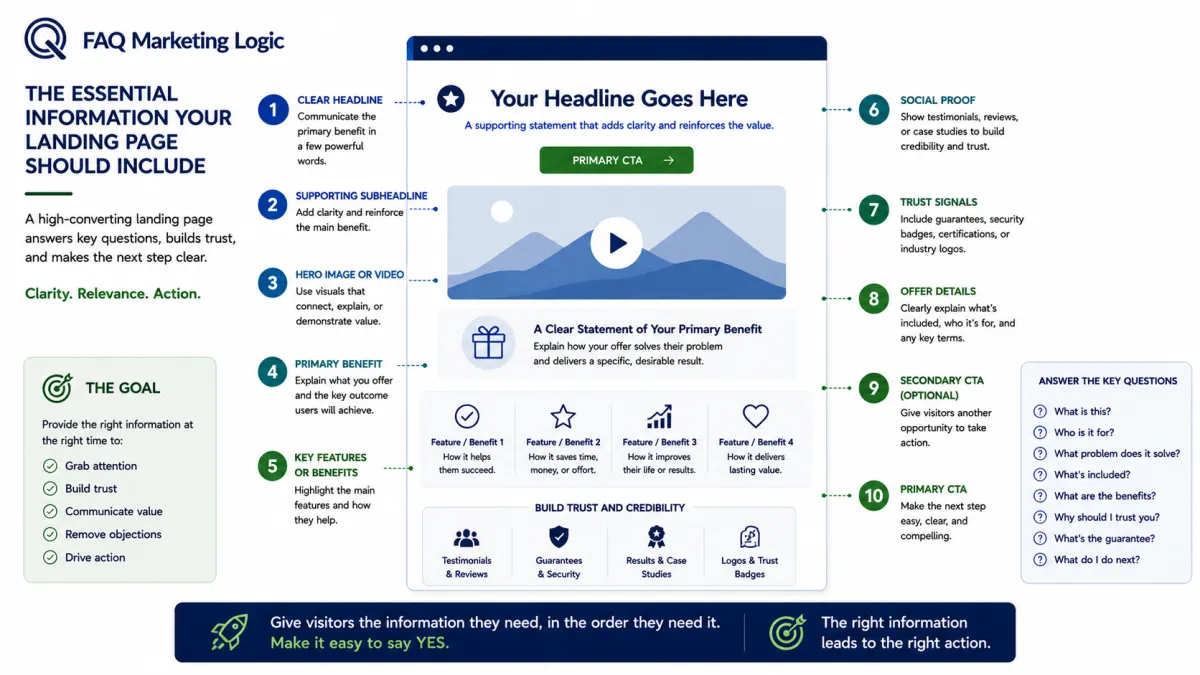
What Information Should A Landing Page Include?
TL;DR
A landing page should include the essential information visitors need to understand your offer, trust your business, and confidently take the next step.
IN SHORT
When someone visits your landing page, they're looking for answers.
They want to know:
What are you offering?
How will it help me?
Why should I trust you?
What should I do next?
The easier you answer these questions, the more likely visitors are to convert.
REAL TALK
Many landing pages either say too little or far too much.
Some provide almost no useful information.
Others overwhelm visitors with endless paragraphs, multiple offers, and unnecessary details.
Neither approach works well.
A good landing page gives visitors exactly what they need to make an informed decision—nothing more and nothing less.
Definition
A landing page is a standalone webpage designed to encourage visitors to complete one specific action, such as subscribing to an email list, requesting a consultation, or purchasing a product.
Unlike a homepage, a landing page focuses on a single goal with minimal distractions.
Start With A Clear Value Proposition
Visitors should immediately understand:
What you're offering
Who it's for
The main benefit
Why it matters
A strong value proposition helps visitors decide they're in the right place.
Explain The Benefits
People are interested in outcomes rather than features.
Instead of simply listing what's included, explain how your offer helps them.
For example:
Instead of:
20 video lessons
Explain:
Learn the complete process step by step without feeling overwhelmed.
Benefits make your offer more meaningful.
Include Trust Signals
Before taking action, visitors often look for reassurance.
Useful trust signals include:
Customer testimonials
Reviews
Case studies
Guarantees
Years of experience
Trust helps reduce uncertainty.
Answer Common Questions
Many people hesitate because they still have unanswered questions.
Consider explaining:
Who the offer is designed for
What's included
How long it takes
What happens after signing up
Whether there's a guarantee
Answering these questions removes unnecessary friction.
End With A Clear Call To Action
Every landing page should make the next step obvious.
Your call to action should clearly explain what visitors need to do.
Examples include:
Download the guide
Start your free trial
Book your consultation
Get instant access
Don't leave visitors wondering what happens next.
Example
Imagine you're offering a free guide about building an email list.
The landing page begins with a clear headline explaining the benefit, followed by a short paragraph describing what readers will learn.
Below that, visitors see a testimonial from someone who successfully used the advice, a simple explanation of what the guide includes, answers to common questions, and one prominent button inviting them to download it.
Every section helps visitors feel more confident about taking the next step.
Common Mistake
Mistake: Assuming visitors already understand your offer.
Fix: Clearly explain the value, build trust, answer questions, and provide one obvious call to action.
Clarity encourages action.
FAQ Quick Fix
To improve your landing page:
Write a clear value proposition.
Focus on benefits.
Add trust signals.
Answer common questions.
Finish with one strong call to action.
RELATED ARTICLES
→ What Makes a Landing Page Convert?
→ What Should Be Above The Fold On A Landing Page?
→ How Do I Structure A High-Converting Sales Page?
QUICK RECAP
An effective landing page should include:
A clear value proposition
Meaningful benefits
Trust-building elements
Answers to common questions
One clear call to action
Good landing pages make decisions easier.
NEXT STEP
Once your landing page contains the right information, the next step is understanding why people still hesitate before making a purchase.
Read: