What Makes An Evergreen Sales Letter Work?
TL;DR
An evergreen sales letter works because the problem, audience, offer and core sales message remain relevant over time.
It doesn't depend heavily on a particular date, temporary trend or short-lived promotion. Instead, it explains a continuing problem, presents a clear solution, builds belief, answers objections and gives the reader a straightforward reason to take action.
Evergreen doesn't mean you write a sales letter once and never touch it again. The strongest evergreen sales letters can continue working for years because their core message remains relevant while individual details are reviewed and updated when necessary.
IN SHORT
Most promotions have a lifespan.
A launch ends.
A seasonal promotion passes.
A discount expires.
A new trend eventually becomes old news.
An evergreen sales letter is different.
It's designed to keep presenting an offer whenever the right prospect arrives.
Someone might read it today.
Someone else might discover it six months from now.
Another prospect might arrive two years later.
If the underlying problem still exists and the offer still provides a relevant solution, the sales letter can continue doing its job.
That's what makes evergreen sales copy such a useful business asset.
REAL TALK
Evergreen doesn't mean:
"Write it once and forget about it forever."
Products change.
Prices change.
Markets change.
Proof becomes outdated.
Links stop working.
Customer objections evolve.
Even a strong evergreen sales letter needs checking occasionally.
The goal isn't to create something that never changes.
It's to avoid building the entire sales message around things that become irrelevant unnecessarily quickly.
Key Definition: What Is An Evergreen Sales Letter?
An evergreen sales letter is a sales message designed to remain relevant and persuasive for an extended period rather than being tied to a specific date, event, launch or temporary promotion.
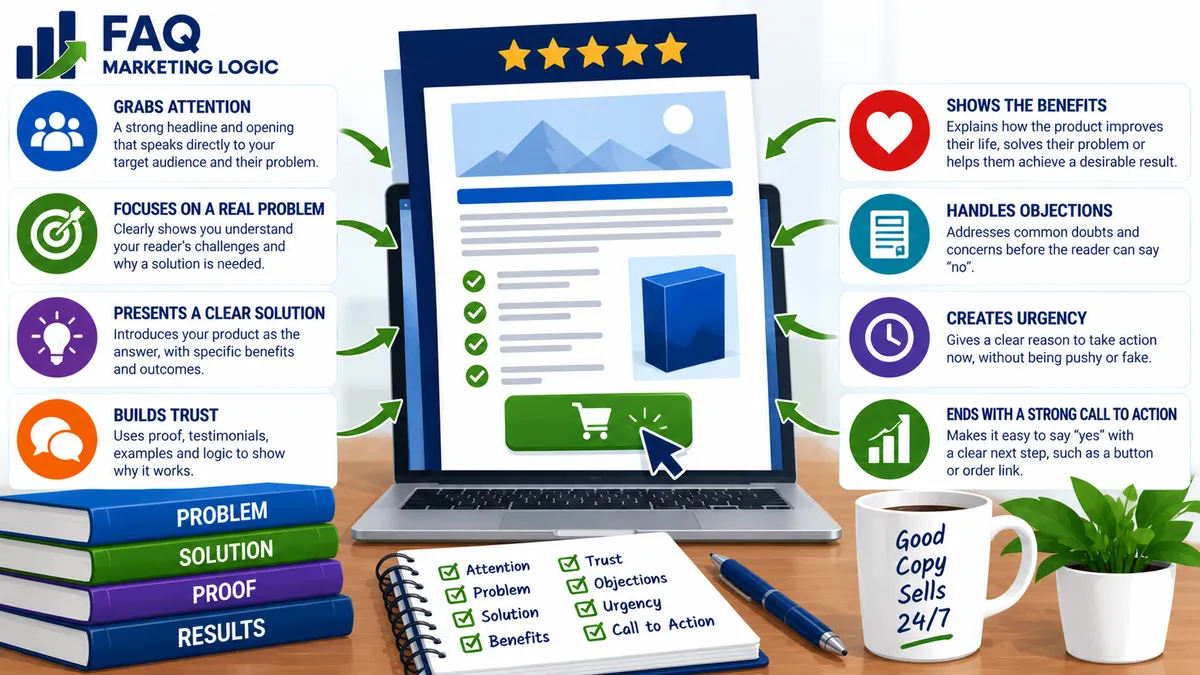
Its core message usually focuses on:
An enduring problem
A clearly defined audience
A relevant solution
Benefits that continue to matter
Reasons to believe the offer
Common customer objections
A clear call-to-action
This allows the sales letter to work as an ongoing selling asset.
Instead of needing to create a completely new promotion every time you want to generate sales, you can continue directing suitable prospects towards a message that already explains the offer.
If you'd like to explore how a carefully constructed sales letter can become a long-term selling asset, you can explore the sales letter approach here.
Start With A Problem That Doesn't Disappear Next Week
The foundation of an evergreen sales letter is usually an evergreen problem.
For example, people are likely to continue wanting to:
Save time
Make better decisions
Improve a skill
Find customers
Increase sales
Reduce costs
Become more organised
Solve recurring frustrations
Compare that with a sales letter built around:
"How to prepare your business for a particular platform update happening next Tuesday."
That might be highly relevant today.
But it has a built-in expiry date.
An evergreen offer addresses something likely to remain important after the current news cycle has moved on.
Know Exactly Who The Letter Is For
Evergreen doesn't mean broad.
In fact, specificity can make an evergreen sales letter stronger.
A sales letter trying to speak to:
"Anybody who wants to make money online"
has a difficult job.
A letter aimed at:
"Someone with useful knowledge who wants to turn it into their first digital product"
has a much clearer reader.
When you understand the audience, you can address:
Their current situation
What they want
What they've already tried
What frustrates them
What worries them
What might stop them buying
Those concerns can remain relevant for years even if the tools and technology around them change.
Make The Offer Easy To Understand
A sales letter can contain excellent writing and still struggle if the reader doesn't understand the offer.
They should be able to work out:
What the product is
What it helps them do
Who it's designed for
What's included
What it costs
What happens after buying
Don't make the reader assemble the offer from scattered clues.
Clarity is especially important with evergreen sales letters because they may receive visitors from many different sources.
One person might arrive from Google.
Another from an email.
Another from an article.
Another from an affiliate.
The sales letter needs to make sense even when the visitor hasn't seen everything that came before it.
Lead With Benefits That Remain Relevant
Features describe what the customer receives.
Benefits explain why those features matter.
For example:
Feature: Twelve video lessons.
Benefit: Follow the process step by step instead of trying to piece the method together yourself.
The number of lessons could eventually change.
The underlying benefit — having a structured process — may remain relevant much longer.
Strong evergreen copy concentrates on the lasting reasons somebody would want the product.
Explain Why The Solution Makes Sense
A sales letter shouldn't simply announce:
"Here's my product. Buy it."
The reader needs to understand the logic connecting their problem to your solution.
For example:
Problem: Creating every digital product from scratch takes considerable time.
Idea: Existing products can sometimes be licensed.
Solution: A resource showing how product licensing works.
The sales letter helps the reader move through that reasoning.
By the time the offer appears, it should feel connected to the problem already being discussed.
Build Belief Before Asking For The Sale
Before someone buys, they usually need to believe several things.
They may need to believe:
The problem is worth solving
The solution makes sense
The product is relevant
The seller is credible
They can actually use what they're buying
The value justifies the price
This is why good sales letters do more than describe products.
They help the reader become comfortable with the decision itself.
That belief can be supported through:
Clear explanations
Demonstrations
Specific details
Testimonials
Examples
Guarantees
Transparent descriptions
Evidence appropriate to the offer
Avoid exaggerated claims.
Believable sales copy usually lasts longer than hype because it doesn't depend on constantly increasing the promise.
Answer The Objections That Don't Go Away
Some objections are remarkably persistent.
Readers may wonder:
"Will this work for someone like me?"
"Is this too difficult?"
"Do I have enough time?"
"Is it worth the price?"
"What happens if it isn't right for me?"
"Why should I trust this?"
If these questions regularly occur before purchase, the sales letter should address them.
An evergreen sales letter becomes stronger when it answers the predictable concerns prospects repeatedly bring to the buying decision.
Use Proof That Can Stand The Test Of Time
Proof can strengthen a sales letter, but some proof ages better than others.
For example:
"More than 500 customers used this during March 2024"
may eventually look dated.
A relevant customer testimonial describing a specific experience may remain useful much longer, provided it still accurately represents the product.
Where you use:
Statistics
Screenshots
Customer numbers
Research
Awards
Testimonials
Case studies
review them periodically.
Evergreen doesn't mean old evidence should remain on the page indefinitely.
Avoid Unnecessary Dates
Sometimes dates matter.
If they do, use them.
But don't date the sales letter unnecessarily.
Phrases such as:
"This year..."
"Over the last few months..."
"The latest opportunity..."
"As we enter 2026..."
can make copy feel old surprisingly quickly.
If the date adds nothing to the argument, removing it can extend the useful life of the copy.
Be Careful With Trends
Trends can attract attention.
But they can also shorten the lifespan of a sales message.
Suppose a sales letter is built entirely around one currently fashionable platform.
If interest in that platform falls, the entire sales argument can weaken.
Where possible, anchor the main message to the underlying need rather than a temporary trend.
Instead of:
"Master this month's hottest marketing platform."
the core message might be about:
"Finding more potential customers online."
The platform could still feature in the product.
It simply doesn't need to carry the entire sales argument.
Give The Reader A Clear Reason To Act
Evergreen doesn't mean passive.
Your sales letter still needs a call-to-action.
Tell the reader what to do next.
For example:
Buy now
Join the membership
Start the course
Get access
Request the guide
Begin the trial
The CTA should be obvious and connected to the offer.
Don't make someone reach the end of a persuasive sales argument and then wonder:
"What am I supposed to do now?"
Does An Evergreen Sales Letter Need Scarcity?
No.
Genuine scarcity can be useful where it naturally exists.
For example:
Limited places for personal coaching
A genuine enrolment deadline
A real quantity limit
A temporary bonus with a genuine expiry
But fake countdown timers and permanently "ending tonight" promotions aren't required to make an evergreen sales letter work.
An evergreen sales letter should be capable of selling because the offer itself is worthwhile, not because every visitor is told the opportunity is about to disappear.
Does An Evergreen Sales Letter Need To Be Long?
Not automatically.
The correct length depends on how much the reader needs to understand before making the decision.
A simple low-cost product may require relatively little explanation.
A more expensive or unfamiliar offer may need:
More detail
More proof
More objection handling
More explanation
More reassurance
The objective isn't to make the sales letter long.
It's to make it complete enough to support the buying decision.
What Should You Update On An Evergreen Sales Letter?
Even if the core message remains strong, review the page periodically.
Check:
Price
Product contents
Bonuses
Testimonials
Links
Screenshots
Statistics
Guarantees
Contact information
Checkout process
References to tools or platforms
Claims about the market
You may discover that 90% of the letter is still perfectly useful.
That's the advantage.
You're maintaining an existing sales asset rather than rebuilding the promotion from scratch.
Practical Example
Imagine you sell a guide teaching beginners how to create their first online course.
You could build the sales letter around:
"The hottest course platform of 2026."
That message may attract attention now, but it immediately starts ageing.
Alternatively, you could build the core message around:
"You have knowledge people could benefit from, but turning that knowledge into a structured course can feel overwhelming."
That problem isn't tied to one platform or year.
The sales letter can then explain:
How to choose a course topic
How to organise the lessons
How to avoid overcomplicating the course
How the product helps
What's included
Why the process works
What the customer should do next
Individual platform recommendations inside the product might change.
But the central sales argument can remain useful for much longer.
Common Mistakes
Mistake: Assuming evergreen means never updating the page.
Fix: Preserve the core message while reviewing details that can become outdated.
Mistake: Building the entire sales argument around a temporary trend.
Fix: Anchor the message to an enduring customer problem.
Mistake: Trying to appeal to everybody.
Fix: Define the audience clearly enough to address their specific situation and objections.
Mistake: Using exaggerated claims to create excitement.
Fix: Build belief with clarity, evidence and realistic benefits.
Mistake: Adding fake scarcity because the sales letter needs urgency.
Fix: Use genuine reasons to act and genuine scarcity only where it exists.
Mistake: Focusing on length instead of completeness.
Fix: Include enough information to help the reader make an informed buying decision.
FAQ QUICK FIX
If you already have a sales letter, ask these five questions:
Will the problem still matter a year from now?
Is it immediately clear who the offer is for?
Can a new visitor understand exactly what I'm selling?
Does the copy rely heavily on dates, trends or temporary claims?
Does the page answer the objections prospects repeatedly have?
If the core message passes those tests, you may already have the foundations of an evergreen sales letter.
FAQ
How Long Can An Evergreen Sales Letter Keep Working?
Potentially for years, but there is no guaranteed lifespan. Its useful life depends on whether the problem, product, market and sales argument remain relevant.
Can I Use An Evergreen Sales Letter For A Digital Product?
Yes. Digital products, courses, memberships, software and other offers can all potentially use evergreen sales pages where the offer is available continuously.
Should I Remove All Dates From An Evergreen Sales Letter?
No. Use dates when they're genuinely useful or necessary. The aim is to avoid unnecessary dating that makes otherwise relevant copy look old.
Can I Change An Evergreen Sales Letter After It Starts Making Sales?
Yes. Evergreen doesn't mean fixed forever. You can improve or update the page as you gather customer feedback and conversion information.
Do Testimonials Make A Sales Letter Evergreen?
Testimonials can provide useful proof, but they don't make a page evergreen by themselves. They should also remain relevant, genuine and representative of the offer being sold.
Can An Evergreen Sales Letter Promote A Changing Product?
Yes, provided you keep the product description and offer details current. The central customer problem and sales argument may remain stable even when parts of the product evolve.
TRY THIS TODAY
Open one of your existing sales pages and highlight every reference to:
Dates
Current trends
Temporary events
Specific software
Statistics
Time-sensitive bonuses
Limited offers
"Latest" or "new" claims
Now ask:
Does this need to be here?
If it does, keep it.
If it doesn't, consider whether the same point could be expressed around a more enduring customer problem or benefit.
You don't need to strip personality or relevance from the copy.
You're simply removing unnecessary expiry dates from the sales message.
What If One Sales Letter Could Keep Working For You?
A strong sales letter can become more than a one-off promotion.
When the message is built around the right audience, an enduring problem and a relevant offer, it can become a sales asset you continue sending prospects to long after it was first written.
One Letter From Retirement explores the idea of creating a carefully structured sales letter capable of continuing to do the selling over time.
→ Show Me The Sales Letter Approach
RELATED ARTICLES
→ What Makes A Sales Letter Keep Selling Over Time?
→ Should I Use Long-Form Or Short-Form Sales Copy?
→ How Do I Handle Customer Objections On A Sales Page?
QUICK RECAP
An evergreen sales letter is designed around things that remain relevant.
Start with an enduring customer problem.
Define exactly who the letter is for.
Make the offer easy to understand.
Focus on benefits that continue to matter.
Build belief before asking for the sale.
Answer predictable objections.
Use credible proof.
Avoid unnecessary dates and temporary trends.
Use genuine scarcity only when it genuinely exists.
Give the reader a clear call-to-action.
Review changing details periodically.
Evergreen doesn't mean a sales letter never changes.
It means the core sales argument is strong enough that it doesn't need rebuilding every few weeks.
NEXT STEP
Once the core sales message can remain relevant over time, the next challenge is making sure the page itself is structured so the reader can move naturally from interest to action.
→ How Do I Structure A High-Converting Sales Page?