What Makes A Sales Letter Keep Selling Over Time?
TL;DR
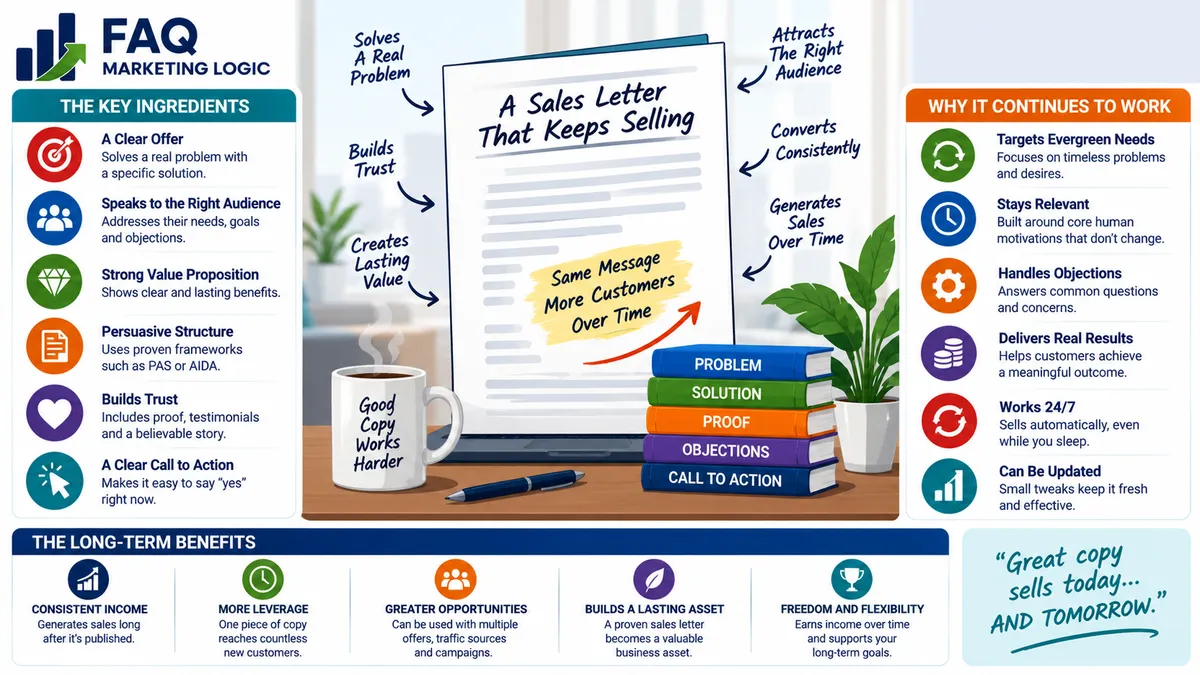
A sales letter can keep generating sales long after it was written when it addresses an ongoing customer problem, communicates a compelling offer and doesn't depend heavily on temporary trends, dates or events.
The strongest evergreen sales letters aren't simply pieces of copy. They become business assets that can continue presenting an offer whenever a new prospect discovers them.
That doesn't mean writing them once and forgetting about them forever. Good sales letters should still be monitored and improved when the market, product or evidence changes.
IN SHORT
Most marketing has a short lifespan.
A social media post disappears down a feed.
An advertisement stops working when you stop paying for it.
A launch email eventually becomes irrelevant.
But a strong sales letter can potentially keep working for months or even years.
Someone discovers your offer today.
Someone else discovers it next month.
Another person arrives six months later.
If the underlying problem and offer remain relevant, the same sales message can continue doing its job.
REAL TALK
A sales letter doesn't become evergreen simply because you leave it online.
Poor copy can sit on a website for years without selling anything.
The real opportunity comes from creating a sales message around something that doesn't quickly become outdated.
If your customer has the same underlying problem next year that they have today, and your product still provides a relevant solution, you've got the foundations for a sales letter with a much longer useful life.
That's when copy starts becoming more than promotion.
It becomes an asset.
Key Definition: What Is An Evergreen Sales Letter?
An evergreen sales letter is a sales message designed to remain relevant and persuasive over an extended period rather than being tied to a specific launch, date or short-term event.
Its purpose is to continually move suitable prospects towards a buying decision by explaining:
The problem
The desired outcome
The solution
The benefits
The offer
The reasons to believe
The next action
As long as those elements remain relevant, the sales letter can potentially continue working whenever a new prospect reaches it.
If you'd like to explore how a carefully constructed sales letter can become a long-term selling asset, you can explore the sales letter approach here.
Why Can A Sales Letter Keep Working For So Long?
The answer comes down to relevance.
Some customer problems don't disappear very quickly.
Businesses will continue wanting more customers.
People will continue wanting to save time.
Entrepreneurs will continue wanting to increase sales.
Customers will continue wanting solutions that make difficult tasks easier.
If your sales letter addresses a persistent problem and presents a relevant solution, new prospects can continue recognising themselves in the message.
The individual reader changes.
The underlying sales conversation doesn't necessarily have to.
What Makes A Sales Letter Evergreen?
Several elements help give a sales letter a longer useful life.
A Timeless Problem
Start with a problem that is unlikely to disappear next week.
A sales letter built around a passing trend may perform well temporarily, but it will naturally have a shorter lifespan.
A letter addressing an established customer need has more opportunity to remain relevant.
A Clearly Defined Audience
The stronger your understanding of the reader, the easier it becomes to write a message that continues resonating with similar prospects.
You need to understand:
What they want
What they're struggling with
What they've already tried
What concerns them
Why they might hesitate
What would make the solution valuable
The better you understand those things, the less your sales letter needs to rely on gimmicks.
A Strong Offer
Great copy can't permanently rescue a weak offer.
The product still needs to provide something customers value.
An evergreen sales letter therefore needs an offer that remains useful and commercially relevant.
Benefits That Matter
Features describe what something contains.
Benefits explain why those features matter to the customer.
If the benefits address enduring customer wants and problems, they're less likely to become irrelevant quickly.
Credible Reasons To Believe
Claims alone aren't always enough.
Evidence can help reduce uncertainty.
Depending on the product and what can legitimately be demonstrated, this might include:
Testimonials
Demonstrations
Examples
Results
Guarantees
Credentials
Explanations of how the product works
Any evidence should, of course, be genuine and support the claims you're actually making.
A Clear Call-To-Action
An evergreen sales letter still needs to tell the reader what to do next.
Don't make someone reach the bottom of the page and wonder:
"What am I supposed to do now?"
The next action should be obvious.
Why Sales Letters Can Become Valuable Business Assets
Imagine you write a sales letter for a $50 digital product.
The letter helps generate 10 sales during its first month.
That's:
10 × $50 = $500
Suppose the same sales letter continues bringing in customers over the following months.
You aren't being paid because you keep writing the letter.
You're benefiting because the work you did previously continues communicating the offer to new prospects.
That is what makes evergreen marketing assets interesting.
The initial work can potentially produce value repeatedly.
Of course, the sales letter still needs traffic. If nobody sees it, it can't sell anything.
But once the asset exists, you can concentrate on sending qualified prospects to it rather than recreating the entire sales message every time.
Does An Evergreen Sales Letter Mean I Never Change It?
No.
Evergreen doesn't mean permanent.
Think of it as long-lasting rather than untouchable.
You may need to update a sales letter when:
The product changes
Pricing changes
Bonuses change
Customer objections change
New evidence becomes available
Parts of the copy become dated
You learn more about your customers
Conversion data reveals a weakness
Sometimes relatively small improvements can make an existing sales asset more effective.
The goal isn't to avoid changing the letter.
It's to avoid having to start again every time you want to make another sale.
What Makes A Sales Letter Become Dated?
Certain types of copy naturally shorten a sales letter's lifespan.
For example:
"This is the hottest strategy of 2026."
That immediately gives the copy an expiry date.
Likewise:
"This month's biggest opportunity..."
will eventually stop making sense.
You should also be careful with temporary statistics, references to current events, outdated screenshots, obsolete technology and claims that may no longer be accurate.
That doesn't mean dates should never appear in sales copy.
It means that if you're deliberately creating an evergreen asset, don't make it unnecessarily dependent on time-sensitive material.
Should A Sales Letter Be Long Or Short?
As long as it needs to be to make the sale effectively.
A relatively simple, inexpensive offer may not require much explanation.
A more expensive or unfamiliar product might require considerably more.
The reader may need to understand the problem, the solution, benefits, objections, evidence, price and guarantee before feeling comfortable buying.
That's why the better question isn't:
"How many words should my sales letter contain?"
It's:
"What does my prospect need to understand before making this decision?"
Does The Headline Matter?
Enormously.
The rest of the sales letter can't do much if the headline doesn't persuade the right person to continue reading.
A useful headline generally gives the intended prospect a reason to think:
"This might be relevant to me."
That could come from highlighting:
A desirable result
A significant problem
A compelling benefit
An interesting opportunity
A strong curiosity gap
The headline earns attention.
The rest of the letter has to justify it.
What About Customer Objections?
An effective sales letter doesn't pretend objections don't exist.
It anticipates them.
A prospect may be thinking:
Will this work for me?
Is it worth the money?
Do I really need it?
Can I trust this business?
What happens if I'm disappointed?
If those concerns are predictable, the sales letter can address them as part of the message rather than leaving the prospect to resolve them alone.
That's one reason a well-written sales letter can keep working without somebody being present to answer every question personally.
Practical Example
Imagine you've created a digital course teaching a skill people have wanted to learn for years.
You write a sales letter explaining:
The problem your audience faces
Why common approaches fail
What outcome they're trying to achieve
How your course helps
What's included
The benefits
Evidence supporting the offer
The price
The guarantee
What they should do next
Nothing in the core message depends on a particular week or month.
You publish the sales letter and begin directing prospects to it through your website, email marketing and other traffic sources.
Six months later, a new visitor arrives.
The sales letter is new to them.
That's an important part of evergreen marketing.
The asset may be months old.
The prospect's experience of it isn't.
Common Sales Letter Mistakes
Mistake: Trying to make the copy sound clever.
Fix: Concentrate on making the message clear, relevant and persuasive.
Mistake: Making the letter unnecessarily time-sensitive.
Fix: If you're creating an evergreen asset, avoid references that will quickly become dated unless they're genuinely necessary.
Mistake: Concentrating on features instead of customer outcomes.
Fix: Explain what the features mean for the person buying.
Mistake: Ignoring objections.
Fix: Identify the reasonable concerns preventing prospects from buying and address them within the sales message.
Mistake: Assuming evergreen means never reviewing the copy.
Fix: Monitor performance and update the letter when the offer, market or evidence changes.
FAQ QUICK FIX
Question: My sales page works, but I constantly feel as though I need to rewrite it.
Quick Fix: Look for parts of the copy that depend on dates, trends or temporary circumstances.
Ask:
"Would this still make sense to a new prospect six months from now?"
If the answer is no, decide whether that section genuinely needs to be time-sensitive or whether it can be made more evergreen.
FAQ
Can A Sales Letter Really Work For Years?
Potentially, yes.
If the underlying customer problem, product and offer remain relevant, the core sales message may continue working for a long time.
However, you should still review it periodically.
Does A Sales Letter Need Constant Traffic?
It needs prospects to see it.
A strong sales letter without traffic is like a salesperson sitting in an empty shop.
The advantage is that once the sales asset exists, different traffic sources can continually send new prospects to the same message.
Should I Remove All Dates From My Sales Letter?
Not necessarily.
Use dates where they're useful or required.
The point is to avoid unnecessary time-sensitive references if you want the letter to remain relevant for longer.
Can I Use An Evergreen Sales Letter With Email Marketing?
Yes.
Email can introduce the problem, build interest and direct suitable prospects towards an evergreen sales letter that handles the fuller sales conversation.
Can I Improve An Evergreen Sales Letter Later?
Absolutely.
In fact, that's one of its advantages.
Instead of constantly producing completely new sales campaigns, you can learn from customer feedback and conversion performance and improve an existing asset.
TRY THIS TODAY
Open one of your existing sales pages and read it as though you're seeing it six months from now.
Look specifically for:
Dates that will become irrelevant.
Temporary trends.
Outdated references.
Benefits that aren't clear.
Objections you haven't answered.
Claims that need stronger evidence.
An unclear next step.
You don't necessarily need to rewrite the entire page.
Start by identifying the parts preventing it from becoming a longer-lasting sales asset.
What If One Sales Message Could Keep Working For You?
A powerful sales letter can do more than support a short promotion.
Built around the right audience, problem and offer, it can become an asset that continues presenting your product to new prospects long after the original writing is finished.
If you'd like to explore how a carefully constructed sales letter can keep doing the selling, I've got a free resource that will show you more.
→ Show Me The Sales Letter Approach
RELATED ARTICLES
→ Should I Use Long-Form Or Short-Form Sales Copy?
→ How Do I Handle Customer Objections On A Sales Page?
→ What Builds Trust Fastest Online?
QUICK RECAP
An evergreen sales letter is designed to remain relevant over an extended period.
Long-lasting customer problems create stronger foundations for evergreen copy.
A good sales letter needs a relevant audience, strong offer, meaningful benefits and a clear next step.
Avoid unnecessary dates and temporary references when longevity matters.
Evergreen doesn't mean never updating the sales letter.
A sales letter still needs qualified traffic before it can generate sales.
Strong sales copy can become a business asset rather than a one-off promotion.
NEXT STEP