Should I Use Long-Form Or Short-Form Sales Copy?
TL;DR
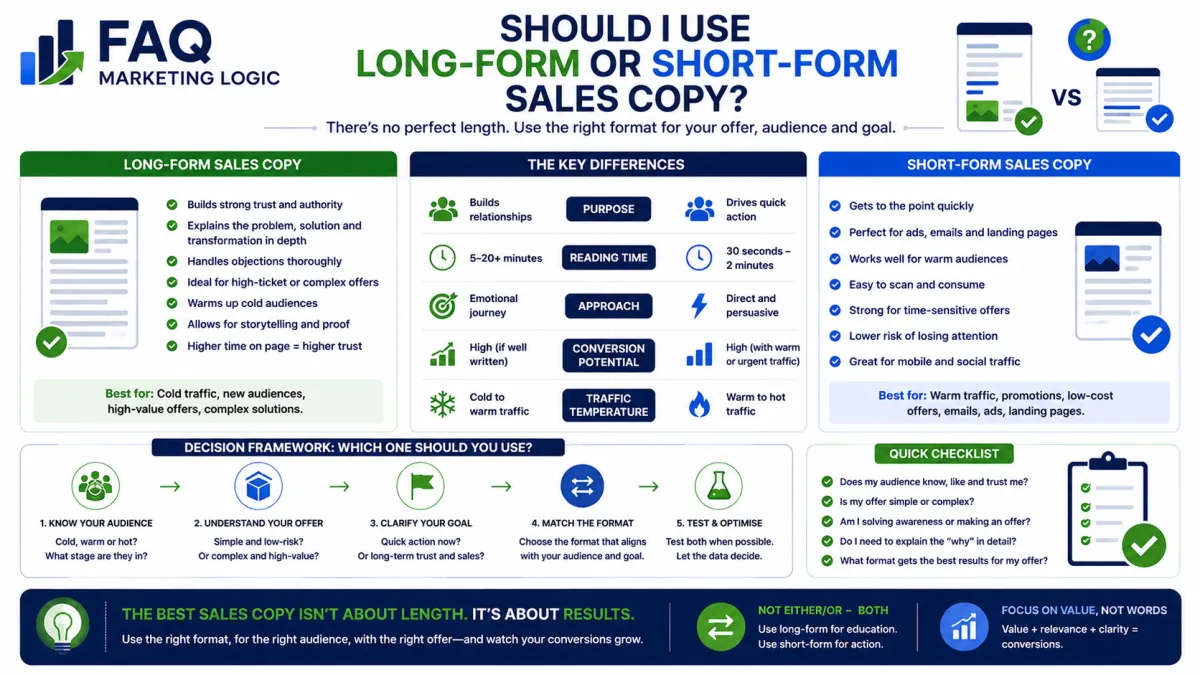
There is no universally better choice between long-form and short-form sales copy. The right length depends on the complexity of your offer, the level of trust your audience has, and how much information they need before making a decision.
IN SHORT
Long-form sales copy works best when:
The offer is expensive.
The product needs explaining.
Trust must be built.
Objections need answering.
Short-form sales copy works best when:
The offer is simple.
The audience already knows you.
The price is low.
The decision is straightforward.
The goal is not to write more or less.
The goal is to include exactly as much information as your audience needs to feel confident taking action.
REAL TALK
One of the biggest myths in marketing is that people don't read long sales pages.
People don't read unnecessary copy.
If your sales page continues answering important questions, reducing objections, and building confidence, people will keep reading.
If every paragraph repeats the last one, they'll stop—whether the page is long or short.
Good sales copy isn't measured in words.
It's measured by how effectively it moves the reader towards a decision.
Key Definition
Sales copy is persuasive writing designed to encourage a visitor to take a specific action, such as making a purchase, joining an email list, or booking a consultation.
Its purpose is to answer questions, build trust, demonstrate value, and make the next step feel like the logical choice.
When Long-Form Sales Copy Works Best
Long-form copy is often the better choice when visitors need more information before committing.
It allows you to:
Explain the problem in detail.
Demonstrate the value of your solution.
Answer common objections.
Share testimonials and case studies.
Build credibility.
Create confidence before asking for the sale.
This approach is particularly effective for:
High-ticket products.
Online courses.
Coaching programmes.
Professional services.
Complex digital products.
The greater the perceived risk, the more information buyers usually need.
When Short-Form Sales Copy Works Best
Short-form copy works well when visitors already understand the offer.
Examples include:
Free downloads.
Low-cost digital products.
Webinar registrations.
Appointment bookings.
Returning customers.
These offers require less explanation because the commitment is lower and the perceived risk is smaller.
In these situations, clarity is often more important than length.
Focus On The Buying Decision
Rather than asking:
"How long should my sales page be?"
Ask:
"What questions does my visitor still need answered before taking action?"
Every section of your page should reduce uncertainty.
If a paragraph doesn't build trust, explain value, or remove an objection, it probably doesn't need to be there.
Practical Example
Imagine two businesses selling different products.
Business A offers a free marketing checklist.
Visitors already understand what they're receiving.
A short page with a clear headline, a brief explanation, and a simple opt-in form is usually enough.
Business B sells a £997 coaching programme.
Prospective customers are making a significant investment.
They are likely to want more information, testimonials, answers to common questions, and reassurance before buying.
The second offer naturally benefits from longer, more detailed sales copy.
Common Mistake
Mistake:
Making a sales page longer simply because longer pages are believed to convert better.
Fix:
Only include information that helps visitors make an informed decision.
Every section should earn its place on the page.
FAQ Quick Fix
If you're unsure which approach to use, ask yourself:
Is the offer simple or complex?
Is the price low or high?
Does the visitor already trust my brand?
Are there likely to be objections?
Will more information increase confidence?
The answers will usually tell you how much copy your page actually needs.
RELATED ARTICLES
→ How Do I Structure A High-Converting Sales Page?
→ How Do I Increase Landing Page Conversions?
→ What Makes A Call-To-Action More Effective?
QUICK RECAP
The best sales copy is:
Appropriate for the offer.
Focused on the buyer.
Clear rather than clever.
Long enough to build confidence.
Short enough to maintain attention.
The right length is whatever helps your audience make a confident decision.
NEXT STEP
You've now completed the Page Structure section of the Conversion pillar.
The next stage explores Persuasion—understanding the psychological factors that influence buying decisions and help visitors move from interest to action.