
How Do I Turn Website Visitors Into Regular Readers?
Turning website visitors into regular readers means giving people a reason to return after they've found the answer they originally came looking for.
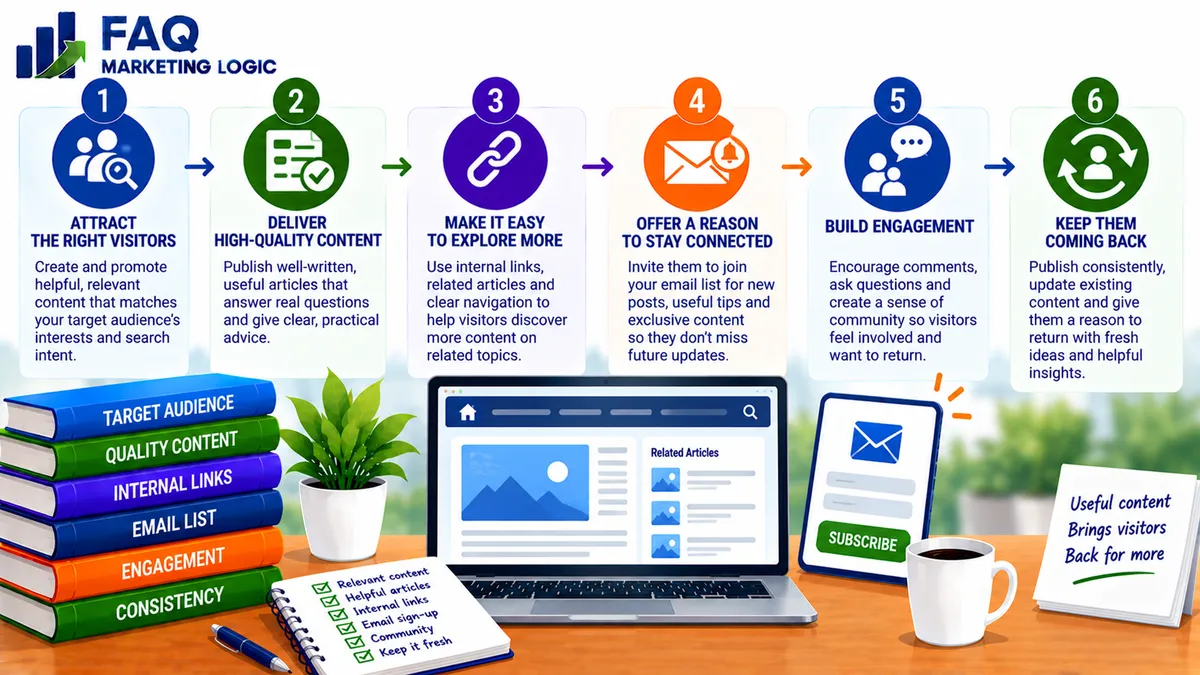
Useful content attracts visitors, but clear organisation, related articles and consistent publishing help turn a single visit into an ongoing relationship.
The key is to make your website a reliable source of information for a particular audience. When readers know what to expect and can easily find answers to their next questions, they're more likely to remember your website and return.
You don't need to persuade everybody to become a regular reader. You need to make it worthwhile for the people who are genuinely interested in your subject.
IN SHORT
Most people arrive at a website because they're looking for something specific.
They might have a question, need help solving a problem or want to understand a subject before making a decision.
Once they've found their answer, they may leave without exploring anything else.
That isn't necessarily a problem. However, if you're building a content-based business, you want interested visitors to discover that your website offers more than one useful article.
The simplest approach is to publish related content, connect articles naturally and give readers a clear reason to continue exploring.
Over time, this can help turn occasional visitors into people who recognise your website as a useful resource.
WHY THIS WORKS
Give Visitors A Reason To Remember Your Website
When someone discovers an article through a search engine, they're usually interested in the answer rather than the website providing it.
They may read your explanation, find it useful and leave without remembering where they found it.
That's why attracting visitors and building a regular readership are two different challenges.
To encourage repeat visits, your website needs a recognisable purpose.
For example, a website that answers practical questions about starting and growing an online business gives readers a reason to associate it with that subject.
If they later encounter another problem, they may remember that your website provides straightforward explanations.
This becomes easier when your content consistently serves the same audience.
An article about choosing an online business model should feel connected to articles about creating offers, attracting visitors and making sales.
The subjects don't need to be identical, but they should belong to a recognisable area of expertise.
Answer The Original Question Properly
Before encouraging someone to read another article, make sure the first one delivers what they came for.
If a visitor searches for an explanation of how long website traffic takes to develop, they shouldn't have to work through several unrelated sections before finding a useful answer.
A clear opening, practical explanation and realistic expectations help readers decide whether your content is worth their attention.
For example, our article How Long Does It Take To Get Traffic? addresses a common concern among website owners who are waiting for their content to attract visitors.
Someone interested in that question may also want to understand which activities can improve their chances of being discovered.
That's where relevant supporting articles become useful.
However, the original article must stand on its own.
Internal links should extend the reader's understanding, not compensate for an incomplete answer.
Build Groups Of Related Content
One of the most effective ways to encourage readers to explore further is to organise articles around connected questions.
Imagine someone arrives at your website looking for advice about attracting traffic.
After reading the article, they discover that you also explain search engines, content planning, internal linking and topical authority.
They now have several reasons to continue exploring.
This is one of the benefits of building content around clearly defined subjects rather than publishing unrelated articles whenever an idea comes to mind.
A structured collection makes it easier for readers to understand what your website covers.
Our Beginner's Guide to Website Traffic brings together the main approaches to attracting visitors and shows how related content can support a wider traffic strategy.
It also creates opportunities to connect articles that naturally support one another.
For example, someone interested in developing a content library may benefit from understanding How Do I Build Topical Authority?.
That article can help them see why covering related questions systematically is useful.
The same principle applies to your own website.
When visitors can follow a logical path through your content, they're more likely to discover information they didn't originally know they needed.
Use Internal Links To Continue The Conversation
Internal links shouldn't feel like interruptions.
They should appear when another article genuinely helps explain the subject being discussed.
Suppose you're writing about publishing content consistently.
You mention that beginners often wonder how many articles they need before seeing meaningful results.
Rather than adding a lengthy explanation that takes the current article off course, you could link naturally to How Many Blog Posts Do I Need Before Seeing Results?.
The reader can explore that question if it's relevant.
Someone who already understands the subject can simply continue reading.
This creates a better experience than inserting unrelated links purely to encourage more page views.
A useful internal link answers the reader's next likely question.
It also helps people discover the wider structure of your website without requiring them to search through menus or category pages.
The important thing is to make every link relevant to the surrounding explanation.
Make Your Content Easy To Explore
Even useful articles can be difficult to discover when a website lacks clear organisation.
Visitors should be able to understand the main subjects you cover and find related information without unnecessary effort.
For an FAQ-style website, this might mean organising content into a small number of clearly defined categories.
Each category can lead to supporting articles that answer more specific questions.
A visitor interested in email marketing, for example, should be able to find information about building a list, writing messages, improving engagement and making offers.
Clear navigation helps readers explore those subjects without having to understand your entire website structure.
You can also use descriptive headings and carefully selected related articles to guide visitors towards useful information.
Avoid overwhelming people with dozens of recommendations.
A few relevant choices are usually easier to understand than a long collection of loosely connected links.
Publish Consistently Without Sacrificing Quality
Regular publishing gives interested readers more reasons to revisit your website.
However, publishing frequently doesn't automatically create a loyal audience.
Readers need to feel that new content is worth their time.
If you publish three articles each week but several repeat the same advice, visitors may struggle to see the value in returning.
A better approach is to plan content around distinct questions.
Each new article should contribute something useful to the wider subject.
For example, an article explaining why search engines discover certain pages can complement another article about improving existing content.
Both address website visibility, but from different perspectives.
If you're deciding whether to create something new or improve material that's already published, Should I Update Old Posts Or Publish New Ones? explores that decision in more detail.
Consistency matters, but usefulness gives consistency its value.
Give Readers A Reason To Stay Connected
Not every interested visitor will remember to return to your website.
People are busy, and even useful resources can be forgotten.
An email list can provide a way to maintain contact with readers who want to hear from you again.
However, the invitation needs to offer something worthwhile.
Simply asking people to subscribe for occasional website updates may not be particularly compelling.
A useful report, practical guide or relevant email series can provide a stronger reason to join.
The important thing is to connect the offer with the reader's interests.
For example, someone exploring how to build an information publishing business may appreciate a beginner-friendly resource explaining the model.
Six Figures A Year In Info Publishing introduces that approach and provides a relevant next step for readers interested in developing a business around useful information.
The objective isn't to collect email addresses from everyone who visits.
It's to give genuinely interested readers an opportunity to continue learning.
An email list is only one way to maintain that connection. Some readers may return through bookmarks, search results or direct visits without subscribing. The important thing is to give people a reason to remember your website, whether or not they choose to receive emails.
Make Your Website Worth Returning To
Regular readers develop because they expect your website to provide something useful.
That expectation grows through repeated positive experiences.
Clear explanations, practical examples, relevant recommendations and a consistent editorial approach all contribute.
You don't need to introduce a completely new idea every time you publish.
Sometimes readers return because they trust your ability to explain familiar subjects in a way that helps them make decisions.
A useful website gradually becomes a reference point.
Someone may first discover it through a question about website traffic, then return when they need help with email marketing or sales pages.
This is particularly valuable when your subjects connect naturally.
Instead of treating each article as an isolated opportunity to attract traffic, think about how it contributes to the wider experience you're creating.
PRACTICAL EXAMPLE
Imagine you run a website helping beginners create and sell digital products.
Someone discovers your article about choosing an online business model through Google.
They read the explanation and find it useful.
At the appropriate point, the article introduces a related question about validating a business idea before investing time in development.
The visitor follows that link.
Later, they discover another article explaining how to turn a suitable idea into a simple offer.
They've now read three articles rather than one.
More importantly, each article has helped them understand the next stage of a process they're interested in.
Before leaving, they notice a relevant free guide that offers further information about information publishing.
They decide to subscribe.
Over the following weeks, they receive useful emails connected with the subject and occasionally return to explore new articles.
Not every visitor will follow this path, and there's no guarantee that someone who reads several articles will become a customer.
However, the example shows how relevant content, sensible internal linking and an appropriate follow-up offer can work together.
The website becomes more than a collection of individual answers.
It becomes a resource the reader has a reason to revisit.
REAL TALK
It's easy to become so focused on attracting new visitors that you forget about the people who have already found your website.
Every new article becomes another attempt to appear in search results.
Every performance report becomes a comparison of clicks and impressions.
Those figures matter, particularly when you're building a website from scratch.
But attracting a visitor is only the beginning.
If someone finds your content useful enough to remember your website, explore related articles or subscribe for further information, you've created an opportunity that goes beyond a single search visit.
That doesn't mean every reader needs to join your list or buy something.
Some people will find their answer and leave. That's perfectly normal.
The aim is to make sure interested visitors have a reason to continue.
A useful website doesn't need to trap people into reading more pages.
It needs to make the next useful answer easy to find.
COMMON MISTAKES
Mistake: Concentrating entirely on new traffic.
You publish more content but give little attention to helping existing visitors explore the website.
Fix: Review internal links, navigation and related content so interested readers can find their next answer.
Mistake: Publishing unrelated articles.
Your website covers so many disconnected subjects that visitors cannot identify its main purpose.
Fix: Organise content around clear topics and build supporting articles that serve the same audience.
Mistake: Adding links simply to increase page views.
Readers encounter recommendations that have little connection with the subject they're reading about.
Fix: Link to articles that answer a relevant question or extend the current explanation.
Mistake: Assuming regular publishing guarantees loyal readers.
You maintain a schedule but don't consider whether each article contributes something useful.
Fix: Focus on distinct questions, practical value and consistent quality.
Mistake: Offering no way to stay connected.
Interested visitors leave without discovering that they can receive further information.
Fix: Provide a relevant opt-in opportunity without interrupting the reading experience.
FAQ QUICK FIX
Want to encourage more visitors to explore your website?
Choose one article that's already attracting readers and work through these five checks.
1. Identify the visitor's original question.
What problem or interest is bringing people to this article?
2. Check that the article answers it properly.
Make sure readers receive a clear and useful explanation before being encouraged to explore further.
3. Identify the next likely question.
Think about what someone might want to understand after reading the article.
4. Add a relevant internal link.
Connect the explanation naturally to another published article that addresses the next question.
5. Review the final recommendation.
Make sure the article ends with a useful next step rather than an unrelated promotion.
Repeat the process with other important articles as time allows.
Small improvements to existing content can make the website easier to explore without requiring you to publish something new.
FAQ
How Do I Encourage Visitors To Return To My Website?
Publish useful content around recognisable subjects, organise it clearly and make related information easy to discover. A relevant email list can also help interested readers stay connected.
Do I Need To Publish Every Day To Build Regular Readers?
No. A manageable publishing schedule is usually more practical than producing frequent articles that add little value. Consistency and usefulness matter more than daily publication.
Can Internal Links Increase Repeat Visits?
Internal links can encourage visitors to explore more content during a visit. They don't guarantee that someone will return later, but they can help readers recognise the wider value of your website.
Should I Ask Every Visitor To Join My Email List?
You can provide an opportunity to subscribe, but the invitation should be relevant and optional. Not every visitor wants ongoing communication, and that's perfectly reasonable.
How Do I Know If People Are Becoming Regular Readers?
Website analytics may provide information about returning users, repeat visits and engagement over time. Email subscriptions, repeat clicks from newsletters and direct visits can also offer useful indications, although measurement isn't always exact.
Is It Better To Have Regular Readers Or More New Visitors?
Both can be valuable. New visitors help your audience grow, while returning readers may indicate sustained interest. The right balance depends on your website's purpose and business model.
TRY THIS TODAY
Open one of your most important published articles.
Read it as though you're visiting the website for the first time.
Ask yourself:
Does the opening answer the question I came to solve?
Can I quickly understand what this website is about?
Are there links to useful supporting articles?
Do those links appear naturally within the explanation?
Is the next recommended article relevant?
Can I easily explore the wider subject?
Is there a worthwhile reason to subscribe?
Would I remember this website as a useful resource?
What question might I want answered next?
Now choose one improvement.
You might add a contextual internal link, replace an unrelated recommendation or make the next step clearer.
If you have analytics available, you can also review whether visitors explore other pages after arriving at that article.
The objective isn't to force people to stay longer.
It's to make the website more useful for readers who want to learn more.
Want To Explore Information Publishing Further?
A website that attracts interested readers can become a valuable foundation for an information publishing business.
By answering useful questions and building a recognisable subject area, you can develop an audience interested in the knowledge and resources you provide.
However, attracting readers is only one part of the process.
You also need to understand how information can be developed into products and offers that serve a particular market.
If you're exploring that business model, Six Figures A Year In Info Publishing introduces the principles behind building a business around useful information.
→ Discover Six Figures A Year In Info Publishing
The physical book is offered free, with a shipping and handling charge.
RELATED ARTICLES
→ What Is The Best Traffic Source For Beginners?
→ What Content Gets Discovered Most Easily?
→ Should I Focus On One Traffic Source Or Many?
QUICK RECAP
Turning website visitors into regular readers means creating a useful experience that extends beyond the first article.
Give your website a clear purpose and recognisable subject.
Answer the visitor's original question properly.
Build collections of related content.
Add contextual internal links where they help readers.
Organise articles so supporting information is easy to find.
Publish consistently without sacrificing quality.
Give interested visitors a relevant way to stay connected.
Review how readers interact with your website.
Improve existing articles when useful.
Make the next answer easy to discover.
Not every visitor will become a regular reader, and that isn't the objective.
The aim is to create a website that people remember because it consistently helps them understand and solve problems.
Getting someone to visit is a good start. Giving them a reason to return is how you begin building a readership.
NEXT STEP
Once you've created useful articles that readers want to explore, the next challenge is making those connections easy to follow.
Relevant internal links help visitors discover supporting information and understand how your content fits together.