
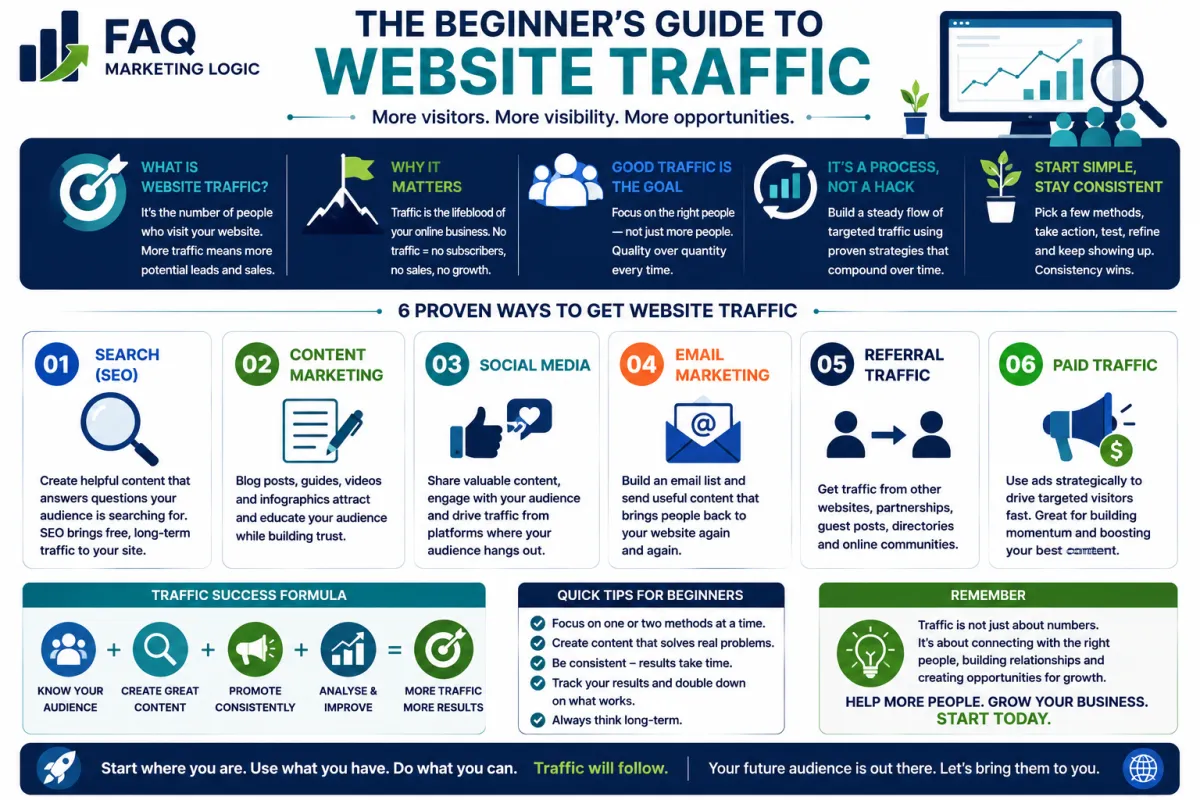
The Beginner's Guide To Website Traffic
TL;DR
Website traffic is simply the flow of people arriving at your website from sources such as search engines, social media, email, referrals, paid advertising, and AI-powered search tools.
Beginners don't need to master every traffic source.
Start by understanding who you want to attract, create useful content or offers for them, concentrate on one or two realistic traffic sources, and measure whether those visitors take meaningful actions.
Traffic alone doesn't build a business.
Relevant traffic does.
IN SHORT
A simple website traffic strategy looks like this:
Know who you want to attract.
Give them a reason to visit.
Choose a realistic traffic source.
Create useful, discoverable content.
Direct visitors towards a logical next step.
Measure what happens after they arrive.
Improve what works before adding more channels.
The objective isn't simply to generate more visitors.
It's to attract more of the right visitors.
REAL TALK
Traffic numbers can become addictive.
100 visitors.
1,000 visitors.
10,000 visitors.
But a website receiving 10,000 irrelevant visits can produce less business than one receiving 500 visits from people actively looking for what it provides.
That's why asking:
"How do I get more website traffic?"
is only half the question.
The better question is:
"How do I attract more people who are interested in what my website helps them do?"
Once you make that distinction, traffic strategy becomes much simpler.
Key Definition
Website traffic refers to the visits made by people arriving at a website through different channels.
Common traffic sources include:
Organic search.
Direct visits.
Referral websites.
Email.
Social media.
Paid advertising.
AI-powered search and answer platforms.
Traffic can be measured in different ways, including users, sessions, page views, and visits from individual channels.
But the number of visitors alone doesn't tell you whether the traffic is valuable.
That depends on what those visitors do next.
Where Does Website Traffic Come From?
Most websites receive visitors from several sources.
Understanding the main ones helps you decide where to concentrate your effort.
Organic Search
Organic search traffic comes from people discovering your website through search engines.
Someone searches for an answer.
Your page appears.
They click through.
This type of traffic can be particularly valuable because the visitor has already expressed an interest by searching for the subject.
The disadvantage is that organic visibility usually takes time to build.
AI Search And Answer Engines
People increasingly discover information through AI-powered search and answer systems as well as traditional search results.
These systems may identify, summarise, reference, or recommend useful information from websites when responding to questions.
That creates another reason to publish content that:
Answers questions directly.
Defines concepts clearly.
Covers topics thoroughly.
Uses logical structure.
Demonstrates subject depth.
Traditional SEO and Generative Engine Optimisation (GEO) aren't identical, but they share an important foundation:
Create information worth discovering and referencing.
Social Media
Social platforms can generate website traffic by introducing content to an audience.
They can be useful for:
Building awareness.
Sharing expertise.
Starting conversations.
Distributing content.
However, social traffic can be unpredictable because reach depends partly on platform algorithms and user behaviour.
A social audience can support your traffic strategy without needing to become your entire strategy.
Email traffic comes from subscribers clicking links in messages you've sent.
Unlike many discovery channels, email lets you communicate repeatedly with people who have already chosen to hear from you.
This makes email particularly useful for bringing previous visitors back to:
New content.
Products.
Offers.
Resources.
Events.
Traffic brought back through email is often warmer because the relationship already exists.
Referral Traffic
Referral traffic comes from links on other websites.
Examples include:
Industry websites.
Guest articles.
Directories.
Partner websites.
Online publications.
A relevant referral can introduce your website to an audience that might otherwise never discover it.
Paid Traffic
Paid traffic comes from advertising.
This might include search ads, social advertising, display campaigns, or other paid placements.
The main advantage is speed.
You can potentially start generating visits quickly.
The disadvantage is equally simple:
When you stop paying, the traffic usually stops.
Paid traffic can be valuable, but sending paid visitors to an unclear offer or poorly converting page can become expensive very quickly.
Traffic Sources Work Differently
One of the biggest beginner mistakes is treating all traffic as interchangeable.
It isn't.
Someone searching:
"best email marketing course for beginners"
may have much stronger buying intent than someone who casually sees a social post about email marketing.
Both count as website visitors.
But their reasons for arriving are completely different.
This is why traffic quality matters.
Think about:
Source → Intent → Destination → Action
Where did the visitor come from?
What were they trying to achieve?
Where did you send them?
What did they do next?
Those questions tell you far more than a traffic number on its own.
Start With One Primary Traffic Source
Beginners often feel they need to be everywhere.
Google.
Facebook.
Instagram.
LinkedIn.
YouTube.
TikTok.
Pinterest.
Paid ads.
Trying to build all of them simultaneously usually spreads your time and attention too thinly.
A better approach is to choose one primary source that suits:
Your audience.
Your skills.
Your business model.
Your available time.
Your budget.
Learn how that channel works.
Build consistency.
Measure the results.
Then consider adding another.
You don't need every traffic source.
You need enough reliable traffic to move your business forward.
Create Something Worth Visiting
Traffic begins with a reason to visit.
For a content-based website, that usually means answering questions or solving problems your intended audience already has.
Useful content might include:
How-to articles.
Beginner guides.
Comparisons.
FAQs.
Tutorials.
Checklists.
Case studies.
Definitions.
Problem-solving resources.
The stronger the match between the visitor's question and your answer, the more useful the visit becomes.
Publishing content simply to "feed Google" misses the point.
Create something a real person would be pleased to discover.
Understand Search Intent
Two people can search around the same topic while wanting completely different things.
Consider:
"What is email marketing?"
That person is probably learning.
Compare it with:
"best email marketing software for small business"
That person may be comparing solutions.
And:
"buy email marketing course"
suggests stronger commercial intent.
Understanding intent helps you create the right page for the right visitor.
A useful website doesn't simply attract traffic.
It matches content to the reason behind the visit.
Build Topical Depth
Search visibility rarely comes from publishing one isolated article and waiting.
Websites become more useful when they cover connected questions around a subject.
For example, a website covering email marketing might answer:
When should I start an email list?
What should I send first?
How often should I email?
How do welcome sequences work?
Why do subscribers stop opening emails?
How do I turn subscribers into buyers?
Individually, each page answers a question.
Together, they create a useful body of knowledge.
That's one reason topical authority matters.
You aren't simply publishing more pages.
You're building connected expertise around the problems your audience wants solved.
Make Your Content Easy To Discover
Creating good content isn't enough if search engines and visitors struggle to find it.
A simple site structure helps.
Useful practices include:
Linking related articles together.
Creating clear pillar pages.
Using descriptive page titles.
Maintaining logical navigation.
Submitting appropriate sitemaps.
Avoiding isolated pages with no internal links.
Think of your website as a connected knowledge system rather than a pile of individual posts.
Each useful connection gives visitors and search engines another route through your content.
Don't Forget What Happens After The Click
Generating traffic isn't the end of the process.
It's the beginning.
Once someone arrives, what should they do?
Perhaps you want them to:
Read another article.
Download a free report.
Join your email list.
View a product.
Request information.
Make a purchase.
Every important page should have a logical next step.
Otherwise, you can spend months increasing traffic only to watch visitors arrive and disappear.
A basic marketing journey might look like:
Discovery → Website → Useful Content → Next Step → Relationship → Offer
Traffic fills the top of that journey.
The rest of your marketing system determines what happens afterwards.
What Website Traffic Metrics Matter?
Beginners don't need to monitor every number available in an analytics dashboard.
Start with metrics that answer useful questions.
Visitors
How many people are reaching your website?
Traffic Source
Where are those visitors coming from?
Landing Pages
Which pages are attracting them?
Engagement
Are visitors interacting with the page and continuing through the site?
Conversions
Are visitors taking the action the page was designed to encourage?
Search Queries
What are people searching for when they discover your content?
That last question can be particularly useful.
Search query data can reveal topics where your website is beginning to gain visibility and help you decide which existing content deserves improvement or which related questions deserve new articles.
The objective is not to collect more statistics.
It's to make better decisions.
How Long Does Website Traffic Take To Build?
It depends heavily on the traffic source.
Paid advertising can potentially generate visits quickly.
An established email list can produce traffic shortly after an email is sent.
Organic search generally takes longer because pages need to be discovered, understood, indexed, evaluated, and potentially ranked.
New websites should therefore be careful about expecting immediate organic results.
Traffic growth is rarely perfectly linear.
You may see little movement initially, followed by individual pages gradually gaining impressions and clicks.
That's why consistency matters.
Build the asset before expecting the asset to perform.
Practical Example
Imagine you've created a new website helping beginners build online businesses.
You decide to focus primarily on search traffic.
Instead of publishing random articles, you identify several core subjects:
Choosing a business model.
Getting website traffic.
Building an email list.
Improving conversions.
Creating business systems.
Scaling.
You then publish useful answers around each subject and connect related pages through internal links and pillar pages.
Search engines begin discovering those pages.
Some start receiving impressions.
A smaller number begin attracting clicks.
You examine which questions are gaining visibility and expand or improve the areas showing demand.
Visitors arriving through those articles are then offered a relevant next step.
You've created a system:
Questions → Content → Discovery → Traffic → Next Step
That's much more sustainable than publishing random content and hoping something happens.
Common Mistakes
Mistake: Trying to use every traffic source immediately.
Fix: Start with one primary channel and build competence before expanding.
Mistake: Measuring success only by visitor numbers.
Fix: Measure relevance, engagement, and conversions as well.
Mistake: Publishing unrelated content purely to increase volume.
Fix: Build depth around subjects relevant to your audience and business.
Mistake: Expecting organic traffic immediately.
Fix: Treat search visibility as a long-term asset that develops over time.
Mistake: Sending visitors to pages without a clear next step.
Fix: Decide what you want a relevant visitor to do after consuming the content.
FAQ QUICK FIX
If you're starting from scratch:
1. Define your audience.
Know who you want visiting the website.
2. Choose one primary traffic source.
Avoid trying to master everything simultaneously.
3. Identify real questions.
Create content around problems your audience is already trying to solve.
4. Build connected content.
Cover related questions rather than publishing isolated articles.
5. Make discovery easy.
Use clear site structure, navigation, and internal links.
6. Give visitors a next step.
Don't let useful traffic reach a dead end.
7. Measure meaningful behaviour.
Watch where visitors come from and what they do.
8. Improve what gains traction.
Use real performance data to guide future effort.
FAQ
Q: What is the best website traffic source for beginners?
There isn't one best source for everyone. The right choice depends on your audience, business model, skills, budget, and how quickly you need results.
Q: Is organic traffic free?
You don't normally pay for each organic search click, but creating, maintaining, and improving content requires time and resources. It is better described as earned traffic than completely free traffic.
Q: How much website traffic do I need to make money?
There is no universal number. A small amount of highly relevant traffic can outperform a large amount of poorly targeted traffic.
Q: Should a new website use paid advertising?
It can, particularly when you have a validated offer and know what a customer is worth. Paid traffic becomes riskier when you're sending visitors to an untested offer or conversion process.
Q: Do I need social media to generate website traffic?
No. Social media is one possible traffic source, not a requirement. A business can build traffic through search, email, referrals, partnerships, paid advertising, or combinations of different channels.
Q: Can AI search send visitors to my website?
AI-powered discovery is becoming another way people encounter information and sources online. Creating clear, well-structured, useful content gives your material a stronger foundation for both traditional search and AI-driven discovery.
TRY THIS TODAY
Write down the three biggest sources currently sending visitors to your website.
Then answer two questions for each:
What are these visitors looking for?
What do I want them to do next?
If you can't answer either question, don't immediately chase more traffic.
Improve the journey for the traffic you already have.
RELATED ARTICLES
→ What’s the Fastest Way to Get Website Traffic?
→ What Is The Best Traffic Source For Beginners?
→ Should I Focus On One Traffic Source Or Many?
QUICK RECAP
Website traffic comes from channels such as:
Search engines.
AI-powered discovery.
Email.
Social media.
Referrals.
Paid advertising.
Beginners don't need all of them.
Start by attracting the right audience through one realistic primary channel.
Create something worth discovering.
Build connected content.
Give visitors a clear next step.
Then use real performance data to decide where to improve.
Traffic is not the objective.
Useful traffic that moves your business forward is.
NEXT STEP
If search is part of your traffic strategy, publishing a page is only the beginning.
Before that page can appear in search results, a search engine first needs to find it.
Read: