New Should I Create My Own Product Or License One?Blog Post
Should I Create My Own Product Or License One?
7 October 2026
TL;DR
Creating your own digital product gives you maximum control and ownership, but it also requires more time, knowledge and development work.
Licensing an existing product can give you a faster route to market, because much of the product creation has already been done. However, you need to understand exactly what the licence allows and make sure the product is good enough to represent your business.
Neither approach is automatically better.
The right choice depends on your skills, available time, budget, market knowledge and how quickly you want to start selling.
IN SHORT
If you want to sell digital products, you don't necessarily have to create everything yourself.
You have two broad options:
Create your own product
or
Acquire the appropriate rights to an existing product.
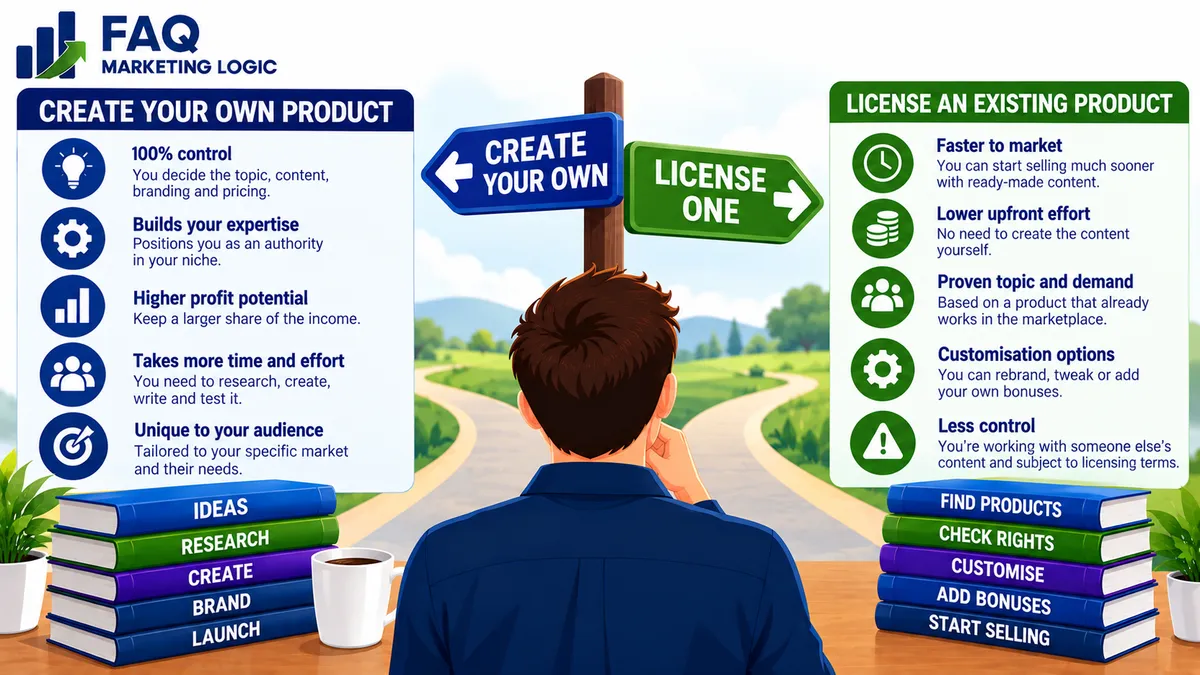
Creating your own gives you complete control over the subject, positioning, content and customer experience.
Licensing can remove much of the initial creation work and let you concentrate on packaging, positioning and marketing.
The important question isn't:
"Which method is better?"
It's:
"Which method makes the most sense for the business I'm trying to build?"
REAL TALK
Product creation can sound exciting until you're six weeks into writing a 150-page guide that still isn't ready to sell.
Licensing can sound easier until you discover you've bought a product that dozens of other people are selling in exactly the same form.
Both approaches have advantages.
Both have weaknesses.
And both still require you to understand the customer.
A poor product doesn't become a good business simply because you created it yourself.
And a licensed product doesn't automatically become profitable simply because somebody else did the creation work.
The product is only part of the business.
Key Definition: What Is Product Licensing?
Product licensing is an arrangement that gives you specified rights to use, sell or otherwise commercially exploit a product created by someone else.
The exact rights depend on the licence.
Depending on the product and agreement, you might be allowed to:
Sell the product
Rebrand it
Edit the content
Bundle it with other products
Use parts within another product
Give it away
Sell certain rights to other people
But you should never assume you have a particular right.
The licence determines what you can and cannot do.
What Does Creating Your Own Product Involve?
Creating your own product usually means developing the underlying material yourself.
That might be:
An Ebook
A Guide
A Course
A Workbook
A Template Pack
A Membership Resource
A Video Training Programme
A Collection Of Tools
You decide:
Who it's for
What problem it solves
What it includes
How it's structured
What it's called
How it's positioned
How much it costs
That control can be valuable.
But it comes with responsibility.
You need to create something people actually want.
What Are The Advantages Of Creating My Own Product?
The biggest advantage is control.
You can build the product around a specific audience and problem.
You can decide exactly what information is included and how it's presented.
You can also create a product that reflects your own:
Knowledge
Experience
Methods
Examples
Frameworks
Brand
That can make differentiation easier.
If competitors can't offer exactly the same product, you're not competing solely on packaging or price.
What Are The Disadvantages Of Creating My Own Product?
The obvious disadvantage is time.
Even a relatively simple digital product can require:
Research
Planning
Outlining
Writing
Editing
Design
Formatting
Technical Setup
Testing
And that's before you've marketed it.
Product creators sometimes spend months building something before discovering whether enough people actually want it.
That's why validation matters.
You don't want product creation to become a way of postponing the moment when you have to test whether somebody will buy.
What Are The Advantages Of Licensing A Product?
Licensing can dramatically reduce the amount of product development required.
Instead of starting with:
"What should I create?"
you may start with:
"How can I turn this existing product into an offer for my audience?"
That can save time.
It may also let you enter a market where you understand the customer but don't want to create every component yourself.
Depending on the licence, you might be able to:
Rebrand the product
Change the positioning
Add bonuses
Improve the packaging
Combine it with your own material
Sell it as part of a larger offer
That makes licensing potentially much more than simply reselling somebody else's file.
What Are The Disadvantages Of Licensing?
The main limitation is that you don't automatically control the underlying rights.
Your licence might restrict:
Editing
Rebranding
Pricing
Distribution
Bundling
Resale rights
Where you can sell
What claims you can make
Another issue is differentiation.
If 100 other marketers have exactly the same product with exactly the same rights, simply uploading it to a sales page may not give customers much reason to buy from you.
That's why the quality of both the product and the licence matters.
Licensing Doesn't Mean Selling Something Unchanged
One of the biggest mistakes with licensed products is assuming:
"Someone else created it, so my work is finished."
Often, that's where your work begins.
Where the licence permits it, you may be able to improve:
The Title
Branding
Positioning
Design
Examples
Bonuses
Sales Message
Target Audience
Customer Experience
The underlying product may give you a head start.
Your job is to turn that asset into an offer that makes sense for your market.
If you'd like to understand the licensing model itself before deciding whether it suits you, you can explore the Product Licensing Formula approach through the relevant FAQ Marketing Logic offer page.
Start With The Customer, Not The Production Method
Suppose you've identified an audience struggling with a specific problem.
You could ask:
"What product should I create?"
But a better question is:
"What would help this customer solve the problem?"
Once you know that, you can decide whether the best solution is:
Something you create yourself
Something you license
Something you outsource
A combination of all three
The customer doesn't necessarily care how the product came into existence.
They care whether it helps them achieve the result they want.
How Much Expertise Do I Have?
Creating your own product can make sense when you already have useful knowledge or experience.
Perhaps you've:
Solved the problem yourself
Worked in the industry
Developed a method
Helped customers with the issue
Researched the subject deeply
You already have raw material.
If you're entering a market where you understand the customer but don't have enough expertise to create the complete solution, licensing may offer another route.
But licensing shouldn't be used to pretend you have expertise you don't possess.
You still need to understand what you're selling well enough to represent it responsibly.
How Quickly Do I Want To Get To Market?
Speed can be an important factor.
If you create a substantial product from scratch, development might take weeks or months.
A suitable licensed product could potentially shorten that process.
But don't confuse:
faster product acquisition
with:
instant business.
You still need:
An Offer
Positioning
Sales Copy
Payment Processing
Customer Support
Traffic
Follow-Up
Licensing can shorten one part of the journey.
It doesn't remove everything else.
What Is My Budget?
Both routes can involve costs.
Creating your own product may require money for:
Design
Software
Editing
Video Production
Research
Outsourcing
Licensing may involve:
Licence Fee
Product Acquisition Cost
Rebranding
Editing
New Graphics
Sales Materials
Don't compare:
"Creating is free"
with:
"Licensing costs money."
Your own time has value too.
Compare the complete cost of getting each option ready to sell.
How Important Is Exclusivity?
If differentiation is important, creating your own product has an obvious advantage.
Nobody else automatically has your exact product.
With licensing, exclusivity depends on the agreement.
Some licences may be:
Widely available
Limited to a certain number of buyers
Restricted by market
Exclusive
Those differences can significantly affect the value of the licence.
A widely available product isn't necessarily useless.
It simply means your positioning and packaging become more important.
Can I Combine Both Approaches?
Absolutely.
This is often overlooked.
You don't have to build a business that is 100% original products or 100% licensed products.
You might:
Create your main product and license bonuses
License a core product and add your own workbook
Add your own videos to licensed written content
Create a course using licensed supporting resources
Combine several properly licensed assets into a broader solution where the licences allow it
This can give you some of the speed of licensing while still creating a more distinctive offer.
Check The Product Before You Check The Licence
Generous rights don't make a bad product valuable.
Before becoming excited about what you're allowed to do with something, ask whether you'd actually want to sell it.
Review:
Content Quality
Accuracy
Relevance
Presentation
Customer Usefulness
Age Of Information
Editing Required
If you wouldn't feel comfortable putting your business name behind the product, the licence isn't the main problem.
The product is.
Then Check The Licence Carefully
Once you're satisfied with the product, understand the rights.
Don't rely solely on promotional phrases such as:
"Full rights included."
What does "full rights" actually mean?
Check the licence itself.
Look for answers to questions such as:
Can I edit it?
Can I rebrand it?
Can I sell it?
Can I give it away?
Can I bundle it?
Can I sell resale rights?
Are there pricing restrictions?
Are there platform restrictions?
Are there geographical restrictions?
Are there restrictions on transferring rights?
If anything important is unclear, get clarification before building your business around it.
Think About The Offer, Not Just The Product
Two businesses can sell very similar underlying information with very different results.
Why?
Because the offer surrounding the product can be different.
One may have:
Clearer Positioning
Better Bonuses
Stronger Proof
Better Sales Copy
Better Customer Support
More Relevant Audience
Better Follow-Up
This matters whether the product is original or licensed.
Customers buy an offer, not simply a folder of digital files.
Don't Spend Months Creating Before Testing Demand
Creating your own product can become a trap if you assume the product must be finished before you learn whether anybody wants it.
You can often test:
Topic
Problem
Positioning
Price Range
Customer Interest
before building the complete product.
Likewise, don't buy an expensive licence simply because the sales page convinces you that the product has enormous potential.
First ask whether your audience has demonstrated interest.
Practical Example
Imagine you've identified an audience of people who want to start a membership business.
Option One: Create Your Own Product
You could develop a complete guide yourself.
You research the topic, create the framework, write the lessons, build worksheets and package everything.
The result is entirely yours.
But it may take several weeks to finish.
Option Two: License A Product
You find a high-quality existing membership guide with suitable commercial rights.
The licence allows you to edit and rebrand it.
You update sections, change the positioning, add your own checklist and create new graphics.
You could potentially reach the market faster.
Option Three: Combine The Two
You license the core written guide but create your own implementation workbook and video walkthrough.
Now you're using licensing to reduce development time while adding original elements to make the offer more distinctive.
The best option depends on your resources and objectives.
Common Mistakes
Mistake: Assuming original products are automatically better.
Fix: Judge the product by how effectively it solves the customer's problem.
Mistake: Assuming licensed products require no work.
Fix: Expect to spend time reviewing, positioning, packaging and marketing the product.
Mistake: Buying licences based only on the rights offered.
Fix: Evaluate the underlying product first.
Mistake: Ignoring licence restrictions.
Fix: Read and understand the actual licence before using the product.
Mistake: Creating for months without validating demand.
Fix: Look for evidence of customer interest before investing heavily in development.
Mistake: Selling widely available licensed content completely unchanged.
Fix: Where the licence permits, improve the positioning, packaging or supporting materials.
FAQ QUICK FIX
Can't decide whether to create or license?
Use these four questions:
1. Do I already have the knowledge to create a strong product?
If yes, creating may be practical.
2. How quickly do I want to reach the market?
If speed matters, suitable licensing may shorten development.
3. How important is having a completely distinctive product?
If it's central to your positioning, creating your own may give you more control.
4. Is there already a high-quality licensed product that solves the problem?
If yes, compare the cost and effort of licensing it with creating your own version.
You're not choosing the "correct" method.
You're choosing the method that best fits this particular product opportunity.
FAQ
Is It Better To Create My Own Digital Product?
Not automatically. Creating gives you greater control and ownership, but it generally requires more development work. The best option depends on your resources, audience and objectives.
Is Product Licensing The Same As PLR?
Not necessarily. Licensing is a broad concept covering permission to use intellectual property under specified terms. PLR is a particular rights model commonly used with digital content.
Can I Change A Licensed Product?
Only if the licence allows you to. Never assume editing or rebranding rights are included.
Can I Put My Name On A Licensed Product?
That depends entirely on the licence. Some allow rebranding or authorship changes; others do not.
Is Licensing Faster Than Creating A Product?
It can significantly reduce product-development time when you find a suitable existing product, but you may still need to review, edit, package and market it.
Can I Sell Both Original And Licensed Products?
Yes. A business can use both approaches, provided every licensed product is used within the rights granted.
TRY THIS TODAY
Take the next product idea you're considering and divide a page into two columns.
On one side write:
CREATE
On the other:
LICENSE
Compare each option against:
Development Time
Cost
Your Expertise
Product Quality
Control
Differentiation
Speed To Market
Editing Required
Customer Demand
Marketing Requirements
Don't automatically choose whichever looks easiest.
Choose the route that gives you the strongest realistic path from:
Customer Problem → Useful Product → Sellable Offer
RELATED ARTICLES
→ What Should I Look For Before Licensing A Digital Product?
→ Can I Sell Digital Products I Didn't Create Myself?
→ How Do I Know If A Digital Product Is Worth Selling?
QUICK RECAP
Creating and licensing are both valid ways to build a digital product business.
Creating gives you greater control and differentiation.
Licensing can reduce development time.
Neither removes the need to understand your customer.
Evaluate product quality before becoming excited about licensing rights.
Read the licence carefully.
Consider the complete cost, including your time.
Don't assume licensed products can be modified.
Validate demand before making a large investment.
Remember that packaging and positioning still matter.
You can combine original and licensed material when the rights allow it.
The real decision isn't simply:
Create or license?
It's:
Which route gives me the best way to put a genuinely useful offer in front of the right customer?
NEXT STEP
If licensing looks like the better route, the next step is understanding exactly how the model works before acquiring a product.
→ What Is Product Licensing And How Does It Work?
Want A Faster Route To Having A Product To Sell?
Creating every product from scratch isn't the only way to build a digital product business.
Product licensing can give you access to products that have already been created, allowing you to focus more of your effort on turning them into offers and getting them in front of customers.