How Do I Know If A Digital Product Is Worth Selling?
TL;DR
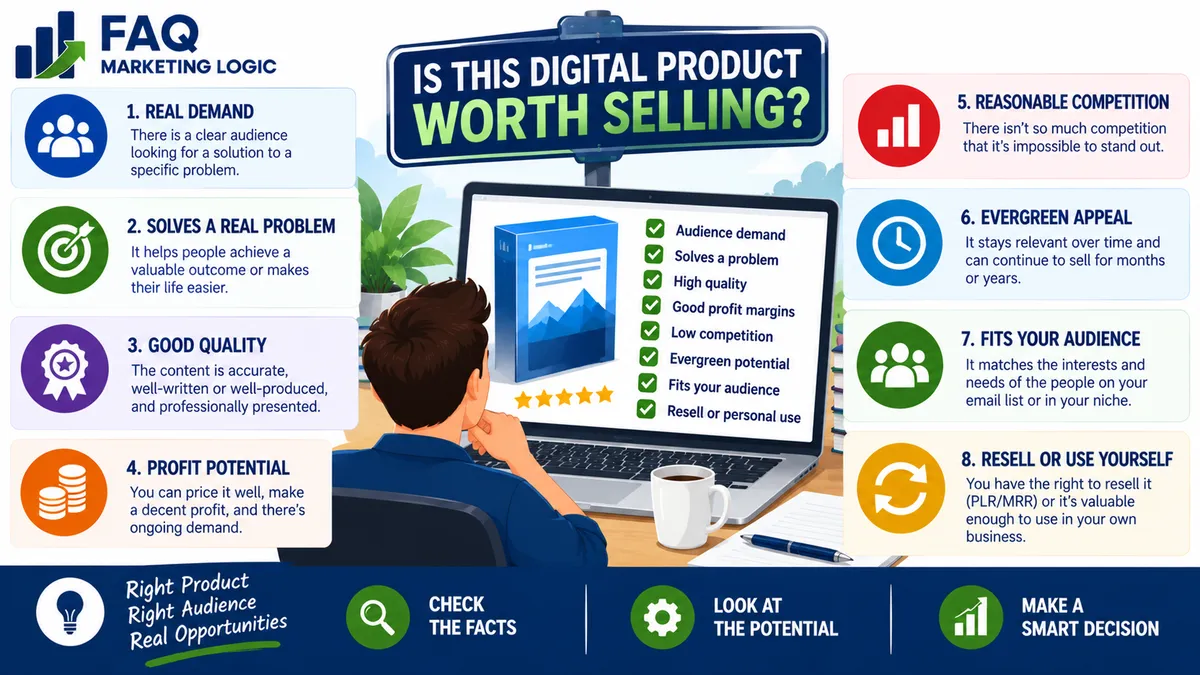
A digital product is worth selling when it solves a real problem for a clearly identifiable audience, provides enough value to justify its price and can be delivered profitably without creating unnecessary complexity.
Don't judge an idea simply because you like it or because similar products already exist.
Look for evidence of demand, usefulness, differentiation, realistic pricing and a practical way to reach potential customers.
You don't need absolute certainty before launching. But you should have enough evidence to justify testing the idea with real people before investing heavily in it.
IN SHORT
Coming up with a digital product idea is easy.
Deciding whether it's worth turning into a business is harder.
You might have an idea for:
An ebook
A Course
A Template Pack
A Checklist
A Membership
A Toolkit
A Workshop
A Digital Resource
The temptation is to start creating immediately.
But before spending weeks producing it, ask:
Does anybody actually want this?
More importantly:
Do they want it enough to take action or pay for a solution?
That's the question that matters.
REAL TALK
A product can be beautifully designed, packed with information and technically excellent...
...and still make very few sales.
Why?
Because product quality and market demand are different things.
Creating something good doesn't automatically mean people want it.
That's why one of the smartest things you can do before creating a digital product is look for evidence that the problem exists and people care about solving it.
You're not trying to prove the product will definitely succeed.
You're trying to reduce the amount of guessing involved.
Key Definition: What Makes A Digital Product Worth Selling?
A digital product is potentially worth selling when there is a reasonable match between:
Audience + Problem + Solution + Value + Reach
In other words:
You can identify who it's for.
Those people have a recognisable problem, need or desire.
The product provides a useful solution.
The perceived value can support a viable price.
You have a realistic way to reach potential customers.
If one of those elements is missing, the product may become much harder to sell.
Start With The Problem, Not The Product
Instead of beginning with:
"I want to create an ebook."
start with:
"What problem am I helping somebody solve?"
The format comes later.
Suppose people repeatedly struggle with planning their first email sequence.
The solution might eventually become:
A Guide
A Template Pack
A Video Course
A Workshop
A Checklist
The opportunity isn't the PDF or video.
The opportunity is the problem people want help solving.
Is The Problem Important Enough?
Not every problem needs a paid solution.
Some are minor inconveniences.
Others create:
Frustration
Lost time
Lost money
Confusion
Uncertainty
Missed opportunities
Repeated mistakes
Generally, the more meaningful the problem is to the customer, the easier it becomes to demonstrate value.
That doesn't mean your product needs to solve a life-changing problem.
A $9 template doesn't need to transform somebody's life.
But it should provide enough useful value to justify spending $9 rather than continuing without it.
Price and problem should make sense together.
Are People Already Looking For Solutions?
Existing demand can appear in many places.
Look at:
Google searches
Questions in online communities
YouTube searches and comments
Forums
Quora
Reviews
Competitor products
Books
Courses
Social media discussions
Questions from your own audience
Pay particular attention to repeated questions.
If lots of people keep asking:
"How do I...?"
"What's the best way to...?"
"Why isn't... working?"
"What should I do when...?"
you may have found a useful problem to investigate.
Is Competition A Bad Sign?
Not necessarily.
Beginners sometimes look for markets with no competition.
That can be risky.
No competition might mean you've discovered an untouched opportunity.
But it could also mean:
Nobody wants the product.
Existing competition can demonstrate that people already spend money solving the problem.
The better question is:
Can I create a useful reason for someone to choose my solution?
That reason could be:
Simpler explanation
Different audience
Better organisation
Different format
More convenient solution
Stronger support
Better positioning
More focused outcome
You don't always need a completely original idea.
You need a useful offer for a recognisable audience.
Can You Describe The Customer Clearly?
Try completing this sentence:
"This product is for __________ who want to __________."
Compare:
"This is for people interested in marketing."
with:
"This is for small online business owners who want to write their first five-email welcome sequence."
The second gives you much more information.
You can begin thinking about:
What they already know
What they struggle with
What they need
What language they use
Where they might be found
What the product should contain
If you can't identify the customer, marketing becomes much harder.
Does The Product Promise A Clear Outcome?
People generally find specific outcomes easier to understand than collections of information.
Compare:
"Everything I Know About Email Marketing"
with:
"How To Create Your First Welcome Email Sequence."
The first describes information.
The second describes progress.
A strong digital product helps the customer move from:
Where I am now
to:
Where I want to be.
The clearer that movement is, the easier it becomes to explain why the product exists.
Would Someone Pay For The Solution?
Interest isn't the same as buying intent.
Someone might happily read a free article about a subject but never consider purchasing a $97 course about it.
Look for stronger evidence where possible.
That could include:
Existing paid products
Customers buying related solutions
Paid books or courses
Successful services addressing the same problem
People asking for recommendations
Your own previous sales
Requests from your audience
Ultimately, the strongest validation is somebody actually paying for the solution.
Until that happens, you're still working with evidence rather than certainty.
Does The Product Need To Be Completely Original?
No.
Very few useful products are based on ideas nobody has encountered before.
People already sell:
Recipe books
Fitness programmes
Business courses
Writing guides
Templates
Photography training
Craft tutorials
The existence of similar products doesn't automatically remove the opportunity.
Your job is to decide how your product will be useful to your particular customer.
Originality can come from:
Your approach
Your organisation
Your examples
Your audience
Your process
Your presentation
Your combination of ideas
You don't need to reinvent the subject.
Is The Product Good Enough?
Demand alone isn't enough.
If you're going to put your name or business behind a digital product, review its quality.
Ask:
Does it deliver what it promises?
Is it accurate?
Is it easy to use?
Is the information reasonably current?
Is anything important missing?
Is there unnecessary filler?
Can the customer understand what to do?
Would I be satisfied if I'd paid for it?
This applies whether you create the product yourself or acquire the rights to an existing product.
A marketable idea attached to a poor product is not a strong foundation.
Can You Reach The People Who Might Buy It?
A great product with no route to potential customers can still struggle.
Think about distribution before creating the product.
Could you reach the audience through:
Search engines
Email
Affiliates
Partnerships
Paid advertising
Communities
Content marketing
Social media
Existing customers
You don't necessarily need an audience already.
But you do need a plausible way of getting the offer in front of one.
Can You Sell It At A Sensible Price?
A viable price needs to work for both the customer and the business.
Consider:
Value of the problem solved
Competing alternatives
Product depth
Customer expectations
Marketing costs
Payment fees
Affiliate commissions
Support requirements
Refunds
Ongoing costs
A digital product might cost very little to deliver to an additional customer, but acquiring that customer may still cost money.
Don't confuse:
low delivery cost
with:
pure profit.
How Much Work Will The Product Create After The Sale?
Some digital products are relatively simple to deliver.
Others require considerable ongoing support.
For example, a downloadable template pack may need little customer assistance.
A complex software product could create:
Technical questions
Updates
Compatibility issues
Customer support
Development costs
Think beyond creating the product.
Ask:
"What happens when 100 people buy this?"
If that thought immediately creates an operational nightmare, the offer may need simplifying.
Can You Test The Idea Before Creating Everything?
Often, yes.
This is one of the best ways to reduce risk.
Depending on the product, you might:
Talk to potential customers
Survey an audience
Create a waiting list
Build a simple sales page
Run a small promotion
Offer a pilot version
Pre-sell where appropriate
Deliver the first version live
The aim is to gather evidence before investing heavily in production.
You don't need a 100-page ebook to discover whether anybody is interested in the subject.
What If I Don't Want To Create The Product Myself?
Creating from scratch isn't the only option.
Depending on your business, you could potentially:
License an existing product
Acquire suitable commercial rights
Partner with a creator
Commission specialists
Use properly licensed content as a starting point
The same evaluation still applies.
A ready-made product isn't worth selling merely because it's ready-made.
You still need to assess:
quality + audience + demand + rights + value + market fit.
Practical Example
Suppose you're considering creating a $27 guide called:
How To Create Your First Lead Magnet
Before writing it, you investigate.
You discover:
Beginners regularly search for lead magnet ideas.
People ask how to create them in online communities.
Other businesses sell lead magnet templates and courses.
Your own audience has asked questions about list building.
You already have several articles attracting readers interested in email marketing.
That's useful evidence.
You then speak to several potential customers and discover their biggest problem isn't understanding what a lead magnet is.
It's deciding:
what to create and how much information to include.
Now the product becomes more focused:
Create Your First Lead Magnet: From Idea To Finished Free Report
You haven't proved it will sell thousands of copies.
But you've moved from:
"I think this might be a good idea."
to:
"I have several pieces of evidence that this solves a real problem."
That's a much better place to start.
Common Mistakes
Mistake: Creating the product before investigating demand.
Fix: Look for evidence of the problem before investing heavily in production.
Mistake: Assuming competition means the market is overcrowded.
Fix: Study what existing competition tells you about demand and possible positioning.
Mistake: Trying to create something completely original.
Fix: Concentrate on making the solution useful and relevant to a defined audience.
Mistake: Choosing the format before understanding the problem.
Fix: Identify what customers need first, then choose the most appropriate format.
Mistake: Confusing interest with willingness to buy.
Fix: Look for commercial evidence and test the offer with real prospects where possible.
Mistake: Ignoring how you'll reach customers.
Fix: Think about distribution before spending months creating the product.
FAQ QUICK FIX
Before creating or acquiring a digital product, ask:
Who is it for?
What problem does it solve?
How important is that problem?
What evidence shows people want a solution?
Are people already paying for similar solutions?
Why might somebody choose this product?
Can I reach the intended audience?
Can I sell it at a viable price?
Can I deliver and support it sensibly?
Can I test the idea before investing heavily?
You don't need ten perfect answers.
But the more evidence you have, the less you're relying on guesswork.
FAQ
How Do I Know If People Will Buy My Digital Product?
You can't know with complete certainty before selling it. Research can identify promising demand, but actual purchases provide the strongest validation.
Should I Create A Product If There Are Already Similar Products?
Potentially, yes. Existing products can demonstrate demand. Look for a clear audience, useful positioning or another way to make your offer relevant.
How Big Does A Market Need To Be?
There is no universal minimum. A small specialised market can support a product if enough suitable customers can be reached profitably.
Should I Choose A Product Based On Search Volume?
Search demand can be useful evidence, but it shouldn't be your only evidence. Some products sell through email, communities, referrals or partnerships rather than search engines.
Does A Digital Product Need To Solve A Big Problem?
No. The value of the solution should make sense relative to the price and commitment you're asking from the customer.
Should I Create The Product Before Building The Sales Page?
Not necessarily. Outlining the offer and writing a basic sales message first can reveal whether you can clearly explain the product's audience, problem, benefits and outcome.
TRY THIS TODAY
Take one digital product idea you're considering and write these five headings:
Customer
Problem
Solution
Evidence
Route To Market
Give yourself no more than three sentences under each.
If one heading is difficult to complete, don't immediately abandon the idea.
That's the area that needs more research.
This simple exercise can reveal whether you're looking at a genuine opportunity or simply an idea you happen to like.
RELATED ARTICLES
→ How Do I Validate An Online Business Idea Before Building It?
→ What Makes An Online Offer Simple Enough To Launch?
→ How Do I Turn Skills Into A Sellable Offer?
QUICK RECAP
A digital product is potentially worth selling when there is a sensible match between the product and the market.
Start with a problem, not a format.
Identify exactly who the product is for.
Look for evidence that people care about solving the problem.
Don't automatically fear competition.
Make the desired outcome easy to understand.
Look for evidence that people pay for similar solutions.
Make sure the product itself is good enough.
Know how you'll reach potential buyers.
Consider pricing and profitability.
Think about support and delivery after the sale.
Test the idea before investing heavily where possible.
You can't remove every risk from launching a product.
But you can replace a surprising amount of guesswork with evidence.
NEXT STEP
Once you've found a digital product idea that appears worth pursuing, the next step is testing whether people are genuinely interested before you spend too much time creating it.