What Should I Look For Before Licensing A Digital Product?.
TL;DR
Before licensing a digital product, don't judge it simply by how quickly you could start selling it.
Check the product quality, licence terms, permitted uses, restrictions, target market, sales potential, existing marketing materials and level of competition.
Most importantly, make sure you understand exactly what rights you're buying.
A good product with the wrong licence may be useless for your intended business. A flexible licence attached to a poor-quality product isn't much better.
The goal is to find a product that is worth selling and gives you the rights you need to sell it properly.
IN SHORT
Licensing an existing digital product can remove one of the biggest obstacles to starting or expanding an online business:
Creating the product yourself.
Instead of spending weeks or months writing a guide, recording a course or developing another digital product, you may be able to acquire commercial rights to something that already exists.
But that doesn't mean every licensing opportunity is worth taking.
Before paying for a licence, you need to answer two separate questions:
Is this a good product?
and:
Does the licence allow me to use it the way I intend?
You need satisfactory answers to both.
REAL TALK
It's easy to become excited by a ready-made product.
The sales page tells you the hard work has already been done.
There's a product.
There may be graphics.
There may even be sales copy and promotional materials.
It can look like a business in a box.
But you're not really buying convenience.
You're acquiring specific rights to a commercial asset.
If you don't understand those rights, you could discover afterwards that you can't edit the product, change the branding, sell it through your preferred platform or use it in the way you'd planned.
That's why the licence deserves just as much attention as the product.
Key Definition: What Does Licensing A Digital Product Mean?
Licensing a digital product means obtaining permission from the rights holder to use, distribute, sell, modify or otherwise commercially exploit a digital product according to agreed terms.
Those rights can vary considerably.
A licence might allow you to:
Sell the product
Keep some or all of the sales revenue
Rebrand it
Edit the content
Bundle it with other products
Use parts of it elsewhere
Offer it as a bonus
Sell it through particular channels
Pass certain rights to your customers
Another licence may prohibit several of those things.
That's why the word licence by itself tells you very little.
You need to know what the particular licence permits.
If you'd like to explore how acquiring rights to existing products can become part of an online business, you can explore the product licensing approach here.
Is The Product Actually Good Enough To Sell?
Start with the product itself.
Don't let the licence distract you from the thing customers will eventually receive.
Ask:
Is the information useful?
Is it accurate?
Is it reasonably current?
Is it well organised?
Is it easy to understand?
Does it solve a recognisable problem?
Would I be comfortable selling it under my business name?
Whenever possible, review the complete product before acquiring the licence.
If you wouldn't be happy buying it as a customer, think carefully before selling it to one.
Does The Product Solve A Clear Problem?
A product becomes easier to position when you can clearly explain what it helps the customer do.
Compare:
"A 75-page guide to online marketing."
with:
"A beginner's guide to setting up your first email follow-up sequence."
The second has a much clearer purpose.
Before licensing a product, try completing this sentence:
"This product helps _________ to _________."
If you struggle to fill in those blanks, you may also struggle to market it.
Is There A Market For The Product?
A polished product isn't automatically a commercially useful product.
Some subjects have little buyer demand.
Others have plenty of demand but enormous competition.
Look for evidence that people are interested in the problem.
You might examine:
Search queries
Existing products
Online communities
Questions people repeatedly ask
Competitor offers
Reviews of similar products
Social media discussions
Your own customer questions
Your existing email audience
You don't necessarily need an untouched market.
Competition can demonstrate that people spend money in the market.
What matters is whether you can identify a realistic audience and a reason for them to consider your offer.
What Rights Does The Licence Actually Give Me?
This is one of the most important checks.
Read the licensing agreement rather than relying only on the promotional page.
Find out whether you can:
Sell the product
Change the title
Change the author's name
Edit the content
Add your branding
Remove existing branding
Create derivative products
Include it in bundles
Use it as a bonus
Sell it through marketplaces
Offer discounts
Give it away
Include it in a membership
Transfer resale rights to customers
Don't assume a permission exists because another licensed product included it.
Every licence can be different.
Are There Any Pricing Restrictions?
Some licences specify how the product can be priced.
For example, there may be:
A minimum selling price
A recommended price
Restrictions on discounting
Rules about giving the product away
Restrictions on auction or marketplace sites
These conditions can affect your marketing strategy.
If your plan is to use the product as a free lead magnet but the licence prohibits free distribution, it isn't suitable for that purpose.
The question isn't merely:
"Can I sell this?"
It is:
"Can I sell and market this in the way my business requires?"
Is The Licence Exclusive?
Don't assume that licensing means exclusivity.
A product may be licensed to:
One business
A limited number of businesses
Hundreds of businesses
An unlimited number of buyers
None of those arrangements is automatically good or bad.
They simply create different circumstances.
If many other businesses can sell exactly the same product, differentiation becomes more important.
You may need to compete through:
Positioning
Branding
Bonuses
Customer service
Audience
Marketing
Packaging
Additional value
If exclusivity matters to your strategy, make sure it is specifically included in the agreement.
Can I Change And Rebrand The Product?
This can make a substantial difference.
If editing is permitted, you might be able to:
Update outdated sections
Add examples
Improve the design
Change the title
Add your own introduction
Remove irrelevant material
Adapt it for a narrower audience
Add complementary resources
But don't make those changes unless the licence allows them.
Owning a licence to sell something doesn't automatically mean you own the underlying copyright or have unrestricted editing rights.
Is The Product Up To Date?
Digital products can age quickly.
This is particularly important with subjects involving:
Software
Social media platforms
Search engines
Advertising
Technology
Online marketing
Regulations
Tools and services
A product might look professionally produced while teaching processes that stopped working several years ago.
Check:
Screenshots
Recommended tools
External links
Platform instructions
Statistics
Examples
Terminology
References to laws or regulations
If the licence allows editing, outdated sections might be fixable.
If editing isn't permitted, an outdated product could be difficult to use.
What Marketing Materials Are Included?
Some licensing arrangements include more than the product.
You may receive:
Sales page copy
Email promotions
Product graphics
Social media material
Banner advertisements
Lead magnets
Upsell material
Promotional videos
These can save time.
But treat them as starting assets rather than automatically assuming they're ready to use.
Read the copy.
Check the claims.
Make sure the marketing accurately represents the product.
And confirm that the licence allows you to use those materials.
Can I Sell The Product Through My Preferred Platform?
This is easy to overlook.
A licence might allow general resale while restricting particular marketplaces, auction sites or distribution methods.
Before buying, consider where you intend to sell:
Your own website
Email
Sales funnels
Membership areas
Third-party marketplaces
Affiliate platforms
Bundles
Then check that the licence supports your intended distribution method.
It's much easier to discover a restriction before you buy than after you've built the sales process.
Who Provides Customer Support?
This matters more than many buyers realise.
If your customer has a problem, who deals with it?
With many licensed products, you are the seller.
That could mean you're responsible for:
Customer questions
Download problems
Refunds
Payment queries
Product access
Complaints
Understand what responsibilities come with the licence as well as what rights it provides.
Can Other People Sell The Same Product?
Often, yes.
This is especially common with PLR, resale rights and non-exclusive licensing arrangements.
That isn't necessarily a reason to reject the product.
But you should investigate how widely it is already being sold.
Search for:
The product title
Distinctive phrases from the sales page
Product images
Author or creator names
If dozens of identical versions appear everywhere at heavily discounted prices, think about how you would differentiate yours.
Sometimes the answer is rebranding.
Sometimes it's adding value.
And sometimes the sensible decision is simply to look for another product.
Does The Product Fit My Existing Business?
A licensing opportunity doesn't need to become a completely separate business.
It could complement something you already sell.
For example, a licensed product might become:
A front-end product
A bonus
An upsell
Part of a bundle
A membership resource
An additional product for existing customers
This can be particularly useful when the product solves the next problem your customers encounter.
Instead of asking only:
"Can I make money selling this?"
also ask:
"Where would this fit within the business I'm already building?"
Practical Example
Imagine you find a licensed course teaching beginners how to create simple digital graphics.
The product looks good and the subject fits your audience.
Before buying the licence, you investigate further.
You discover:
The training is current.
You can change the branding.
You can edit the lessons.
You can sell it from your own website.
You can include your own bonuses.
You cannot give the main course away free.
You cannot pass resale rights to your customers.
The licence is non-exclusive.
Now you can make an informed decision.
Perhaps your plan was to sell the course for $47 with a collection of your own templates as a bonus.
The licence supports that model.
But if your plan had been to give the course away as a lead magnet, the same licence wouldn't work.
The product hasn't changed.
Your intended use determines whether the licence is suitable.
Common Mistakes
Mistake: Buying because the product looks impressive.
Fix: Review the actual content and decide whether you'd be comfortable selling it to your customers.
Mistake: Assuming all licences provide similar rights.
Fix: Read the individual licence before buying.
Mistake: Ignoring restrictions.
Fix: Compare the licence terms directly with your intended marketing and distribution plan.
Mistake: Assuming licensed means exclusive.
Fix: Check whether other businesses can license and sell the same product.
Mistake: Buying without checking demand.
Fix: Look for evidence that the problem and market exist before acquiring the product.
Mistake: Using supplied marketing materials without reviewing them.
Fix: Check every claim and make sure the promotional material accurately represents what you're selling.
FAQ QUICK FIX
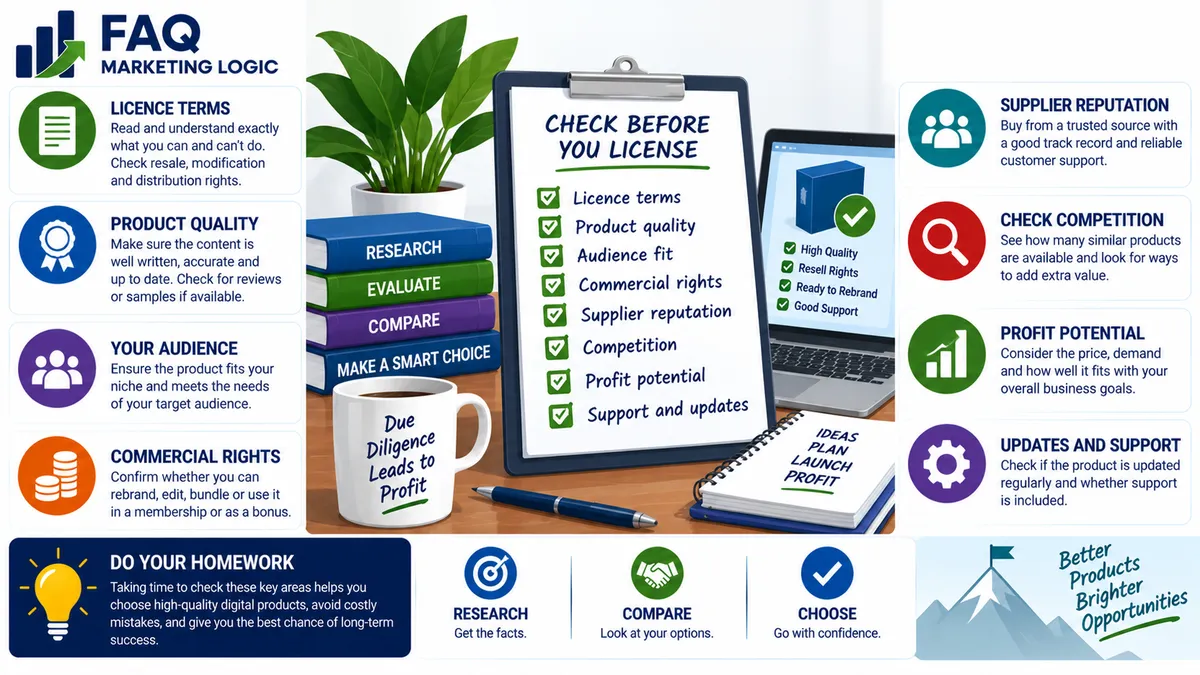
Before licensing any digital product, use this simple checklist:
Product: Is it genuinely good?
Problem: Does it solve something people care about?
Market: Can I identify potential buyers?
Rights: Exactly what am I allowed to do?
Restrictions: What am I prohibited from doing?
Competition: Who else can sell it?
Rebranding: Can I change or improve it?
Marketing: What promotional assets are included?
Distribution: Can I sell it through my preferred channels?
Fit: Does it make sense within my business?
If you can't answer one of those questions, investigate it before paying for the licence.
FAQ
Should I Read The Entire Licence Before Buying?
Yes. The licence defines what you can and cannot do with the product. Don't rely solely on a summary in the sales copy.
Is An Exclusive Product Licence Always Better?
No. Exclusivity can reduce direct competition, but it may also cost considerably more. Whether it matters depends on your business model and how you intend to position the product.
Can I Change A Licensed Digital Product?
Only if the licence gives you permission. Some licences allow extensive editing and rebranding, while others permit resale of the original product only.
Can I Sell A Licensed Product Under My Own Name?
Possibly, but don't assume you can. Check whether the licence allows rebranding, attribution changes or claiming authorship.
Can I Put A Licensed Product Into A Membership?
Only if the licence permits membership distribution. The right to sell a product individually doesn't necessarily include the right to place it inside a membership.
Should I Get Legal Advice Before Signing A Product Licence?
For significant commercial licensing agreements, particularly where substantial money, exclusivity, intellectual property or ongoing obligations are involved, professional legal advice may be sensible.
TRY THIS TODAY
If you're considering a licensing opportunity, create two columns.
In the first, write:
WHAT I WANT TO DO WITH THE PRODUCT
List everything you intend to do:
Rebrand it
Edit it
Sell it
Bundle it
Add bonuses
Promote it through email
Include it in a membership
Sell through particular platforms
In the second, write:
LICENCE ALLOWS THIS?
Then check the agreement one item at a time.
Don't proceed on assumptions.
By the end, you should be able to see whether the licence actually matches your business plan.
Want To Sell Digital Products Without Creating Everything Yourself?
Licensing can give you a faster route to product ownership, but knowing which products to consider and which rights you need makes a huge difference.
Product Licensing Formula explores how product licensing works and how existing products can become part of an online business.
→ Discover How Product Licensing Works
RELATED ARTICLES
→ What's The Difference Between PLR And Product Licensing?
→ Can I Sell Digital Products I Didn't Create Myself?
→ Should I Start With Services Or Digital Products?
QUICK RECAP
Before licensing a digital product:
Check the quality of the actual product.
Make sure it solves a recognisable problem.
Look for evidence of a potential market.
Read the complete licensing terms.
Understand exactly what you're allowed to do.
Check pricing and distribution restrictions.
Find out whether the licence is exclusive or non-exclusive.
Confirm whether you can edit and rebrand the product.
Investigate how widely it is already being sold.
Review any supplied marketing materials.
Make sure the product fits your existing business.
Don't license something simply because it saves you the work of creating a product.
Look for the combination of a useful product + suitable commercial rights + a realistic market.
NEXT STEP
Once you understand what to check before acquiring a licence, it's worth understanding the licensing model itself and how the rights work.