What Is Product Licensing And How Does It Work?
TL;DR
Product licensing allows you to obtain permission to sell, distribute or use a product created by somebody else under an agreed set of terms.
For an online business owner, this can provide an alternative to creating every digital product from scratch. Depending on the licence, you may be able to sell an existing product, package it with other resources, modify it or market it under particular conditions.
The important part is understanding exactly what the licence allows you to do before you start selling.
IN SHORT
Creating a digital product yourself can take considerable time.
You need an idea, research, content, design, packaging, sales materials and a way to deliver it.
Product licensing offers another route.
Instead of starting with a blank page, you acquire certain rights to an existing product and build your offer around those rights.
However, licensing is not simply a case of buying a product and doing whatever you want with it. The licence determines what you can and cannot do.
REAL TALK
There's a common assumption that if you want to sell digital products, you have to create everything yourself.
You don't.
Creating your own products certainly has advantages, particularly when you want complete control over the content and intellectual property. But it isn't the only way to become a product owner.
Businesses have licensed products, brands, technology and intellectual property for decades.
The same basic principle can also be applied to information and digital products.
That can make product licensing particularly interesting for someone who wants to build a product-based business but doesn't necessarily want to spend weeks or months creating every product from the ground up.
Key Definition: What Is Product Licensing?
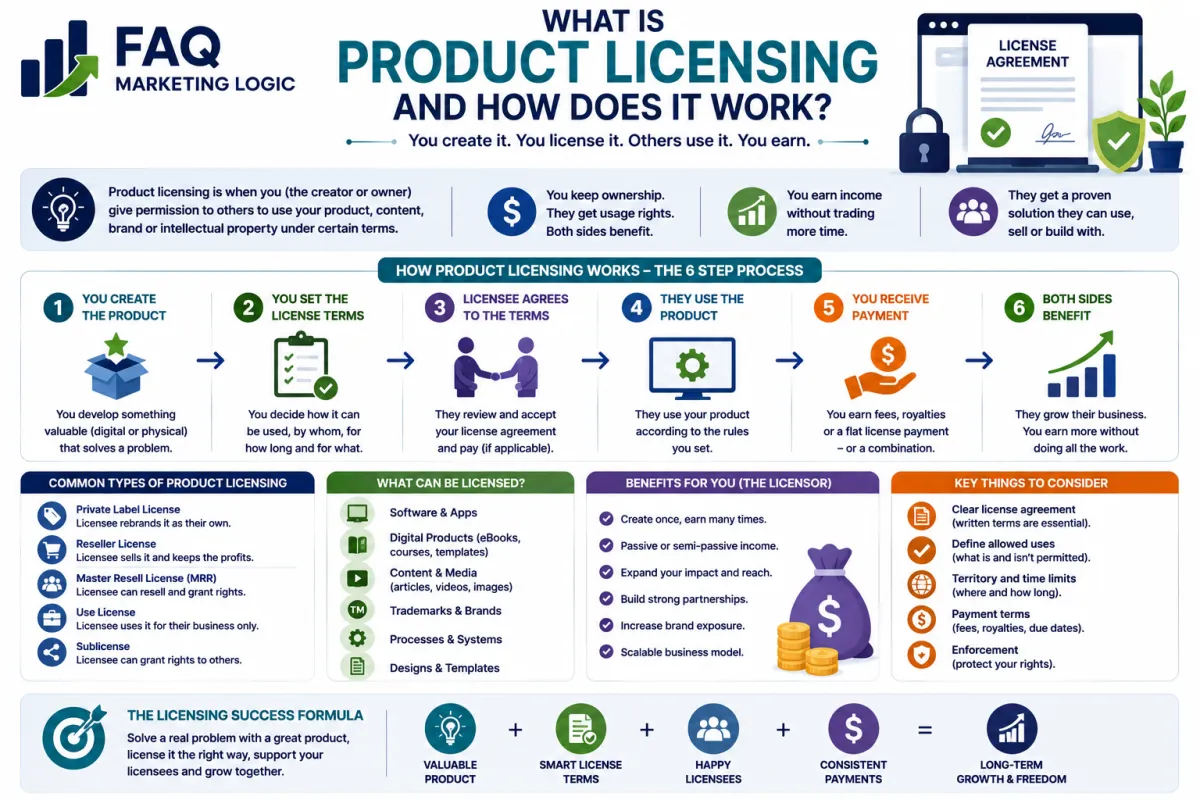
Product licensing is an arrangement in which the owner of a product gives another person or business permission to use, market, distribute or sell that product according to specified terms.
The original creator or rights holder is the licensor.
The person or business receiving the rights is the licensee.
The licence sets the boundaries of the agreement, including what the licensee is allowed to do with the product.
If you're interested in exploring how this can work with information and digital products, you can explore the product licensing approach here.
How Does Product Licensing Work?
At its simplest, product licensing involves three things:
Someone owns the rights to a product.
They grant another party specific rights to use or sell it.
The other party operates within the conditions of that licence.
The precise arrangement can vary considerably.
For example, a licence might allow you to sell a digital product while preventing you from altering its contents.
Another might allow you to change the branding or adapt parts of the product.
Some licences may restrict where the product can be sold, how it can be priced or whether the licence itself can be transferred to somebody else.
That's why the word licensing on its own doesn't tell you enough.
You need to know which rights are actually included.
What Can Be Licensed?
Many different kinds of assets can be licensed.
In the wider business world, this can include:
Brands
Software
Patents
Designs
Characters
Technology
Music and other creative works
Within an online information business, licensing opportunities can potentially involve assets such as:
Reports
Guides
Ebooks
Training materials
Courses
Templates
Marketing resources
Other digital products
The rights attached to each product may be different, so never assume that because you have licensed one product in a particular way, another licence will work the same way.
Why Would Someone License A Product Instead Of Creating One?
The most obvious reason is speed.
Suppose you decide you want to sell a detailed digital guide.
Creating it yourself could involve researching the subject, planning the content, writing it, editing it, formatting it and producing the accompanying marketing material.
With an appropriate licensed product, much of the underlying product development may already have been completed.
You can then concentrate more of your attention on areas such as:
Selecting the right market
Positioning the offer
Marketing
Building an audience
Generating traffic
Email follow-up
Customer service
That doesn't mean licensing removes all the work.
It changes where the work takes place.
Is Product Licensing The Same As PLR?
Not necessarily.
This distinction is important.
PLR (Private Label Rights) is one particular rights model commonly associated with digital content. Depending on the specific PLR licence, buyers may be allowed to edit, rebrand and sell the material.
Product licensing is a broader concept.
A licensing agreement can grant whatever specific rights the owner and licensee agree upon. Those rights may be broader or narrower than those attached to a typical PLR product.
So rather than asking:
"Is this PLR?"
A better question is:
"Exactly what does this licence allow me to do?"
We'll look at the differences between PLR and product licensing in greater detail in a separate FAQ.
What Should You Check Before Licensing A Digital Product?
The product itself is only half of the equation.
You also need to examine the licence.
Before committing to a product, establish exactly what rights you're receiving.
Questions worth asking include:
Can I sell the product?
Can I change the product?
Can I put my own name or brand on it?
Can I change the title?
Can I set my own selling price?
Can I bundle it with another product?
Can I give it away?
Can I use it as a bonus?
Can I sell through marketplaces or third-party platforms?
Can I transfer or resell the licence?
Are there geographical restrictions?
Does the licence expire?
You may not need every one of these rights.
What matters is that the rights you receive match what you intend to do with the product.
Does Licensing Mean You Own The Copyright?
Usually, no.
This is another important distinction.
Receiving permission to sell or use a product does not automatically mean ownership of the underlying copyright or intellectual property has been transferred to you.
The original rights holder may continue to own the product while granting you specified commercial rights.
Think of it as the difference between owning something outright and having permission to use it in particular ways.
The licensing agreement should make that distinction clear.
Is A Licensed Product Automatically A Good Product?
No.
Licensing solves the creation problem, but it doesn't automatically solve the quality or demand problem.
A poor product doesn't become valuable simply because you've acquired the right to sell it.
Before licensing something, consider the product from the customer's perspective.
Ask:
Does it solve a genuine problem?
Is the information useful and reasonably current?
Is there a recognisable audience for it?
Is the quality good enough for me to put in front of customers?
Can I position it differently from competing offers?
Does it fit the business I'm trying to build?
The licence might give you permission to sell something.
The market still decides whether anybody wants to buy it.
Practical Example
Imagine you wanted to enter a market where customers were looking for practical training on a particular subject.
You could create the entire product yourself.
Alternatively, you might find an existing training product available under a commercial licence that gives you the right to market and sell it.
You review the product, the market and the licensing terms and decide that all three are suitable.
Rather than spending the next several weeks creating the core training, you can concentrate on building the offer around it.
That might involve improving the positioning, creating a useful bonus, developing your email campaign and finding ways to reach the right audience.
The licensed product hasn't created the business for you.
It has simply given you a different starting point.
Common Mistakes With Product Licensing
Mistake: Assuming all licences are the same.
Fix: Read the specific terms attached to the product. Never assume rights from one licence apply to another.
Mistake: Choosing a product solely because it is available to license.
Fix: Evaluate the market and product quality before worrying about the licence.
Mistake: Thinking the product will sell itself.
Fix: Treat marketing, positioning and customer acquisition as separate jobs. Licensing can provide the product, but you still need to create demand.
Mistake: Ignoring restrictions in the licence.
Fix: Make sure your intended sales and marketing methods are permitted before investing time or money in the offer.
Mistake: Confusing licensing rights with copyright ownership.
Fix: Check exactly what intellectual-property rights remain with the original owner.
FAQ QUICK FIX
Question: I want to sell digital products, but I don't want to spend months creating my first one. What are my options?
Quick Fix: Don't automatically assume creation is your only route. Investigate whether suitable products in your market can be licensed commercially. Evaluate the product, the audience and the licensing terms separately before deciding whether the opportunity makes sense.
FAQ
Can I Make Changes To A Licensed Product?
Possibly, but only if the licence allows it.
Some licences permit substantial modification, while others restrict changes or require the original product to remain intact.
Can I Put My Own Brand On A Licensed Product?
Only when the licensing agreement gives you that right.
Never assume that selling rights automatically include rebranding rights.
Can More Than One Person License The Same Product?
Yes, depending on the licensing arrangement.
Some licences are non-exclusive and may be offered to multiple licensees. Others may provide exclusivity within a particular market, territory or arrangement.
Do I Have To Pay Royalties On Licensed Products?
It depends on the agreement.
Licensing arrangements can use different payment structures. Some may involve an upfront fee, royalties, ongoing payments or another commercial arrangement.
Always establish the financial terms before entering the agreement.
Is Product Licensing Suitable For Beginners?
It can be, particularly for someone who would prefer to concentrate on marketing an existing product rather than creating everything themselves.
However, beginners still need to understand the market, evaluate the product and read the licensing terms carefully.
TRY THIS TODAY
If you've been considering creating a digital product, write down the idea and then ask yourself two questions:
Could I create this myself?
and:
Could an appropriate existing product be licensed instead?
Don't decide which route is better yet.
Simply recognise that creation and licensing are two different ways of getting a product to market.
Want A Faster Route To Becoming A Product Owner?
Creating your own digital product isn't the only way to build a product-based online business.
Product licensing can give you another route by allowing you to work with existing products and established materials rather than starting every project from a blank page.
If you'd like to explore how product licensing can work in practice, I've got a free resource that will show you more.
→ Discover How Product Licensing Works
RELATED ARTICLES
→ Should I Start With Services or Digital Products?
→ How Do I Turn Skills Into A Sellable Offer?
→ How Do I Validate an Online Business Idea Before Building It?
QUICK RECAP
Product licensing gives you specified rights to use or sell somebody else's product.
The licence determines exactly what you can and cannot do.
Licensing can reduce the amount of product creation required.
Licensing rights do not necessarily mean you own the copyright.
PLR is a type of rights arrangement, but product licensing is a broader concept.
Product quality and market demand still matter.
Always understand the licensing terms before selling or modifying a product.
NEXT STEP
A natural question from here is:
→ Can I Sell Digital Products I Didn't Create Myself?