Can I Sell Digital Products I Didn't Create Myself?
TL;DR
Yes, you can sell digital products you didn't create yourself provided you have the legal right or permission to sell them.
Those rights might come through a product licence, reseller agreement, private label rights (PLR) or another commercial arrangement.
What matters isn't who originally created the product. What matters is what rights you've been granted and whether your intended use falls within those rights.
IN SHORT
Creating your own digital product isn't the only way to become a product seller.
You can potentially sell products created by other people, but you can't simply find a useful ebook, course, template or piece of software and start selling it.
The creator normally owns the intellectual property.
You therefore need permission that specifically allows you to sell or distribute the product.
That permission is where licensing rights become important.
REAL TALK
There's a huge difference between:
"I have a copy of this product."
and:
"I have the right to sell this product."
Buying an ebook doesn't normally give you permission to sell copies of it.
Buying a course doesn't normally allow you to start selling the training yourself.
Even having permission to give something away doesn't necessarily mean you can charge money for it.
If you want to build a business selling products created by somebody else, the first question should always be:
What am I actually allowed to do with this product?
Key Definition: What Does It Mean To Sell A Product You Didn't Create?
Selling a digital product you didn't create means commercially offering a product originally developed by another person or business under rights that permit you to do so.
Those rights could potentially allow you to:
Sell the product
Distribute it
Rebrand it
Modify it
Bundle it with other products
Use it as a bonus
Sell it through particular channels
But having one right doesn't automatically give you all the others.
The exact permissions depend on the licence or agreement.
If you'd like to explore how acquiring the rights to existing digital products can work as a business model, you can explore the product licensing approach here.
How Can You Legally Sell Someone Else's Digital Product?
There are several possible arrangements.
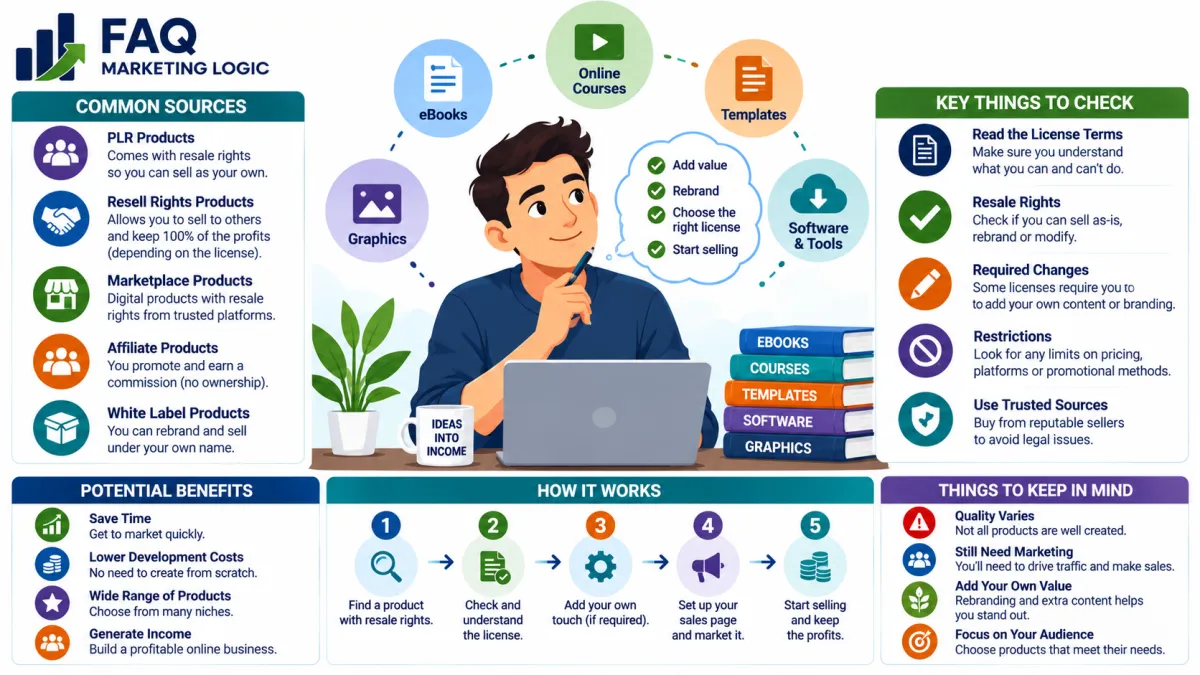
One is a commercial product licence, where the rights holder gives you specified permission to sell or market the product.
Another is a reseller arrangement that specifically gives you resale rights.
You might also encounter products offered with Private Label Rights (PLR), where the licence may allow you to modify or rebrand the material before selling it.
Affiliate marketing is another way of earning from somebody else's product, but there's an important difference.
As an affiliate, you normally refer the customer to the seller and receive a commission when a qualifying sale occurs.
With appropriate licensing or resale rights, you can become the seller of the product yourself.
Those are two different business models.
Do I Need Permission From The Original Creator?
Yes, unless the necessary rights have already been granted through a valid licence or another arrangement.
Digital products are not automatically free for anybody to resell simply because they're easy to copy.
If somebody creates an ebook, course, video, template or other original digital work, intellectual-property rights may apply to it.
A licence allows the rights holder to give other people permission to use that product in specified ways without necessarily transferring ownership of the underlying copyright.
That's why you should establish your rights before building an offer around somebody else's product.
What Types Of Digital Products Can Be Licensed?
Depending on what is available and the rights offered, examples could include:
Ebooks
Reports
Guides
Courses
Training materials
Templates
Worksheets
Graphics
Software
Tools
Resource packs
However, don't make the mistake of assuming that a particular type of digital product automatically comes with resale rights.
The product and the licence are separate things.
An ebook could be sold with personal-use rights only.
Another ebook could include resale rights.
Another could include PLR.
The licence determines what you're allowed to do.
What's The Difference Between Resale Rights And PLR?
The terminology and permissions can vary, so always read the actual licence rather than relying on the label alone.
Broadly, resale rights usually give you permission to sell the product while potentially restricting your ability to modify it.
Private Label Rights may provide broader permissions, such as editing, adapting or rebranding the content.
However, PLR licences can differ significantly from one seller to another.
One PLR licence might allow you to change the title and put your name on the product.
Another might impose restrictions on pricing, marketplaces, giveaway rights or transferring rights to your customers.
So don't assume that PLR means unlimited rights.
It doesn't.
Is Product Licensing Different?
Product licensing is the broader principle of a rights holder granting another party permission to use or commercially exploit a product under agreed terms.
Those terms can be designed around the particular product and commercial arrangement.
This can provide opportunities that go beyond simply purchasing generic content with predefined resale rights.
If you haven't already read it, our guide to What Is Product Licensing And How Does It Work? explains the basic licensing model in more detail.
Why Sell A Product You Didn't Create?
One of the biggest advantages is time.
Creating a substantial digital product can involve:
Research
Planning
Writing
Recording
Editing
Design
Formatting
Packaging
Testing
Acquiring appropriate rights to an existing product can potentially remove much of that initial development work.
That allows you to concentrate more heavily on:
Understanding the market
Positioning the offer
Building an audience
Creating marketing
Generating traffic
Email follow-up
Customer acquisition
You're not eliminating the work involved in building a business.
You're choosing to concentrate your effort on selling and marketing rather than creating the underlying product from scratch.
What Are The Disadvantages?
The biggest limitation is control.
When you create a product yourself, you decide what goes into it.
When you license somebody else's product, you're starting with something another person created.
Depending on your rights, you may not be able to change it.
There may also be other businesses selling the same or similar product.
That means you need to consider:
Product quality
Market demand
Competition
Licensing restrictions
Your positioning
Your marketing angle
How you'll differentiate your offer
A ready-made product can shorten the creation process.
It doesn't automatically give you a ready-made business.
How Do You Make A Licensed Product Your Own?
This depends entirely on the rights you've been granted.
Where modification is permitted, you might be able to change elements such as:
Branding
Product name
Design
Examples
Additional material
Bonuses
Packaging
Positioning
But differentiation doesn't always have to happen inside the product itself.
You can also differentiate an offer through who you sell it to, the problem you focus on, your marketing message, bonuses, support and customer experience.
Two businesses could potentially start with the same underlying licensed product and build very different offers around it.
Should I Check The Product Before Buying The Rights?
Absolutely.
Don't become so focused on acquiring resale or licensing rights that you forget to evaluate what you're actually going to sell.
Ask:
Is the information accurate?
Is it reasonably current?
Is it useful?
Is it well presented?
Does it solve a genuine problem?
Would I be comfortable selling it to my customers?
Is there a market for it?
Can I differentiate my offer?
If the product isn't good enough, generous licensing rights don't make it a good business opportunity.
Practical Example
Suppose you want to enter a market where customers need practical training on a particular subject.
You estimate that creating a comprehensive training package yourself would take several weeks.
Instead, you discover an existing digital training product available under a licence that permits commercial resale.
You review:
The product — Is it good enough?
The market — Do people want the solution?
The licence — Can you use it in the way you intend?
All three check out.
You acquire the appropriate rights and concentrate your time on positioning the offer, building a sales process and reaching prospective customers.
You haven't created the original product.
But because you've legitimately obtained the necessary rights, you can build an offer around it within the terms of the licence.
Common Mistakes
Mistake: Assuming buying a product gives you resale rights.
Fix: Personal ownership and commercial resale rights are different. Check the licence.
Mistake: Assuming all PLR licences are identical.
Fix: Read the specific terms for every product you acquire.
Mistake: Buying because the licensing rights sound impressive.
Fix: Evaluate the underlying product and market first.
Mistake: Selling the product exactly as everybody else does.
Fix: Look for legitimate ways to differentiate your positioning, offer and marketing.
Mistake: Ignoring restrictions because the product is digital.
Fix: Treat licensing terms seriously. Digital doesn't mean unrestricted.
FAQ QUICK FIX
Question: I've found a digital product I'd like to sell. How do I know whether I can?
Quick Fix: Find the licence or commercial agreement and identify exactly what it says about reselling the product.
If you cannot establish that you have permission to sell it, don't sell it until you've clarified your rights.
FAQ
Can I Buy An Ebook And Resell It?
Not normally.
Buying an ebook usually gives you a copy for personal use. You need separate permission if you want to resell it.
Can I Change A Product Before Selling It?
Only if your rights allow modification.
Resale permission and modification permission are not necessarily the same thing.
Can I Put My Name On A Product Someone Else Created?
Only if the licence gives you the appropriate right to do so.
Never assume that resale rights include authorship or rebranding rights.
Can I Sell PLR Products?
Potentially, yes, provided you comply with the specific PLR licence.
Check for restrictions concerning modification, pricing, marketplaces, distribution and the rights you can pass to customers.
Is Licensing Better Than Creating My Own Product?
Neither approach is automatically better.
Creating gives you maximum control and originality.
Licensing can save development time and let you concentrate more heavily on marketing and selling.
The right choice depends on your resources, skills, market and business objectives.
TRY THIS TODAY
If you've found a digital product you might like to sell, don't begin by asking how much money you could make from it.
Find the licence first.
Write down:
What you're allowed to do.
What you're prohibited from doing.
Whether you can modify the product.
Where you're allowed to sell it.
Whether there are pricing or distribution restrictions.
Then decide whether those rights fit the business you actually want to build.
Want To Sell Digital Products Without Creating Everything From Scratch?
Creating your own products can be rewarding, but it isn't the only route to becoming a digital product owner.
Product licensing can allow you to work with existing products and materials, giving you more time to concentrate on positioning, marketing and making sales.
If you'd like to explore how product licensing can work in practice, I've got a free resource that will show you more.
→ Discover How Product Licensing Works
RELATED ARTICLES
→ Should I Start With Services or Digital Products?
→ How Do I Turn Skills Into A Sellable Offer?
→ How Do I Validate an Online Business Idea Before Building It?
QUICK RECAP
You can sell digital products you didn't create if you have the appropriate rights.
Buying a product doesn't automatically give you permission to resell it.
Resale rights, PLR and product licensing can provide different permissions.
Always read the specific licence rather than relying on its label.
Licensing can save product-development time, but marketing is still your responsibility.
Product quality and market demand matter just as much as the rights.
Never sell somebody else's product unless you're confident you have permission to do so.
NEXT STEP