
Why Do Subscribers Stop Opening Emails?
TL;DR
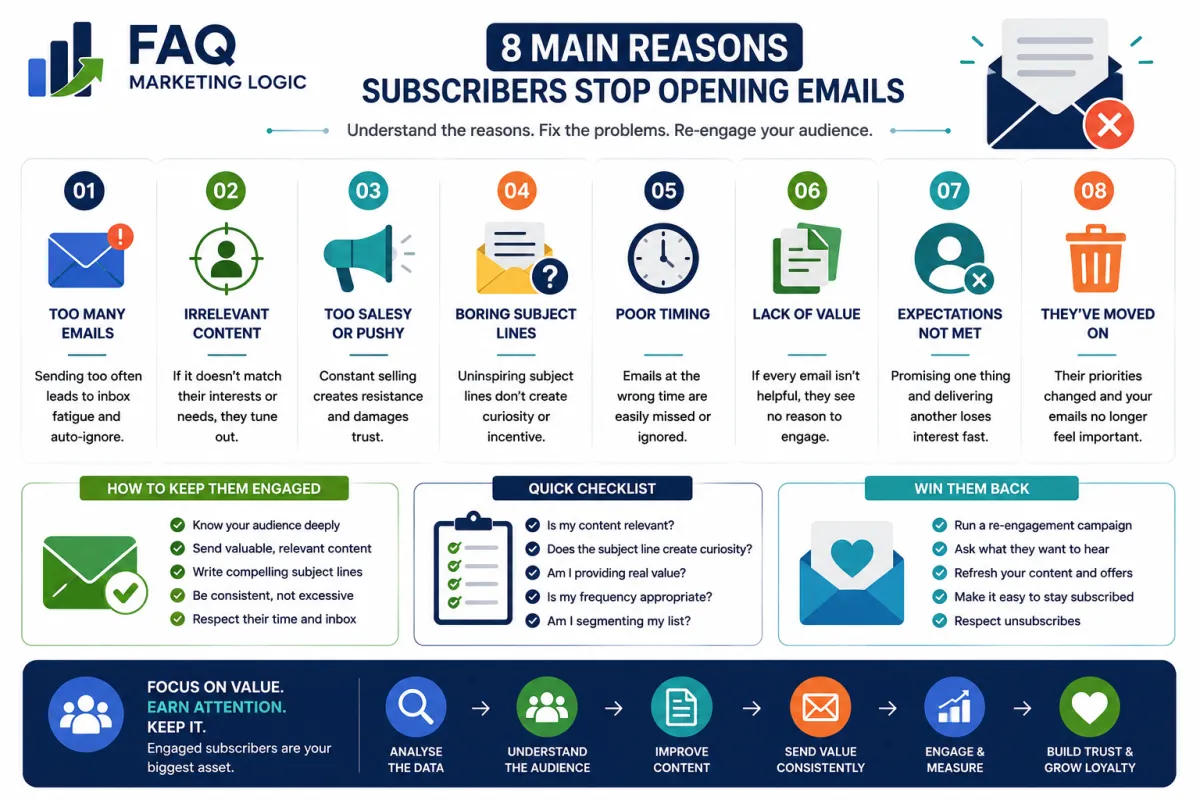
Subscribers usually stop opening emails because the messages have become less relevant, too predictable, too frequent, or no longer worth their attention.
Falling engagement doesn't automatically mean you need better subject lines. Often, the real problem is the relationship between your emails and the expectations you created when someone subscribed.
IN SHORT
Subscribers may stop opening when:
The content no longer feels relevant.
Every email leads to a sales pitch.
Emails arrive too frequently or inconsistently.
Subject lines don't give them a reason to open.
The content becomes repetitive.
They have simply lost interest in the original topic.
The solution isn't to send louder emails.
It's to give subscribers a reason to pay attention again.
REAL TALK
Getting someone onto your email list is only the beginning.
You don't permanently earn their attention because they filled in a form six months ago.
Every email competes with work messages, family messages, newsletters, promotions, notifications, and dozens of other things demanding attention.
If your emails repeatedly give subscribers nothing useful, they learn something very quickly:
They don't need to open them.
That's why declining engagement is rarely fixed by finding a clever new subject-line formula.
You need to understand why the subscriber stopped caring.
Key Definition
An inactive email subscriber is someone who remains on your email list but has stopped meaningfully engaging with your messages over a defined period.
Inactivity might include:
Not opening emails.
Not clicking links.
Not responding.
Not purchasing.
Not taking other measurable actions.
However, open tracking isn't completely reliable because privacy features and email technology can affect whether an open is recorded.
That's why subscriber engagement should be judged using several signals rather than open rates alone.
Why Do Previously Active Subscribers Lose Interest?
Most subscribers don't suddenly decide:
"I'm never reading another email from this business."
Engagement usually fades gradually.
They skip one email because they're busy.
The next doesn't seem particularly relevant.
Then another looks similar to the previous one.
Eventually, ignoring your emails becomes a habit.
Several factors can accelerate that process.
Your Emails No Longer Match Why They Subscribed
Someone may have joined your list because they wanted help solving one specific problem.
If your emails gradually move away from that subject, relevance declines.
For example, someone who downloads a guide about building an email list probably expects further help with email marketing.
If they suddenly receive constant promotions about cryptocurrency, property investing, and fitness programmes, the original connection disappears.
The wider the gap between why they subscribed and what you're sending, the easier your emails become to ignore.
You're Sending Too Many Promotions
Selling through email isn't a problem.
People understand that businesses have products.
The problem begins when subscribers know what every email will contain before they open it:
Story → problem → sales pitch.
Again.
And again.
And again.
Eventually, even useful emails can start feeling like disguised advertisements.
Promotional emails work better when they're part of a relationship rather than the entire relationship.
Your Emails Have Become Predictable
Consistency is useful.
Repetition isn't.
If every email uses the same structure, talks about the same problem, and reaches the same conclusion, there's little reason to keep opening.
You don't need to reinvent your entire strategy every week.
But you can vary the way you communicate:
Answer a question.
Tell a relevant story.
Challenge an assumption.
Share a useful resource.
Explain a mistake.
Give a practical tip.
Recommend a solution.
The subject can remain consistent while the presentation changes.
Your Sending Pattern Has Changed
Frequency creates expectations.
If someone signs up expecting a weekly email and suddenly receives one every day, they may feel overwhelmed.
The opposite can happen too.
If you disappear for three months and then suddenly return, subscribers may barely remember who you are.
There isn't one perfect email frequency.
There is, however, value in being reasonably consistent.
Your Subject Lines Have Lost Relevance
The subject line decides whether the email gets an opportunity to be read.
If your subject lines are repeatedly vague, exaggerated, or uninteresting, subscribers may stop opening before discovering whether the content is worthwhile.
But subject lines should not be treated in isolation.
If someone has been disappointed by the previous ten emails, an excellent eleventh subject line has a much harder job.
Your reputation arrives in the inbox alongside your subject line.
The Subscriber's Needs Have Changed
Sometimes there isn't anything wrong with your emails.
People change.
Someone who was interested in starting a business twelve months ago may now have started one.
Someone researching Facebook advertising may have decided to concentrate on SEO.
Someone interested in your subject may simply have moved on.
Not every inactive subscriber needs to be rescued.
That's an important distinction.
Look Beyond Open Rates
Suppose your email open rate begins declining.
It's tempting to conclude:
"My subject lines aren't working."
But look deeper.
Are clicks declining too?
Are people still purchasing?
Are replies falling?
Are unsubscribe rates increasing?
Different signals suggest different problems.
For example:
Opens down, clicks relatively stable: Tracking changes or subject-line issues may be contributing.
Opens and clicks down: Relevance or overall engagement may be weakening.
Opens strong, clicks weak: People are opening but the email itself isn't creating enough interest in the next step.
Unsubscribes increasing: Frequency, expectations, relevance, or promotional pressure may need attention.
One metric rarely tells the whole story.
Practical Example
Imagine you have 2,000 subscribers.
For several months, you've sent useful weekly emails answering common marketing questions.
Engagement is healthy.
Then you launch a product.
For the next three weeks, almost every message promotes it.
Open rates begin falling.
You conclude that subscribers are bored with email marketing.
But that might not be the problem at all.
They may simply be bored with hearing about the same product.
Return to useful educational emails, vary the topics, and give subscribers something valuable without requiring a purchase.
If engagement starts recovering, you've learned something useful.
The list wasn't necessarily the problem.
The communication pattern was.
Common Mistakes
Mistake: Assuming every decline in opens is caused by subject lines.
Fix: Review relevance, frequency, clicks, conversions, and recent content before drawing conclusions.
Mistake: Increasing email frequency when engagement falls.
Fix: Improve the reason to open before increasing the number of opportunities to ignore you.
Mistake: Sending increasingly aggressive promotions.
Fix: Restore value and relevance before asking for another sale.
Mistake: Trying to keep every subscriber forever.
Fix: Accept that some people naturally lose interest and allow them to leave easily.
Mistake: Treating inactive subscribers as one identical group.
Fix: Look at how long they've been inactive and what originally brought them onto the list.
FAQ QUICK FIX
If subscribers are becoming less engaged:
1. Review your last ten emails.
Look at what you've actually been sending rather than what you think you've been sending.
2. Compare engagement patterns.
Check clicks, replies, conversions, unsubscribes, and opens where available.
3. Revisit subscriber expectations.
Ask whether your recent emails still match why people originally joined.
4. Reduce repetition.
Vary the angles, formats, examples, and types of value you provide.
5. Identify genuinely inactive subscribers.
Separate temporary disengagement from longer-term inactivity.
6. Consider re-engagement.
Give inactive subscribers a clear reason to become interested again before deciding whether they should remain on your active list.
FAQ
Q: How long before a subscriber should be considered inactive?
There isn't one universal period. It depends on how frequently you normally email. Someone who hasn't engaged for three months may be inactive on a daily newsletter but less unusual on a monthly list.
Q: Should I remove subscribers who don't open emails?
Not immediately. Open tracking isn't completely reliable. Consider clicks, purchases, replies, and other activity before making that decision.
Q: Will changing my subject lines bring inactive subscribers back?
It may help, but only if subject lines are the real problem. If subscribers no longer find your emails relevant, changing the wording in the inbox won't solve the underlying issue.
Q: Does sending too many emails reduce engagement?
It can, particularly when frequency exceeds subscriber expectations or the emails don't provide enough value to justify the additional attention.
Q: Should I stop selling when engagement falls?
Not necessarily. Selling is a legitimate part of email marketing. The better question is whether your promotions remain relevant and balanced with useful communication.
TRY THIS TODAY
Open your email platform and look at your last ten emails.
Don't start with the statistics.
Start with the content.
Ask:
"If I were a subscriber, would these ten emails give me ten worthwhile reasons to keep opening?"
If several messages feel repetitive, overly promotional, or disconnected from why people joined, you've found somewhere to start.
RELATED ARTICLES
→ How Often Should You Send Emails?
→ How to Increase Email Engagement and Click-Through Rates
→ How Do I Write Better Email Subject Lines?
QUICK RECAP
Subscribers stop opening emails for many reasons:
Relevance declines.
Content becomes repetitive.
Promotions dominate.
Frequency changes.
Expectations aren't met.
Interests change.
Don't assume the answer is simply writing more exciting subject lines.
Look at the entire subscriber experience.
The strongest reason for someone to open your next email is often that your previous email was worth reading.
NEXT STEP
If subscribers have already stopped engaging, identifying the problem is only the beginning.
The next step is deciding whether you can earn their attention again.
Read: