
How Do I Re-Engage Inactive Subscribers? | FAQ Marketing Logic
TL;DR
Re-engage inactive subscribers by giving them a genuine reason to pay attention again.
Don't simply send more emails. Remind subscribers why they joined, offer something useful, ask what they're interested in, and make it easy for people who are no longer interested to leave.
The objective isn't to keep everyone on your list.
It's to identify the people who still want to hear from you.
IN SHORT
To re-engage inactive subscribers:
Identify who has genuinely stopped engaging.
Remind them why they originally subscribed.
Lead with useful or relevant content.
Ask what they want to hear about.
Try a different email angle.
Give them a clear reason to respond or click.
Allow uninterested subscribers to leave.
Re-engagement is about rebuilding relevance.
Not chasing an open.
REAL TALK
A large email list can look impressive.
But if thousands of subscribers routinely ignore everything you send, the number isn't particularly useful.
Keeping inactive people simply because you don't want your subscriber count to fall can become a vanity exercise.
Some subscribers can be re-engaged.
Some have simply moved on.
Your job is to find out which is which.
Key Definition
Email re-engagement is the process of reconnecting with subscribers who have stopped interacting with your emails and determining whether they still want to receive them.
A re-engagement campaign might target subscribers who haven't:
Clicked an email.
Visited your website from an email.
Made a purchase.
Replied.
Taken another measurable action.
Open data can also be considered, but it shouldn't be your only measure because email privacy features can make open tracking unreliable.
The goal is to identify meaningful inactivity rather than simply a missing tracking signal.
Decide What "Inactive" Actually Means
Before trying to re-engage subscribers, define inactivity.
Someone who hasn't clicked for two weeks isn't necessarily inactive if you only send one email each week.
Likewise, waiting a year may be too long if you email every day.
A practical definition depends on:
Your normal sending frequency.
Your typical buying cycle.
The type of emails you send.
Previous subscriber behaviour.
The important thing is consistency.
Create a definition you can use repeatedly rather than deciding subscriber by subscriber.
Work Out Why Engagement Fell
Don't start a re-engagement campaign until you've considered why people stopped engaging.
Look at recent emails.
Has your content changed?
Have you increased the number of promotions?
Has your sending frequency changed?
Are you repeating the same subjects?
Have subscribers been receiving emails that no longer match their original interests?
Sometimes the problem isn't the subscriber.
It's what you've been sending them.
Fixing that first gives your re-engagement campaign a much better chance.
Remind Them Why They Joined
People forget.
Someone may have downloaded a guide six months ago, enjoyed it, and then gradually stopped paying attention to your emails.
A re-engagement message can reconnect them with the original reason they subscribed.
For example:
You originally joined because you downloaded our guide to building an email list. Since then, we've published several new resources that may help you take the next step.
That gives the email context.
You're not appearing unexpectedly and demanding attention.
You're reminding them of an existing relationship.
Give Them Something Worth Returning For
"WE MISS YOU!" isn't much of a reason to re-engage.
Your subscriber probably hasn't spent the last three months wondering whether your business misses them.
Give them something useful instead.
That could be:
A particularly helpful guide.
A new resource.
A useful checklist.
Your best recent article.
A practical tip.
An updated version of something they originally requested.
The easiest way to regain attention is to become useful again.
Ask What They Want
Sometimes the simplest approach is to ask.
You could give subscribers several choices:
What would you most like help with?
Getting more traffic.
Building an email list.
Improving conversions.
Creating better systems.
Growing an existing business.
Their response can help you understand whether they're still interested and what content is most relevant.
It can also improve future segmentation.
Instead of guessing what an inactive subscriber wants, let them tell you.
Change The Pattern
If subscribers have ignored your last twenty emails, sending number twenty-one in exactly the same style may not change much.
Try a different approach.
You might:
Use a very direct subject line.
Send a short plain-text email.
Ask a question.
Share one useful resource without selling anything.
Invite them to update their preferences.
The purpose isn't to trick someone into opening.
It's to interrupt a pattern of automatic ignoring.
Consider A Short Re-Engagement Sequence
One email may not be enough.
A simple sequence could contain three messages.
Email 1: Reconnect
Remind the subscriber why they're hearing from you and provide something useful.
Email 2: Ask
Find out whether they're still interested and what they would like to receive.
Email 3: Confirm
Explain that you don't want to keep sending unwanted emails and give them a simple way to remain subscribed or leave.
You don't need fifteen emails.
You're trying to clarify interest, not wear someone down.
Know When To Stop
This part matters.
Re-engagement does not mean repeatedly emailing someone until they finally click something.
If a subscriber consistently shows no meaningful activity after you've made a reasonable attempt to reconnect, continuing indefinitely may provide little benefit.
Keeping your list focused on people who genuinely want your communication can be more useful than maintaining the largest possible subscriber count.
A smaller engaged list can be a much healthier business asset.
Practical Example
Imagine you have 5,000 subscribers.
You identify 800 who haven't clicked, purchased, replied, or otherwise engaged for several months.
Instead of immediately removing them, you send a short re-engagement sequence.
The first email shares one of your most useful recent resources.
The second asks which marketing subject they're currently most interested in.
The third asks whether they still want to receive your emails.
Some subscribers begin clicking again.
Some update their interests.
Some unsubscribe.
Others remain completely inactive.
You now have better information.
Rather than treating all 800 people identically, you've separated subscribers who still have an interest from those who appear to have moved on.
That's a successful re-engagement campaign.
Common Mistakes
Mistake: Offering a huge discount immediately.
Fix: Rebuild relevance before relying on incentives.
Mistake: Sending "We miss you" without giving the subscriber any value.
Fix: Give them a useful reason to return.
Mistake: Measuring inactivity using opens alone.
Fix: Consider clicks, replies, purchases, and other meaningful activity.
Mistake: Sending too many re-engagement emails.
Fix: Use a short, purposeful sequence.
Mistake: Refusing to let inactive subscribers go.
Fix: Accept that a healthy list doesn't need to contain everyone who has ever subscribed.
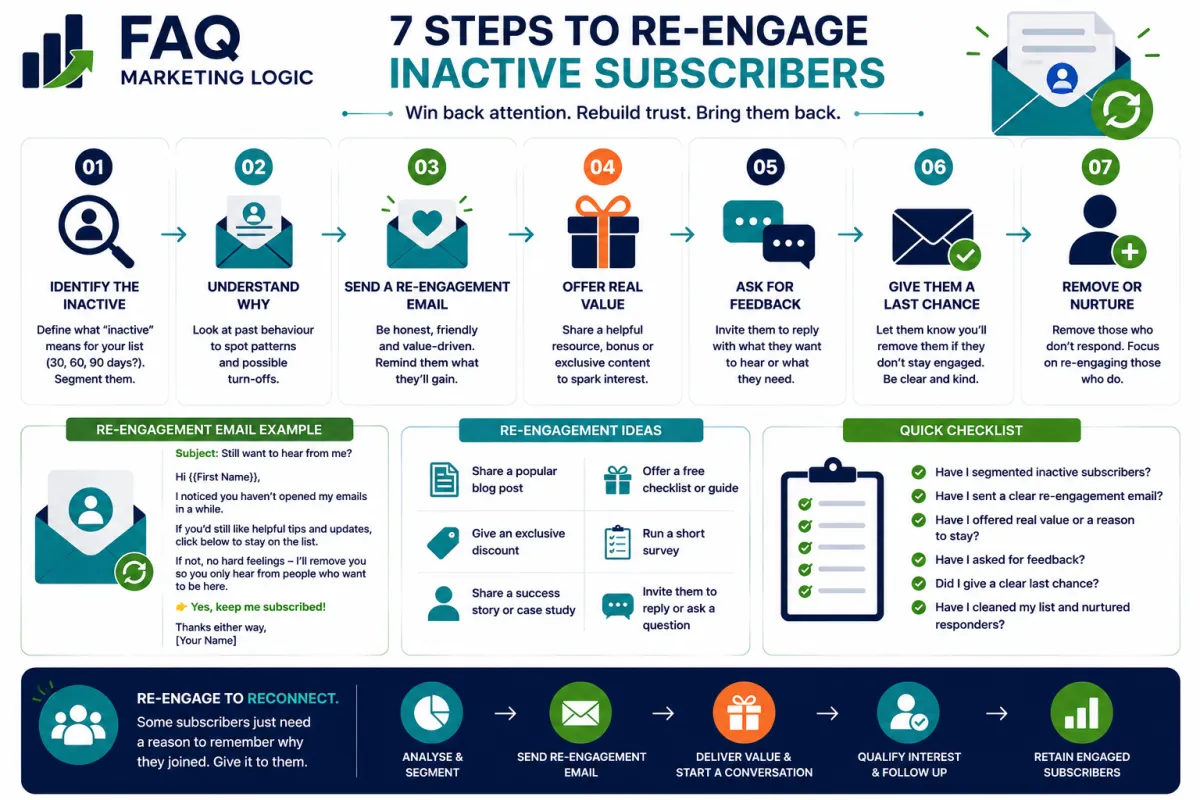
FAQ QUICK FIX
If you have inactive subscribers:
1. Define inactivity.
Choose a period that makes sense for your sending frequency.
2. Review what you've been sending.
Make sure the problem isn't simply repetitive or irrelevant emails.
3. Segment inactive subscribers.
Avoid sending your re-engagement campaign to everyone.
4. Send something useful.
Give people a reason to pay attention again.
5. Ask about their interests.
Let subscribers tell you what they want.
6. Confirm whether they want to stay.
Make the choice simple.
7. Review the results.
Separate renewed engagement from continued inactivity.
FAQ
Q: How many re-engagement emails should I send?
A short sequence is usually enough to establish whether there's still meaningful interest. The objective is to reconnect, not repeatedly chase subscribers.
Q: Should I offer a discount to inactive subscribers?
You can when it's appropriate, but don't assume a discount solves the underlying problem. If someone is no longer interested in the subject, a cheaper product may not change that.
Q: Should I remove every subscriber who doesn't open emails?
No. Open tracking isn't reliable enough to make that decision by itself. Consider other engagement signals as well.
Q: Can inactive subscribers become good customers later?
Yes. Someone may become inactive because the timing wasn't right rather than because they've permanently lost interest.
Q: Should I ask inactive subscribers why they stopped reading?
You can. A simple question or preference survey can provide useful information and may itself encourage engagement.
TRY THIS TODAY
Look at your email list and identify subscribers who haven't meaningfully engaged for a reasonable period.
Then ask yourself:
"What could I send these people that would genuinely be worth returning for?"
Don't begin with:
"What can I sell them?"
Begin with:
"How can I become relevant again?"
That's the foundation of re-engagement.
RELATED ARTICLES
→ Why Do Subscribers Stop Opening Emails?
→ How to Increase Email Engagement and Click-Through Rates
→ Email Segmentation: When and How to Segment Your List
QUICK RECAP
Re-engagement works by:
Identifying genuine inactivity.
Understanding why engagement declined.
Restoring relevance.
Providing useful content.
Asking about subscriber interests.
Changing established patterns.
Allowing uninterested subscribers to leave.
The objective isn't to force inactive subscribers back into your email programme.
It's to discover who still wants to be part of it.
NEXT STEP
Re-engagement can help repair a relationship that's faded.
But it's even better to build that relationship properly from the moment someone joins.
That starts with the very first message they receive.
Read: