How Do I Write Better Email Subject Lines?
TL;DR
Better email subject lines create enough relevant curiosity or value to earn the open without misleading the reader.
Keep them clear, specific, and connected to the content of the email. The goal isn't simply to increase open rates. It's to attract the right reader into the right message.
IN SHORT
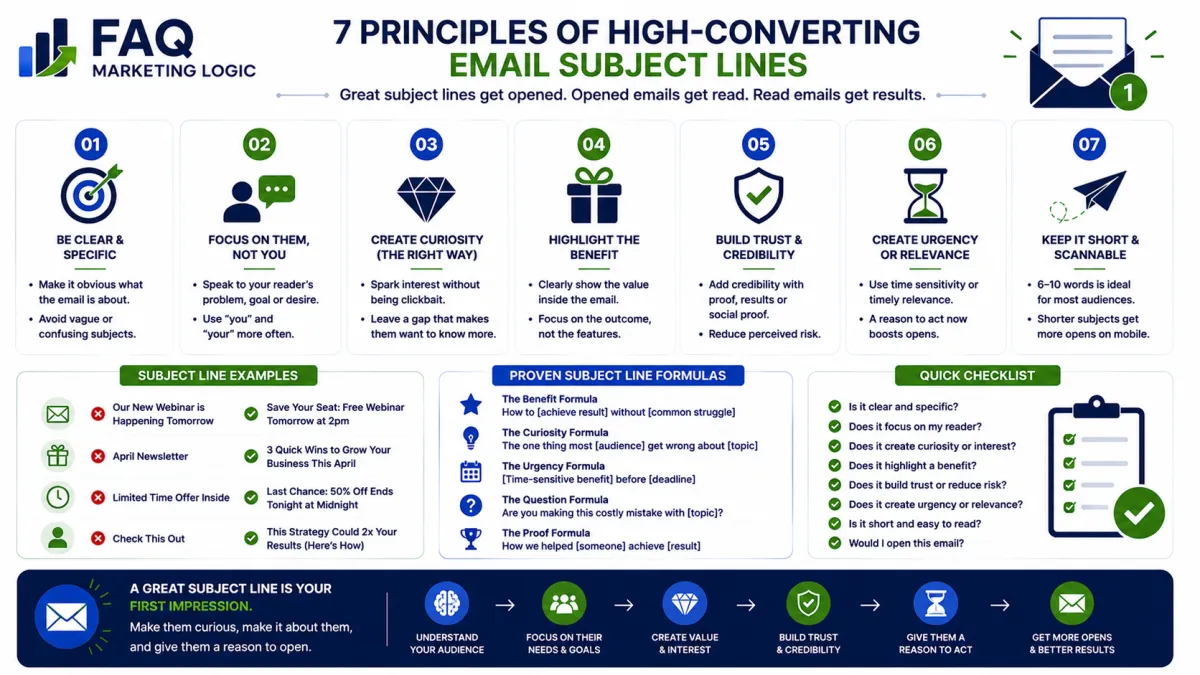
Effective email subject lines usually do at least one of these things:
Promise a relevant benefit.
Highlight a problem.
Create genuine curiosity.
Ask a useful question.
Make the topic immediately clear.
Give the reader a reason to pay attention now.
The subject line earns the open.
The email must then deliver what the subject line promised.
REAL TALK
You can find hundreds of "high-converting subject line formulas" online.
Use this word.
Add an emoji.
Put the reader's name here.
Create a curiosity gap.
None of those tactics can compensate for sending emails people don't want to receive.
Your subject line matters.
But the relationship you've built with the subscriber matters more.
Eventually, people aren't just deciding whether to open a subject line.
They're deciding whether emails from you are worth opening.
Key Definition
An email subject line is the short piece of text displayed alongside the sender's name in an inbox that tells or suggests what the email is about.
Its primary purpose is to help the recipient decide whether the email deserves their attention.
A good subject line creates an accurate expectation.
A great email then fulfils it.
Start With The Email, Not The Subject Line
One of the easiest ways to struggle with subject lines is to write them before knowing exactly what the email is trying to achieve.
First identify:
The main idea.
The reader's problem.
The benefit.
The desired action.
Then ask:
"What would make someone interested in this particular message?"
That gives you something meaningful to build the subject line around.
Clarity Often Beats Cleverness
Clever subject lines can attract attention.
They can also create confusion.
Consider:
"Something you need to see..."
versus:
"Why your landing page isn't converting"
The first creates curiosity but provides almost no context.
The second immediately tells the right reader why the email might matter.
You don't always need to explain everything in the subject line.
But readers should have enough information to recognise relevance.
Use Curiosity Without Hiding The Subject
Curiosity works when there's a genuine information gap.
For example:
"The email mistake I keep seeing"
creates a natural question:
"What mistake?"
But the reader still knows the email concerns email marketing.
Compare that with:
"You won't believe what happened..."
That's curiosity without useful context.
It might earn an occasional open, but it doesn't build much trust.
Good curiosity creates interest.
Bad curiosity withholds information purely to manufacture a click.
Make The Benefit Specific
A benefit can give someone a clear reason to open.
For example:
Weak:
"Some email marketing tips"
Better:
"3 ways to get more clicks from your emails"
The second tells the subscriber what they will gain from reading.
Specificity makes the value easier to recognise.
Ask Questions The Reader Actually Cares About
Questions can work particularly well when they reflect something the reader is already wondering.
Examples:
"Are you emailing your list too often?"
"Why aren't subscribers clicking?"
"Is your welcome email doing this?"
"Do you really need another funnel?"
The question creates engagement because the reader instinctively considers the answer.
But don't add a question mark to a dull statement and expect it to become interesting.
The underlying question still needs to matter.
Use Urgency Carefully
Urgency can be appropriate when something genuinely has a deadline.
For example:
"Registration closes tonight"
"Last day to join"
"Your early-bird price ends Friday"
That's useful information.
Artificial urgency is different.
If every email says:
URGENT
LAST CHANCE
DON'T MISS THIS
people eventually stop believing you.
Use urgency to communicate a genuine reason for acting now, not simply to manufacture pressure.
Think About The Sender Name Too
Your subject line doesn't appear alone.
The reader also sees who sent the email.
As familiarity develops, your sender name can become one of the strongest reasons someone opens.
That's why consistent useful communication matters.
Over time, you want subscribers to think:
"This is usually worth reading."
That's far more valuable than finding one clever subject-line trick.
Don't Forget The Preview Text
Many inboxes display a short piece of preview text beside or underneath the subject line.
Use it to support the subject rather than repeat it.
For example:
Subject: Why aren't subscribers clicking?
Preview: The problem may have started before they reached your CTA.
The subject creates the question.
The preview adds another reason to open.
Together, they work as a pair.
Practical Example
Imagine you're sending an email about improving landing page conversions.
You could use:
Subject: Newsletter #47
Accurate.
But not particularly interesting.
Or:
Subject: Landing page optimisation tips
Better, but still broad.
Or:
Subject: Why are visitors leaving without taking action?
Now you've identified a specific problem that matters to the intended reader.
The subject hasn't promised an unbelievable result.
It hasn't manufactured urgency.
It has simply made the relevance of the email clear.
That's often enough.
Common Mistakes
Mistake: Using clickbait to increase opens.
Fix: Create curiosity without misleading the subscriber.
Mistake: Trying to explain the entire email in the subject line.
Fix: Communicate one strong idea.
Mistake: Making every subject line urgent.
Fix: Reserve urgency for genuine deadlines.
Mistake: Writing vague subjects because they sound intriguing.
Fix: Give readers enough context to recognise relevance.
Mistake: Measuring subject lines only by open rate.
Fix: Consider what happens after the open as well.
FAQ Quick Fix
Before sending an email, check your subject line against these five questions:
Is it relevant?
Will the intended reader recognise why this matters?Is it clear?
Can they understand the basic subject without guessing?Is there a reason to open?
Does it offer value, curiosity, usefulness, or timely information?Is it honest?
Does the email actually deliver what the subject suggests?Does it sound natural?
Would you use similar language when speaking to the reader?
If it passes all five, you're probably ready to send.
FAQ
Q: How long should an email subject line be?
There is no perfect length. Keep it concise enough that the important message can be understood quickly, especially on mobile devices.
Q: Should I use emojis in subject lines?
You can, if they fit your brand and audience. They aren't automatically going to improve performance, and overusing them can become distracting.
Q: Should I personalise subject lines with someone's name?
Personalisation can sometimes attract attention, but relevance is more important. Using someone's first name doesn't make an irrelevant email interesting.
Q: Should I use capital letters in subject lines?
Normal sentence-style writing is usually easier to read. Excessive capitals can make promotional emails feel aggressive.
Q: Should I test different subject lines?
Yes, when you have enough subscribers for the results to be meaningful. Testing can help you understand which approaches resonate with your particular audience.
TRY THIS TODAY
Take the next email you plan to send.
Write five different subject lines for it:
One based on the benefit.
One based on the problem.
One using a question.
One using curiosity.
One that's completely direct.
Then ask:
Which one would make the right reader most interested in this particular email?
Choose that one.
Don't automatically choose the cleverest.
RELATED ARTICLES
→ How Can I Make My Emails Clearer and More Direct?
→ How to Increase Email Engagement and Click-Through Rates
→ What Makes An Email Offer More Compelling?
QUICK RECAP
Better subject lines are:
Relevant.
Clear.
Specific.
Interesting.
Honest.
Consistent with the email.
Their job isn't to trick someone into opening.
Their job is to make the right person want to know more.
NEXT STEP
Getting the open is only the beginning. Once someone starts reading, the next challenge is encouraging them to take the action you want.
Read: