What's The Difference Between PLR And Product Licensing?
TL;DR
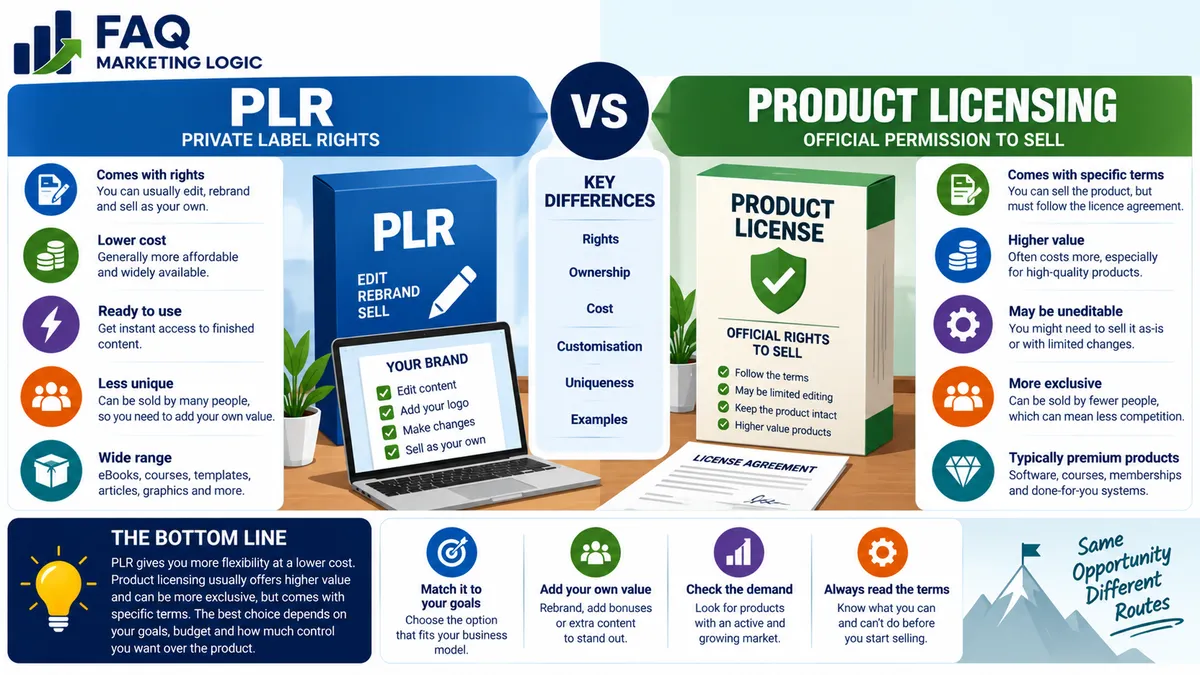
PLR and product licensing both let you work with products or content you didn't originally create, but they aren't the same thing.
PLR (Private Label Rights) usually gives multiple buyers predefined rights to edit, rebrand or sell the same underlying material.
Product licensing is a broader commercial arrangement where the product owner grants specific rights to use or sell an existing product under agreed terms.
The important difference isn't simply what the arrangement is called. It's what rights you actually receive, what restrictions apply and what you're allowed to do with the product.
IN SHORT
If you want to sell digital products without creating everything yourself, you'll probably encounter terms such as:
PLR
Resale rights
Master resale rights
Commercial licences
Product licensing
They can sound similar because they all involve using something created by somebody else.
But the rights can be very different.
PLR is typically sold with a predefined licence that tells buyers what they can and cannot do with the material.
Product licensing can involve a broader range of arrangements, with the rights depending on the particular product and agreement.
Neither is automatically better.
What matters is whether the rights match what you want to do with the product.
REAL TALK
It's easy to become more interested in the label on a licence than the product itself.
You see:
PLR RIGHTS INCLUDED
or:
LICENSING RIGHTS AVAILABLE
and immediately start thinking about everything you could sell.
But rights don't create demand.
A poor product with generous rights is still a poor product.
And an excellent product with the wrong rights may be useless for your intended business model.
Before asking:
"Is PLR or product licensing better?"
ask:
"What am I trying to build, and what rights do I need to build it?"
That's a much more useful starting point.
Key Definition: What Is PLR?
PLR stands for Private Label Rights.
It generally describes content or products supplied with a licence allowing the purchaser to use the material in specified ways.
Depending on the licence, you might be permitted to:
Edit the content
Rebrand it
Change the title
Add your own material
Package it with other products
Sell the finished product
Use parts within another product
Use it for marketing or lead generation
However, those permissions vary.
One PLR licence might allow extensive modification and commercial use.
Another might prohibit certain marketplaces, restrict the rights you can pass to customers or prevent you from selling the original source material.
PLR doesn't mean you can automatically do whatever you want with the product.
Always read the licence.
Key Definition: What Is Product Licensing?
Product licensing is an arrangement where a rights holder gives another person or business permission to use, distribute or commercially exploit a product under specified terms.
The licence determines what the licensee can do.
Depending on the agreement, this could include permission to:
Sell the product
Market the product
Distribute it
Use particular marketing materials
Sell within specified markets
Operate within particular territories
Modify certain elements
Sell under particular commercial terms
Product licensing therefore isn't one fixed set of rights.
It's the agreement that defines the commercial relationship.
If you're interested in exploring how existing products can become part of your own business rather than creating everything from scratch, you can explore the product licensing approach here.
What's The Main Difference Between PLR And Product Licensing?
The simplest distinction is this:
PLR is a particular type of rights-based product model.
Product licensing is the broader principle of obtaining permission to commercially use somebody else's product.
With PLR, the licence is commonly created in advance and offered to multiple purchasers.
You buy the package and accept the rights that come with it.
With product licensing, the arrangement can potentially be more specific to the product, owner, market or commercial opportunity.
That's why you shouldn't assume the two terms are interchangeable.
Is PLR Usually Sold To More Than One Person?
Often, yes.
A PLR creator may sell the same underlying content to many customers.
Each purchaser then receives whatever usage rights are specified in the licence.
This is one reason why simply buying PLR and immediately reselling it unchanged can be problematic from a marketing perspective.
Other businesses may have exactly the same:
Product
Title
Cover
Sales angle
Content
Positioning
The rights may allow you to sell it.
But that doesn't automatically give customers a reason to buy it from you.
Does Product Licensing Give You Exclusive Rights?
Not necessarily.
This is an important distinction.
A product licence could be:
Exclusive
Non-exclusive
Restricted to a market
Restricted to a territory
Limited by time
Limited by sales channel
Subject to other conditions
Never assume that the word licensing means exclusivity.
If exclusivity matters to your business model, it needs to be established in the agreement.
Can You Change A PLR Product?
Often, but not always.
One of the attractions of PLR is that the licence may allow you to modify the original material.
For example, you might be able to:
Rewrite sections
Add new information
Remove outdated material
Change examples
Add worksheets
Create a new title
Redesign the product
Combine it with other material
That can make PLR useful as a starting point rather than a finished product.
Instead of staring at a blank page, you're starting with an existing body of material and developing something better suited to your market.
But again, check the individual licence before making changes.
Can You Change A Licensed Product?
Only if the licensing agreement allows it.
A product owner may want their product sold exactly as supplied.
Another may permit certain modifications.
Another arrangement might give you considerably wider control.
That's why the phrase product licensing by itself doesn't tell you enough.
You need to know the actual rights being licensed.
PLR Vs Product Licensing: Which Gives You More Control?
It depends entirely on the licence.
PLR may give you considerable freedom to edit and rebrand the underlying material.
A product licensing agreement might provide less freedom over the product itself but potentially give you access to a more established or complete product.
Alternatively, a licensing agreement could grant extensive commercial rights.
There isn't a universal hierarchy where:
Product licensing = more rights
or:
PLR = more rights
The correct comparison is:
Licence A versus Licence B.
Read what each actually permits.
What About Resale Rights And Master Resale Rights?
These are related terms you may encounter.
Resale Rights (RR) generally means you have permission to resell the product under the conditions specified by the licence.
Master Resale Rights (MRR) may allow you to sell the product and also pass certain resale rights to your customers.
But terminology isn't always used consistently across the digital-product market.
That's why the label should never replace reading the licence.
Two products described as having MRR could still have different restrictions.
Is PLR The Same As Owning The Copyright?
No.
This is an important distinction.
Purchasing PLR normally gives you licensing rights, not ownership of the original copyright itself.
The original creator or rights holder may still own the underlying intellectual property while granting you permission to use it in particular ways.
The same principle applies to product licensing.
A licence gives you specified rights.
It doesn't automatically transfer ownership of the underlying intellectual property.
Which Is Better If You Want To Build Your Own Brand?
PLR can be useful when the licence allows substantial modification.
You may be able to take the original material and adapt it to suit:
Your audience
Your positioning
Your terminology
Your examples
Your branding
Your wider product range
But this requires work.
Simply changing the cover and putting your name on a generic PLR report doesn't automatically create a distinctive product.
Product licensing can also support your brand, depending on the rights and the way the offer is structured.
The important question is whether the arrangement allows you to create an offer that fits naturally into your business.
Which Is Better If You Want To Get To Market Quickly?
Both approaches can potentially reduce product-development time.
PLR gives you existing material to work from.
Product licensing can give you access to an existing product without requiring you to create the underlying product yourself.
But faster doesn't mean instant.
You still need to evaluate:
Product quality
Market demand
Positioning
Pricing
The licence
Your offer
Marketing
Customer experience
You're reducing one part of the workload: product creation.
You're not eliminating the work involved in building a business.
When Might PLR Make More Sense?
PLR may be worth considering when:
You want source material you can adapt.
You enjoy editing and improving existing content.
You need supporting products or bonuses.
You want to create content more quickly.
The licence gives you the commercial flexibility you need.
It can be particularly useful when you treat the material as a foundation to build upon, rather than something to upload unchanged.
When Might Product Licensing Make More Sense?
Product licensing may be worth exploring when:
You want to sell an existing product.
You'd rather concentrate on marketing than creation.
You've identified a product that fits an existing audience.
The available commercial rights fit your business model.
You want to investigate opportunities beyond standard PLR packages.
The attraction is the possibility of starting with something that already exists and concentrating more of your effort on positioning, marketing and selling it.
How Do You Choose Between PLR And Product Licensing?
Don't start with the terminology.
Start with your objective.
Ask yourself:
What Do I Want To Sell?
Are you looking for raw material to develop into something of your own?
Or do you want an existing product you can take to market?
How Much Do I Want To Change?
If extensive editing and rebranding are important, you need rights that specifically permit them.
Do I Need Exclusivity?
If you don't want other businesses selling the same product, establish whether exclusive rights are actually available.
What Rights Do I Need?
Write down what you intend to do before evaluating the licence.
For example:
"I want to edit the product, sell it under my own brand and include it inside a paid membership."
Now you know what permissions to look for.
Is The Product Good Enough?
This question comes before everything else.
Don't acquire rights to something you wouldn't be happy selling to your customers.
Practical Example
Imagine you want to add a digital guide to your business.
Option One: PLR
You purchase a PLR guide.
The licence allows you to edit it, change the title, redesign it and sell your finished version.
You spend time rewriting sections, adding your own examples and positioning it specifically for your audience.
You now have a differentiated version based on the original PLR material.
Option Two: Product Licensing
You identify an existing finished product that already fits your market.
The rights holder offers a commercial licence allowing you to sell it under specified conditions.
Instead of substantially rebuilding the product, you concentrate on the offer, positioning and marketing.
Both routes allow you to start with something somebody else created.
But the rights, process and business opportunity are different.
Common Mistakes
Mistake: Assuming PLR means unlimited rights.
Fix: Read the individual licence. PLR permissions and restrictions vary.
Mistake: Assuming product licensing means exclusive rights.
Fix: Exclusivity must be stated in the agreement.
Mistake: Buying rights before evaluating the product.
Fix: Judge the product, market and licence separately.
Mistake: Selling generic PLR completely unchanged.
Fix: Where your licence permits it, consider improving, repositioning or repackaging the material so your offer has a reason to stand out.
Mistake: Concentrating entirely on what you're allowed to do.
Fix: Also ask whether customers actually want the product.
FAQ QUICK FIX
If you're comparing a PLR product with a licensing opportunity, create three columns:
PRODUCT | RIGHTS | MARKET
Then ask:
Is the product good enough to sell?
Do the rights allow my intended business model?
Is there a market I know how to reach?
You want all three answers to be yes.
Generous rights can't rescue a poor product.
And a great product isn't useful if the licence prevents you from using it the way you intend.
FAQ
Is PLR A Form Of Product Licensing?
Broadly, PLR operates through licensing rights because you're being granted specified permissions to use material created by somebody else.
However, in digital marketing, PLR usually refers to a particular type of pre-packaged rights arrangement, while product licensing can describe a broader range of commercial licensing agreements.
Is PLR Better Than Product Licensing?
Not automatically.
The better option is the one that provides the right product and appropriate rights for the business you're trying to build.
Can I Sell PLR Without Changing It?
Some licences may allow that.
But whether you can and whether you should are different questions.
If many other people can sell an identical product, differentiation becomes more difficult.
Can I Sell A Licensed Product Under My Own Name?
Only if the licence allows you to do so.
Don't assume selling rights include rebranding or authorship rights.
Do I Own A Product After Licensing It?
Usually, licensing a product means acquiring specified usage or commercial rights rather than ownership of the underlying intellectual property.
The exact arrangement depends on the agreement.
Should I Get Legal Advice Before Licensing A Product?
For a significant commercial licensing agreement, particularly where substantial money, exclusivity or intellectual-property rights are involved, professional legal advice can be sensible.
For standard PLR or resale-rights products, you should still carefully read and retain the licence supplied with the product.
TRY THIS TODAY
Before buying another PLR or licensed product, write down exactly what you want to do with it.
For example:
I want to:
Change the product name.
Edit the content.
Add my branding.
Sell it from my website.
Include bonuses.
Keep the revenue from my sales.
Then compare that list with the licence.
Don't buy because the rights sound impressive.
Buy only when the rights support the business you actually intend to build.
Want To Explore Product Licensing Further?
PLR can be useful when you want existing material that you can develop and adapt.
But it's not the only way to build a digital-product business without creating every product yourself.
Product licensing opens up another approach: finding existing products and obtaining the appropriate rights to market and sell them.
If you'd like to discover more about how that model works, I've got a free resource that takes you through the approach.
→ Discover How Product Licensing Works
RELATED ARTICLES
→ Can I Sell Digital Products I Didn't Create Myself?
→ How Do I Turn Skills Into A Sellable Offer?
→ Should I Start With Services Or Digital Products?
QUICK RECAP
PLR and product licensing both allow you to work with products or material created by somebody else, but they're not interchangeable.
PLR typically comes with predefined rights that may allow editing, rebranding and resale.
Product licensing is the broader process of obtaining commercial rights to use or sell an existing product.
Neither automatically gives you exclusive rights.
Neither automatically transfers copyright ownership.
The actual licence matters more than the label.
Product quality and market demand matter just as much as the rights.
Choose the arrangement that fits what you're actually trying to build.
The key question isn't:
"Which licence sounds better?"
It's:
"Does this licence give me the rights I need for this product and this business?"
NEXT STEP
Now that you understand the difference between PLR and product licensing, take a closer look at how the licensing model itself works.