
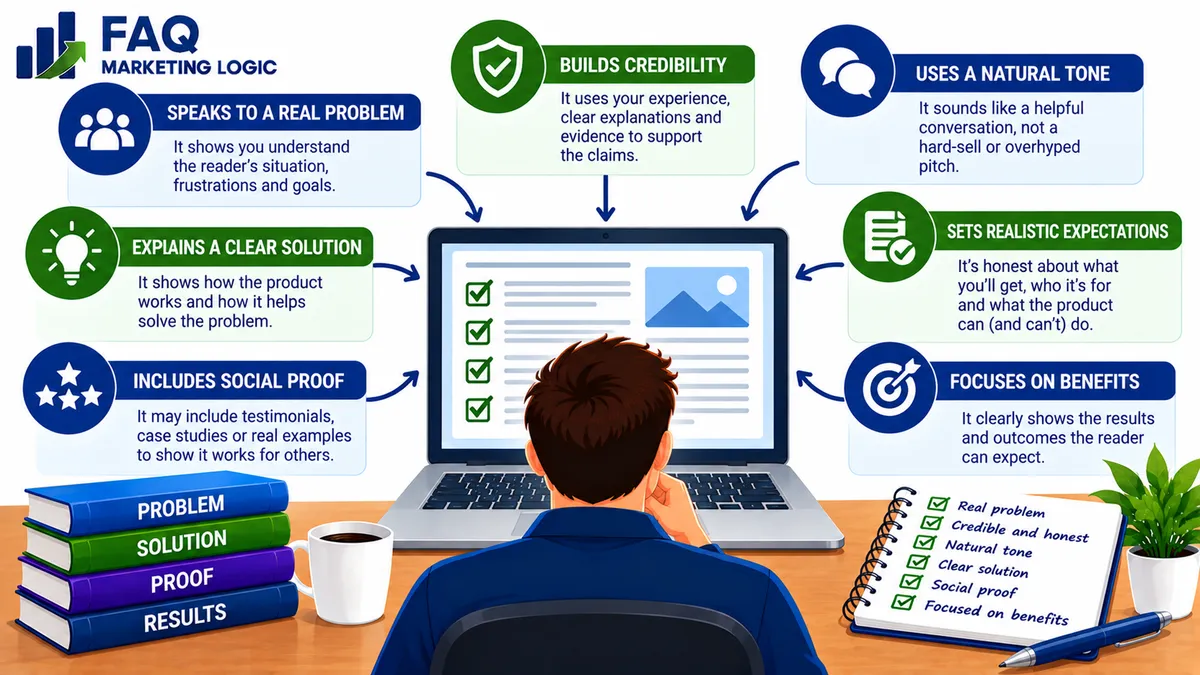
What Makes A Sales Letter Feel Believable?
TL;DR
A believable sales letter makes realistic promises, explains its offer clearly and gives readers enough evidence to judge whether the product is right for them.
Trust doesn't come from using stronger claims or more persuasive language. It develops when the message makes sense, the benefits are relevant and the supporting information matches what is being promised.
The aim isn't to remove every doubt. It's to give potential customers good reasons to feel confident about their decision.
IN SHORT
A sales letter feels believable when its claims are specific, its explanations are logical and its promises are supported by credible evidence.
Readers should be able to understand what the product does, who it helps and why the proposed solution might work.
Clear language, realistic expectations and genuine proof are more persuasive than exaggerated claims or artificial urgency.
A believable sales letter doesn't ask readers to suspend their judgement. It gives them enough information to make an informed buying decision.
WHY THIS WORKS
Believability Starts With A Realistic Promise
Every sales letter makes a promise, whether that's helping someone learn a skill, solve a problem or achieve a particular outcome.
The strength of that promise matters, but so does its credibility.
Consider a product that teaches beginners how to create their first digital guide.
A claim such as "Build a six-figure information business in seven days" may attract attention, but it also creates serious questions about whether the result is realistic.
Compare that with "Learn how to plan, structure and create your first digital guide without starting from a blank page."
The second promise is narrower, but it's also easier to understand and evaluate.
A believable promise connects the product with a result that seems possible, rather than suggesting every buyer will achieve an exceptional outcome.
Explain Why The Solution Should Work
A promise becomes more convincing when readers understand the reasoning behind it.
If you're selling a workbook that helps people choose a profitable niche, simply claiming that it makes niche selection easier isn't particularly persuasive.
Explain what the workbook actually helps them examine. Perhaps it guides them through identifying customer problems, reviewing competing offers and assessing whether people already spend money in the market.
That gives the reader a reason to believe the product could be useful.
The same principle applies to courses, software, templates and membership programmes.
You don't need to reveal every detail of the product, but you should explain enough of the process to make the benefits understandable.
When the explanation follows a logical sequence, readers can begin to see how the promised outcome connects with what they're buying.
Use Specific Details Instead Of Vague Claims
Vague statements are easy to write, but they don't give customers much to evaluate.
For example:
"This amazing system will transform your online business."
What does that actually mean?
A more useful explanation might be:
"The training shows you how to identify a suitable product idea, develop a simple offer and create a basic sales process."
The second statement identifies specific activities and gives readers a clearer picture of what the training covers.
Specificity also helps prevent misunderstandings.
If a product includes six lessons, three worksheets and a collection of templates, explain that. If it's designed for beginners rather than experienced business owners, say so.
Clear details make the offer easier to judge, which can strengthen credibility.
Support Claims With Genuine Evidence
Evidence helps readers move from understanding a promise to believing it may be achievable.
Depending on the product, that evidence could include customer feedback, demonstrations, screenshots, samples, worked examples or a clear explanation of the creator's relevant experience.
However, the evidence must support the actual claim.
A testimonial saying someone enjoyed a course doesn't prove that the course consistently produces a particular financial result.
Similarly, a screenshot showing one successful sale doesn't establish that every customer can expect the same outcome.
If you don't have testimonials yet, you can still build credibility.
Show part of the product, explain how it works, provide a useful demonstration or describe exactly what customers will receive.
Genuine evidence doesn't need to be dramatic. It needs to be relevant and accurate.
Make The Sales Letter Easy To Follow
A believable offer can lose credibility when the sales letter is confusing.
If readers struggle to understand what's being sold, how much it costs or what happens after purchase, uncertainty increases.
A logical sales letter usually introduces a recognisable problem, explains the proposed solution, demonstrates its relevance and then presents the offer.
Each section should answer a question the reader is likely to have.
For example, someone considering a digital marketing guide may want to know whether it's suitable for beginners, how much practical instruction it contains and whether they'll need additional tools.
Answering those questions naturally is often more effective than filling the page with repeated claims about how valuable the product is.
This is one reason established sales-letter approaches remain useful. They provide a structure for explaining an offer rather than simply adding more persuasive language.
If you'd like to explore how a written sales presentation can be developed into a reusable marketing asset, One Letter From Retirement introduces that approach.
Address Doubts Without Becoming Defensive
Potential customers rarely arrive at a sales page without questions.
They may wonder whether the product is suitable for them, whether they have enough experience or whether the purchase represents good value.
These concerns aren't necessarily objections to overcome through pressure. They're often reasonable questions that deserve clear answers.
For example, if you're selling a beginner's guide, explain what knowledge the reader needs before starting.
If the product requires paid software or additional resources, make those requirements clear.
If results depend on the customer's effort, experience or circumstances, avoid suggesting that success is automatic.
The more accurately you describe the product and its limitations, the easier it becomes for suitable customers to make a confident decision.
Keep The Tone Natural And Consistent
Readers notice when a sales letter suddenly shifts from helpful explanation to exaggerated excitement.
A calm, confident tone can be particularly effective when you're selling educational products because customers are looking for useful guidance rather than entertainment.
That doesn't mean sales copy must be dull.
You can use examples, comparisons, stories and strong headlines to maintain interest. The important thing is that the language remains consistent with the offer and the audience.
Avoid using urgency simply because you think every sales letter needs a deadline.
A genuine closing date or limited availability can be relevant, but an invented deadline creates a credibility problem.
The same applies to guarantees. Explain the actual terms rather than making promises that are broader than the protection customers receive.
Believability grows when the entire message feels consistent.
PRACTICAL EXAMPLE
Imagine you're selling a $49 digital guide that teaches beginners how to create their first online course.
Your original sales letter opens with the claim:
"Discover the secret system that lets anyone create a profitable online course in just one weekend."
The statement creates several problems.
It suggests that the process is effortless, implies that profitability is almost automatic and gives readers little information about what the guide actually teaches.
Now consider a more specific approach:
"Learn how to plan and structure your first online course, organise your lessons and prepare your material for delivery."
The revised promise is less dramatic, but it describes a result the product may realistically help someone achieve.
You then explain the process, show a sample course outline and describe the worksheets included with the guide.
You also clarify that creating a course doesn't guarantee sales and that marketing the finished product is a separate challenge.
The resulting sales letter gives readers more useful information and fewer reasons to question the claims.
It may not appeal to everybody, but it can help the right customers recognise whether the guide suits their needs.
REAL TALK
A sales letter doesn't become more persuasive simply because every claim is stronger than the one before it.
In fact, the opposite can happen.
When everything is described as revolutionary, effortless or guaranteed, readers have little reason to trust any of it.
You don't need to make an ordinary product sound extraordinary. You need to explain why it's useful to the people who actually need it.
That means being willing to describe limitations, answer awkward questions and avoid promising outcomes you can't substantiate.
A believable sales letter may persuade fewer unsuitable prospects, but that's not necessarily a disadvantage.
The objective is to attract customers who understand what they're buying and have realistic expectations about what the product can deliver.
FAQ QUICK FIX
Want to know whether your sales letter feels believable?
Read it as someone who has never heard of you or your business.
Then work through these five checks.
1. Examine the main promise.
Is it specific and realistic, or does it suggest results that are difficult to believe?
2. Check the explanation.
Does the letter explain how the product helps, or does it rely mainly on enthusiastic claims?
3. Review the evidence.
Are testimonials, demonstrations and examples genuine, relevant and consistent with what you're promising?
4. Look for unanswered questions.
Can readers understand what they receive, who the product is for and what limitations or requirements apply?
5. Remove unnecessary pressure.
Are deadlines, guarantees and scarcity claims genuine and clearly explained?
These checks won't guarantee more sales, but they can help you identify parts of the letter that may be creating unnecessary doubt.
FAQ
Does A Sales Letter Need Testimonials To Be Believable?
No. Genuine testimonials can provide useful evidence, but they're not the only way to establish credibility. Product demonstrations, samples, clear explanations and relevant experience can also help readers evaluate an offer.
Should I Mention The Limitations Of My Product?
Yes, when those limitations affect whether the product is suitable for a customer. Explaining requirements and realistic expectations can reduce misunderstandings and help buyers make better decisions.
Can A Short Sales Letter Be More Believable Than A Long One?
Yes. Length alone doesn't determine credibility. A short letter can work when the offer is straightforward, while a more complex or expensive product may require additional explanation and supporting evidence.
Does Strong Sales Copy Have To Sound Exciting?
No. Persuasive copy needs to hold attention and communicate value, but exaggerated language isn't essential. Clear explanations and relevant benefits can be more convincing than constant excitement.
Should I Include A Guarantee In My Sales Letter?
If you offer a guarantee, explain its terms accurately. A clear and genuine guarantee may reduce perceived risk, but it shouldn't be used to imply protection that the customer doesn't actually receive.
How Do I Make A Sales Letter Believable Without Previous Customers?
Focus on what you can demonstrate. Explain the product, show useful samples, describe the process and make realistic claims. Don't invent testimonials or imply that you've achieved results you cannot verify.
TRY THIS TODAY
Choose one sales page or promotional letter you've already written.
Read the headline, opening promise and main product explanation without looking at the rest of the page.
Ask yourself:
Is the main promise clear?
Would a first-time visitor understand what I'm selling?
Have I explained why the product could help?
Are my claims specific enough to evaluate?
Can I support the strongest statements?
Have I answered the most obvious buying questions?
Is there anything that sounds exaggerated or unnecessarily complicated?
Now rewrite one section that relies too heavily on vague claims or enthusiastic language.
Replace those claims with a clearer explanation, a practical example or relevant supporting evidence.
You don't need to rewrite the entire sales letter to make it more credible.
Sometimes one well-explained promise can do more than several paragraphs of persuasion.
Want To Make Your Sales Letters Work Harder?
A believable sales letter is a useful starting point, but it also needs to explain the offer, maintain interest and guide suitable readers towards a buying decision.
One approach is to develop a written sales presentation that can continue introducing your product to new prospects without needing to be recreated for every promotion.
If you'd like to explore that model, One Letter From Retirement introduces the idea of building a business around a reusable written sales presentation.
→ Discover One Letter From Retirement
RELATED ARTICLES
→ What Builds Trust Fastest Online?
→ How Do I Handle Customer Objections On A Sales Page?
→ What Makes An Evergreen Sales Letter Work?
QUICK RECAP
A believable sales letter gives readers clear reasons to trust what they're being told.
Make realistic, specific promises.
Explain how the product helps.
Replace vague claims with useful details.
Support important statements with genuine evidence.
Show customers what they'll receive.
Answer reasonable buying questions.
Be clear about limitations and requirements.
Avoid exaggerated language and invented proof.
Use genuine deadlines and accurate guarantees.
Keep the message natural and consistent.
A sales letter doesn't need to convince readers that your product can do everything.
It needs to help the right people understand what it can genuinely do.
Credibility makes persuasion easier because readers have fewer reasons to doubt the message.
NEXT STEP
Once your sales letter makes a believable promise and supports it with clear evidence, the next challenge is making sure the message continues to persuade new prospects over time.