
How Do I Keep Email Subscribers Interested Between Offers?
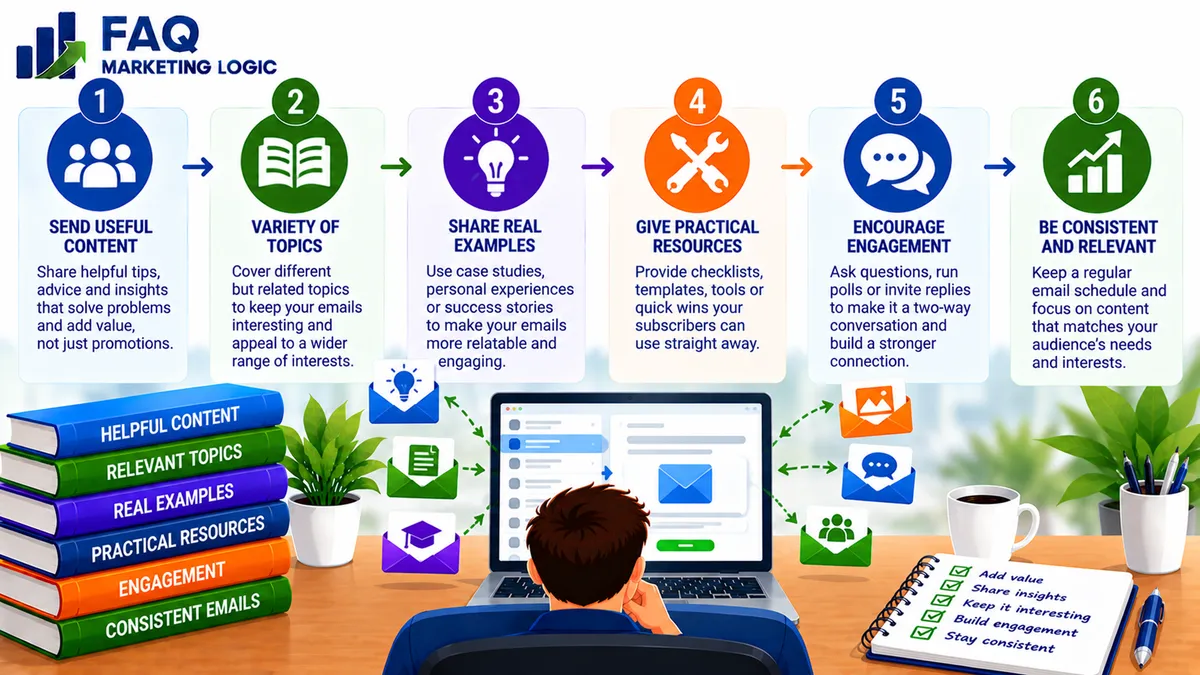
The best way to keep email subscribers interested between offers is to send useful, relevant messages that give people a reason to continue opening your emails.
You don't need to sell something in every message, but you shouldn't disappear between promotions either. Share practical advice, answer common questions, explain useful ideas and help subscribers make progress towards the goals that brought them onto your list.
When your emails consistently provide something worthwhile, relevant promotional messages are more likely to feel like a natural part of your communication rather than an unexpected interruption.
IN SHORT
Keeping subscribers interested is about maintaining relevance, not simply increasing the number of emails you send.
Your subscribers joined your list for a reason. They may want to learn a skill, solve a problem, explore a business opportunity or receive useful information about a particular subject.
The more closely your emails connect with those interests, the more reasons subscribers have to keep reading.
A simple approach is to alternate between practical teaching, useful observations, relevant examples and occasional offers.
The objective is to build familiarity and trust while helping subscribers move forward.
WHY THIS WORKS
Remember Why People Subscribed
Before deciding what to send, consider what encouraged people to join your email list in the first place.
Someone who downloaded a beginner's guide to creating digital products probably expects information about choosing ideas, developing products and finding customers.
If your next few emails cover unrelated subjects, that subscriber may quickly lose interest.
The problem isn't necessarily the quality of your writing. It's the lack of connection with the original reason for subscribing.
A useful starting point is to review your opt-in offer and the promise made on your subscription page.
What did people expect to receive? What questions are they likely to have after consuming the initial resource?
Those questions provide a natural direction for your follow-up emails.
Rather than constantly searching for something new to say, continue the conversation your lead magnet started.
This is part of building a consistent email marketing strategy rather than treating every message as a separate campaign. Our Complete Guide To Email Marketing For Beginners explains how subscriber relationships, useful content and relevant offers work together.
Give Subscribers A Reason To Open Each Email
People rarely open marketing emails simply because they recognise the sender.
They open because they expect the message to contain something useful, interesting or relevant.
That expectation develops through experience.
If your emails regularly answer questions, explain problems or offer practical suggestions, subscribers begin to understand what they'll gain by reading them.
You don't need to produce lengthy lessons every time.
A short explanation of a common mistake, a useful example or a practical tip can be enough.
The important thing is to make the message worthwhile.
For example, instead of sending a general update about your business, you might explain why beginners often create digital products before checking whether anyone wants them.
You could then suggest one simple way to investigate demand.
That gives the subscriber something they can use, even if they don't purchase anything.
Use Questions As A Source Of Email Ideas
One of the easiest ways to maintain an email conversation is to answer the questions your audience is already asking.
Every niche contains recurring problems, misunderstandings and decisions.
For an online business audience, these might include:
How do I choose a suitable product idea?
Should I build an audience before creating a product?
How much should I charge for my first offer?
What should I include in a welcome email?
How do I know whether my sales page is working?
Each question could become a useful email.
You don't need to answer everything in one message. Concentrate on one question, explain the main point and give the reader a practical next step.
This approach also helps you avoid sending emails simply to fill a schedule.
When every message addresses a recognisable problem, there's a clear reason for it to exist.
Mix Teaching With Practical Examples
Useful information becomes more interesting when readers can see how it applies to a real situation.
Suppose you're explaining why digital products should solve specific problems.
You could simply tell subscribers to choose a narrow subject.
Alternatively, you could compare a broad product called "The Complete Guide To Online Business" with a focused workbook that helps beginners choose their first business model.
The example makes the principle easier to understand.
It also gives readers something to consider when developing their own products.
Examples don't need to be dramatic success stories.
You can use hypothetical situations, comparisons, simple calculations or observations from common business problems.
Just make it clear when an example is illustrative rather than an actual customer result.
The purpose is to make your advice easier to apply.
Maintain A Consistent Email Rhythm
Subscribers are more likely to recognise and remember your emails when you communicate reasonably consistently.
That doesn't mean you must send a message every day.
The right frequency depends on your audience, the subject and the value you're able to provide.
For some businesses, two or three emails each week may be appropriate. Others may communicate less frequently.
The important thing is to choose a rhythm you can maintain without sacrificing quality.
Long gaps can make your next promotional email feel unexpected, particularly if subscribers have forgotten why they joined.
However, sending more messages simply to remain visible can create the opposite problem.
A consistent schedule should support useful communication rather than become a reason to send unnecessary emails.
Give People Something To Do
An email doesn't need to contain a sales offer to encourage action.
You can invite subscribers to think about a question, try a small exercise, read a related article or reply with their experience.
For example, an email about product ideas might end by asking readers to write down three problems their intended customers regularly experience.
That gives the message a practical purpose.
Occasionally inviting replies can also help you understand what subscribers are struggling with.
Not everyone will respond, and that's perfectly normal.
However, the questions and comments you do receive may provide useful ideas for future emails, products and articles.
The key is to make the action relevant to the message rather than asking for engagement simply to increase activity.
Connect Your Content To Your Offers Naturally
Keeping subscribers interested between promotions doesn't mean avoiding commercial subjects altogether.
If your business helps people create and sell digital products, it's reasonable to discuss problems connected with that process.
You might explain how to choose a product idea, why clear offers matter or how to build a simple sales process.
Those subjects can naturally lead towards relevant products when the time is right.
The distinction is between providing useful information and turning every email into a sales pitch.
For example, an email explaining how to write clearer promotional messages could provide a practical tip before introducing a relevant training resource.
If you're exploring a more structured approach to selling through email, The Lazy Way To Email Riches introduces a system focused on email marketing and monetisation.
The important thing is to make recommendations that fit the subscriber's interests and the subject you're discussing.
Pay Attention To Signs Of Declining Interest
Even a useful email sequence can become less effective over time.
Subscriber interests change. Some people solve their original problems, while others become interested in different aspects of the subject.
Watch for patterns in your email performance.
Click-through rates, replies, unsubscribes and spam complaints can all provide useful signals.
Open rates may offer some indication of activity, but they're not always reliable because email privacy features can affect how opens are recorded.
A single email receiving fewer clicks isn't necessarily a problem.
However, a sustained decline in engagement may suggest that your content, frequency or audience targeting needs attention.
Rather than immediately sending more emails, investigate what subscribers are responding to.
You may discover that practical tutorials perform better than general updates, or that certain subjects consistently generate more interest.
Use those observations to improve your content.
PRACTICAL EXAMPLE
Imagine someone joins your email list after downloading a free guide about starting an information publishing business.
Your welcome sequence introduces the subject and delivers the promised resource.
You then begin sending regular emails.
During the first week, you explain how to identify a problem people might pay to solve.
In the second week, you share an example of turning a broad idea into a focused digital product.
The following week, you discuss a common pricing mistake and offer a simple exercise to help readers evaluate their first offer.
None of these messages needs to contain a sales pitch.
However, they're all connected with the subscriber's original interest.
When you eventually recommend a relevant product, the offer follows naturally from the subjects you've been discussing.
The subscriber has already received useful information and understands why the resource might be relevant.
That doesn't guarantee a purchase, but it creates a more coherent experience than disappearing for several weeks and returning with an unrelated promotion.
REAL TALK
One of the easiest mistakes in email marketing is treating the time between promotions as empty space.
You send several emails when there's something to sell, then go quiet until the next campaign.
From the business owner's perspective, that may seem perfectly reasonable.
From the subscriber's perspective, the relationship can start to feel rather one-sided.
Every time they hear from you, there's another offer.
The solution isn't to send endless free information or avoid selling.
You have a business to run, and suitable offers are part of that.
The solution is to make your emails useful even when nobody buys anything.
A subscriber who regularly learns something from your messages has a reason to remain interested.
And when you do make an offer, it becomes part of an established conversation rather than the only reason you ever get in touch.
COMMON MISTAKES
Mistake: Only emailing when you have something to sell.
Subscribers hear from you during promotions but receive little useful communication between them.
Fix: Maintain a manageable schedule of relevant information, examples and practical advice.
Mistake: Sending content unrelated to the original opt-in.
People subscribe for one subject but receive emails about several unrelated topics.
Fix: Build your follow-up content around the interests and expectations that attracted subscribers.
Mistake: Making every email too complicated.
You try to teach an entire subject in one message, leaving readers with too much information.
Fix: Concentrate on one useful idea or question at a time.
Mistake: Increasing frequency when engagement falls.
You assume that sending more emails will automatically generate more interest.
Fix: Review relevance, content quality and subscriber behaviour before changing the schedule.
Mistake: Avoiding offers completely.
You provide useful information but never introduce subscribers to products that could help them further.
Fix: Recommend relevant resources when they provide a logical next step.
FAQ QUICK FIX
Want to keep your subscribers interested without constantly creating new promotions?
Start by planning a simple sequence of useful emails.
1. Identify the main subscriber interest.
Write down the problem or goal that encouraged people to join your list.
2. Choose three related questions.
Think about what subscribers need to understand after receiving your initial resource.
3. Create one email for each question.
Keep the messages focused and provide a useful explanation or practical suggestion.
4. Include a relevant next step.
Invite readers to try an exercise, explore a related article or consider a useful resource.
5. Review the response.
Look for clicks, replies and other meaningful signs that subscribers find the content useful.
You can repeat this process with new questions as your email programme develops.
FAQ
How Often Should I Email Subscribers Between Offers?
There's no universal frequency. Choose a schedule that suits your audience and allows you to provide useful information consistently. Quality and relevance matter more than sending a particular number of messages.
What Should I Send When I Have Nothing To Promote?
Answer common questions, explain useful concepts, share practical examples, discuss mistakes or help subscribers complete a small task. Your emails can provide value without containing a sales offer.
Will Subscribers Get Bored If I Keep Teaching The Same Subject?
Not necessarily. People often need different explanations and examples as they develop their understanding. However, avoid repeating identical advice without adding anything useful.
Should Every Email Include A Link?
No. Some emails may simply explain an idea or invite a reply. Include links when they help subscribers access relevant information or take an appropriate next step.
How Do I Know Whether Subscribers Are Still Interested?
Look for patterns in clicks, replies, unsubscribes and complaints. Use open rates cautiously because privacy features can make them unreliable.
Can I Sell Products While Building Subscriber Engagement?
Yes. Useful content and promotional emails can work together. The important thing is to recommend relevant products and avoid making every message feel like an unrelated sales pitch.
TRY THIS TODAY
Open your email marketing system and look at the last five messages you've sent.
For each email, ask:
Did it address a recognisable subscriber problem?
Was the main point easy to understand?
Did it provide something useful?
Was the subject connected with the reason people subscribed?
Did it include a sensible next step?
Was the message mainly helpful, mainly promotional or a mixture of both?
Would someone have a reason to read it even if they weren't ready to buy?
Now plan your next three non-promotional emails.
Choose one common question for each message and write a short explanation that helps the reader make progress.
You don't need to create an elaborate newsletter.
Three useful messages that connect with your subscribers' interests are a practical starting point.
Want To Make Your Email Marketing Work Harder?
Keeping subscribers interested is an important part of building an email marketing business.
But maintaining engagement is only one part of the process.
You also need to understand how useful communication, relevant offers and well-structured promotional emails work together.
If you'd like to explore that approach further, The Lazy Way To Email Riches introduces a system for developing and monetising an email list.
→ Discover The Lazy Way To Email Riches
RELATED ARTICLES
→ How Often Should You Send Emails?
→ How to Increase Email Engagement and Click-Through Rates
→ Email Segmentation: When and How to Segment Your List
QUICK RECAP
Keeping subscribers interested means giving them a reason to value your emails between promotions.
Remember why people joined your list.
Focus on subjects connected with their interests.
Answer common questions and solve recognisable problems.
Use practical examples to make advice easier to understand.
Maintain a consistent, manageable sending schedule.
Encourage useful actions without making every email a sales pitch.
Introduce relevant products when they fit the conversation.
Monitor meaningful engagement rather than relying entirely on open rates.
Adjust your content as subscriber needs change.
You don't need to entertain subscribers constantly or produce something extraordinary in every message.
You need to make your emails worth receiving.
When subscribers regularly find your messages useful, they have a reason to keep reading even when you're not making an offer.
NEXT STEP
Once you're keeping subscribers interested with useful content, the next challenge is learning how to introduce offers without making your emails feel unnecessarily promotional.