
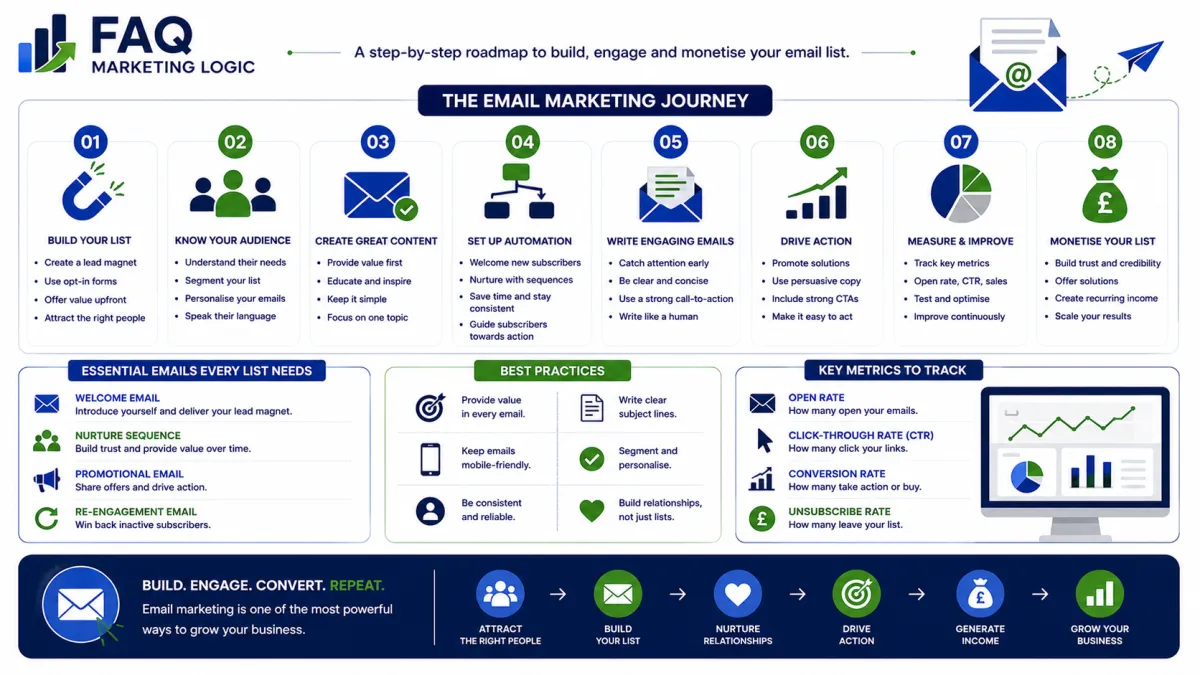
The Complete Guide To Email Marketing For Beginners
TL;DR
Email marketing gives you a direct way to communicate with people who have chosen to hear from you.
For beginners, the goal is not to build complicated automations or send constant promotions. Start by attracting the right subscribers, providing useful information, building trust, and introducing relevant offers when they make sense.
A simple email marketing system can turn occasional website visitors into an audience you can communicate with repeatedly.
Introduction
Website traffic is useful.
But most visitors leave.
Some may return. Many won't.
Email marketing gives you a way to continue the relationship after someone leaves your website.
Instead of depending entirely on Google, social media, paid advertising, or another platform to bring the same person back, you can communicate with subscribers directly.
That makes email one of the foundations of a sustainable online marketing system.
But beginners often make it unnecessarily complicated.
They worry about sophisticated funnels, dozens of automations, advanced segmentation, and sending the perfect email.
You don't need any of that to begin.
You need a reason for someone to subscribe, something useful to say, and a relevant next step when they're ready for more.
Key Definition
Email marketing is the use of permission-based email communication to build relationships with subscribers and encourage actions such as reading content, considering an offer, or becoming a customer.
A basic email marketing system consists of:
A way to collect email addresses.
A useful reason for someone to subscribe.
An email marketing platform.
An initial welcome sequence.
Regular communication.
Relevant offers.
The technology matters.
But the relationship matters more.
Why Email Marketing Matters
Most marketing channels depend on someone else's platform.
Search rankings change.
Social media algorithms change.
Advertising costs change.
An email list is different because you've created a direct communication channel with people who have actively chosen to hear from you.
That doesn't mean you own the subscriber.
It means you have permission to continue the conversation.
This makes email particularly valuable for businesses that use content to attract potential customers.
The journey can become:
Content → Subscriber → Relationship → Relevant Offer → Customer
Instead of needing to win someone's attention from scratch every time, you can build familiarity over multiple interactions.
Start With A Reason To Subscribe
"Join my newsletter" isn't always a compelling reason to give someone an email address.
People are more likely to subscribe when there's a clear exchange of value.
That might be:
A useful report.
A checklist.
A template.
A short course.
A resource library.
A practical guide.
The best incentive solves a problem closely related to what your business eventually sells.
That creates alignment between the subscriber's initial interest and the offers you may introduce later.
What Should Happen After Someone Subscribes?
Don't collect email addresses and then disappear.
The first few emails should help new subscribers understand:
Who you are.
What you can help them with.
What type of emails they'll receive.
Why continuing to read will be worthwhile.
This is where a welcome sequence becomes useful.
It doesn't need to contain twenty emails.
A short sequence can introduce your approach, provide useful information, and help the subscriber become familiar with your business.
After that, regular communication can continue the relationship.
What Should You Email About?
This is where many beginners get stuck.
They assume every email needs to contain something groundbreaking.
It doesn't.
Useful emails can:
Answer a common question.
Explain a mistake.
Share a useful article.
Tell a relevant story.
Challenge a misconception.
Provide a practical tip.
Introduce a useful product or service.
The important thing is relevance.
Your emails should consistently help subscribers understand or solve the problems that brought them to you in the first place.
How Often Should You Email Your List?
There is no universal perfect frequency.
Consistency matters more.
Sending several emails one week and then disappearing for two months makes it difficult to build familiarity.
Choose a schedule you can maintain.
That might mean:
Once a week.
Twice a week.
Three times a week.
Some businesses email more frequently.
Others email less.
The right frequency depends on your audience, your content, and what subscribers expected when they joined.
The key is to remain useful enough that your emails continue to deserve attention.
How Do Emails Build Trust?
Trust usually develops through repeated positive interactions.
Each useful email provides another opportunity to demonstrate that you understand the subscriber's problem.
You build trust when you:
Give practical advice.
Explain things clearly.
Keep your promises.
Avoid unnecessary hype.
Recommend relevant solutions.
Respect the reader's attention.
One brilliant email rarely creates a customer relationship.
Consistent usefulness can.
When Should You Start Selling?
You don't need to avoid selling.
Your subscribers understand that businesses sell things.
The problem begins when every email feels like a promotion.
A better approach is to make offers part of the broader relationship.
Provide useful information.
Help subscribers recognise problems.
Explain possible solutions.
Then introduce relevant products when they genuinely help someone take the next step.
Selling becomes much easier when the offer fits naturally with the conversation you've already been having.
Email Marketing Is A Journey
It helps to think about email marketing as progression rather than a collection of broadcasts.
A simple journey might look like:
Visitor → Subscriber → Welcome → Education → Trust → Offer → Customer
Not everyone moves through that journey at the same speed.
Some subscribers may buy quickly.
Others may read your emails for months before purchasing anything.
That's normal.
Your job isn't to force everyone towards a sale.
It's to make the next logical step clear when they're ready.
What Should Beginners Measure?
You don't need dozens of metrics.
Start with a few basic signals.
Delivery
Are your emails successfully reaching subscribers?
Opens
Are people interested enough in the sender and subject line to open the email?
Open data is not perfectly reliable, so treat it as a directional signal rather than an exact measurement.
Clicks
Are readers taking the next step?
Clicks can show whether your content and call-to-action created enough interest for someone to continue.
Conversions
Are subscribers completing the action the email was designed to encourage?
That might mean:
Reading an article.
Downloading something.
Registering for an event.
Purchasing a product.
Metrics should help you improve decisions, not simply give you numbers to watch.
Practical Example
Imagine someone discovers your website through Google while researching how to start an online business.
They read a helpful article.
At the bottom of the page, you offer a free guide that helps them take the next step.
They subscribe.
Instead of hoping they remember your website next week, you can now continue helping them through email.
They receive:
The resource they requested.
A welcome email.
Several useful follow-up emails.
Recommendations for relevant articles.
Eventually, an offer related to the problem they're trying to solve.
The original website visit created attention.
Email turned that attention into an ongoing relationship.
That's the real value of email marketing.
Common Mistakes
Mistake: Building a list without a clear reason for people to subscribe.
Fix: Offer something genuinely useful and closely related to the problems your business solves.
Mistake: Only emailing when you have something to sell.
Fix: Communicate consistently between promotions.
Mistake: Trying to automate everything immediately.
Fix: Start with a simple welcome sequence and regular emails before adding complexity.
Mistake: Sending emails about unrelated subjects.
Fix: Keep communication aligned with why people originally joined your list.
Mistake: Obsessing over list size.
Fix: Focus on relevance and engagement. A smaller interested audience can be far more valuable than a large indifferent one.
FAQ Quick Fix
If you're starting email marketing today:
Create one useful reason to subscribe.
Add a simple opt-in form.
Deliver what you promised immediately.
Create a short welcome sequence.
Choose a sustainable email frequency.
Send genuinely useful information.
Introduce relevant offers naturally.
Track clicks and conversions.
Improve based on subscriber behaviour.
You don't need a complicated system.
You need a useful one.
FAQ
Q: Do beginners really need an email list?
If you're building an online business, an email list gives you a direct way to continue communicating with interested visitors rather than relying entirely on them returning to your website.
Q: How big should my email list be before I start selling?
There is no minimum number. If your offer is relevant and can genuinely help the subscriber, you can introduce it to a small list.
Q: Do I need an automated email funnel?
Not initially. A simple welcome sequence followed by regular communication is enough to start.
Q: Should every email contain a link?
No. The email should have a purpose, but that purpose doesn't always need to be generating a click.
Q: Can I email subscribers too often?
Yes, particularly if the emails aren't useful or the frequency is very different from what subscribers expected. Relevance and consistency matter more than chasing an arbitrary number of emails.
Conclusion
Email marketing doesn't need to be complicated.
At its core, you're building a direct relationship with people who have shown an interest in what you do.
Give them a worthwhile reason to subscribe.
Deliver what you promised.
Continue helping them.
Build familiarity and trust.
Then introduce products and services when they represent a logical next step.
That's email marketing without the unnecessary machinery.
RELATED ARTICLES
→ When Should I Start Building My Email List?
→ How to Build a High-Converting Welcome Sequence
→ How to Turn Subscribers into Revenue
QUICK RECAP
Beginner email marketing comes down to:
Attracting relevant subscribers.
Providing a clear reason to join.
Welcoming new subscribers properly.
Communicating consistently.
Building trust.
Making relevant offers.
Measuring meaningful actions.
You don't need the biggest list.
You need a list of people who have a reason to keep listening.
NEXT STEP
Once you have subscribers and are communicating consistently, the next step is learning how to present an offer that feels relevant and valuable rather than simply promotional.
Read: