
What Is The Best Welcome Email To Send First? | FAQ Marketing Logic
TL;DR
The best first welcome email delivers what the subscriber asked for, confirms what they can expect from you, and gives them one simple next step.
Don't try to tell your entire story or sell everything immediately.
Your first email has one main job:
Make the subscriber glad they joined.
IN SHORT
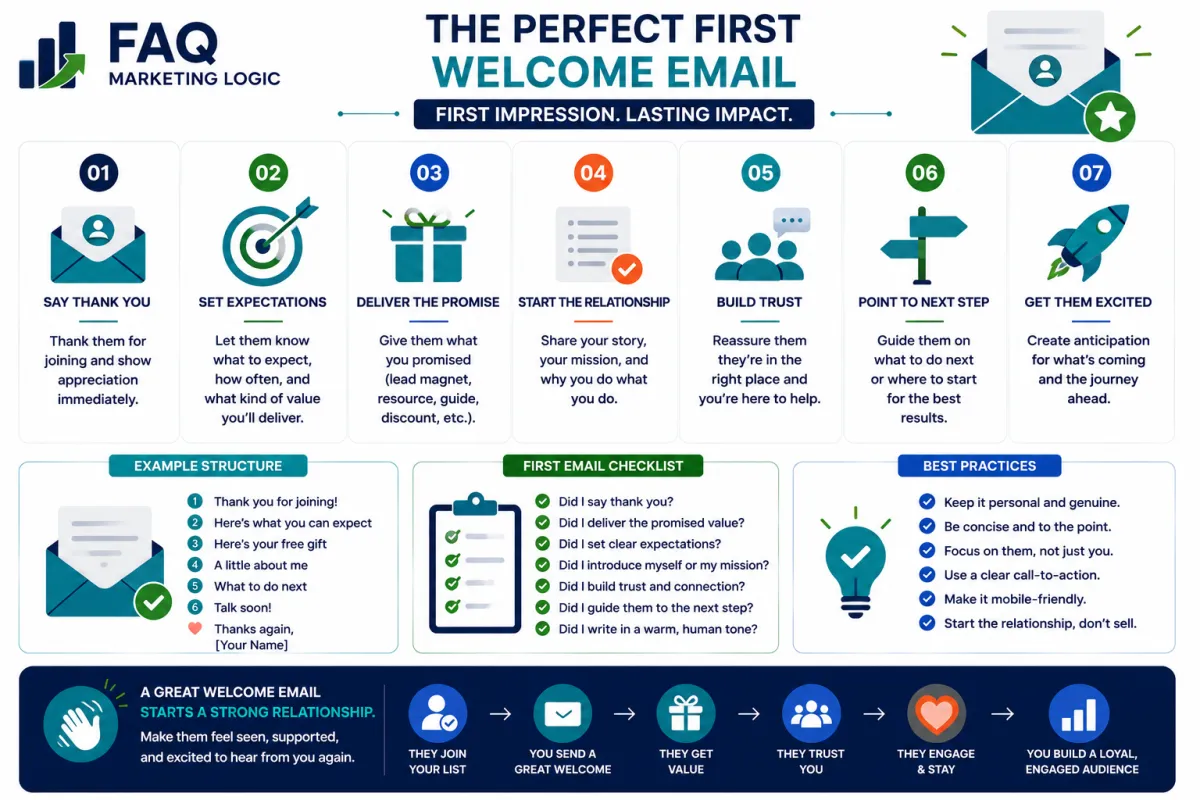
A strong first welcome email should:
Arrive immediately.
Deliver the promised resource.
Confirm why the subscriber is receiving it.
Introduce you briefly.
Set expectations for future emails.
Provide one clear next step.
The first email begins the relationship.
Keep it useful, simple, and relevant.
REAL TALK
Someone has just trusted you with access to their inbox.
Don't reward them with a corporate autobiography.
And don't immediately hit them with three products, seven links, and a "special offer that expires at midnight."
They subscribed for a reason.
Start there.
If you promised a report, give them the report.
If they joined for a course, tell them how to access it.
If they asked for updates, explain what they'll receive.
Your first welcome email should fulfil the promise that persuaded them to subscribe.
Everything else comes afterwards.
Key Definition
A welcome email is the first message sent to a new subscriber after they join an email list.
It normally confirms the subscription, delivers any promised resource, introduces the sender, and establishes what the subscriber should expect next.
A welcome email is different from a welcome sequence.
The welcome email is the first individual message.
The welcome sequence is the series of emails that follows and develops the relationship over time.
That distinction matters because your first email doesn't need to accomplish everything.
What Should The First Welcome Email Achieve?
Think of the first email as a handover.
The subscriber has moved from:
Visitor → Subscriber
Your job is to make that transition smooth.
The email should answer four immediate questions:
Did my subscription work?
Where is the thing I requested?
Who is emailing me?
What happens next?
Answer those clearly and you've already created a good first experience.
Deliver What You Promised First
If someone subscribed to receive a free guide, checklist, template, report, or other resource, make that the priority.
Don't bury the download link halfway through a long email.
Put it near the beginning.
For example:
Thanks for requesting the guide. You can access it here:
Download Your Guide
Then continue with the rest of the email.
The subscriber shouldn't have to search for something you've already promised them.
Remind Them Why They're Hearing From You
People forget quickly.
Even if your welcome email arrives immediately, a short reminder provides context.
Something as simple as:
You're receiving this because you requested my free guide on building an email list.
is enough.
This becomes even more important if the subscriber doesn't open the email until later.
Context reduces confusion.
Introduce Yourself Briefly
The subscriber needs to know who you are.
They don't necessarily need your entire life story.
A short introduction can explain:
Who you are.
What you help people with.
What they can expect from you.
For example:
I'm Dean, and I publish practical marketing guides designed to make online marketing easier to understand and implement.
That's enough to begin establishing context.
You can tell more of your story later when it's relevant.
Set Expectations
Tell subscribers what happens next.
Will you email:
Once a week?
Several times a week?
When new resources are available?
As part of a short welcome sequence?
You don't need to create a detailed schedule.
Simply give them a reasonable idea of what they've joined.
For example:
Over the next few days, I'll send you several short emails that build on the guide you've just downloaded.
Now the next email isn't unexpected.
You've prepared the subscriber for it.
Give Them One Next Step
Your first welcome email can encourage another action.
But keep it simple.
Depending on your business, that might be:
Read the report.
Visit a Start Here page.
Read one useful article.
Reply to a question.
Add your email address to their contacts.
Complete the first lesson.
Avoid presenting five different options.
The subscriber has only just arrived.
One useful next step is enough.
Should You Sell In The First Welcome Email?
You can.
But that doesn't mean you always should.
If the subscriber joined specifically because of a product-related offer and the next logical step is commercial, introducing it may be appropriate.
But for many lists, the first email is better used to deliver the promised value and establish the relationship.
There's plenty of time to sell.
A welcome sequence gives you opportunities to:
Educate.
Demonstrate expertise.
Understand subscriber needs.
Introduce relevant products.
Handle objections.
Make offers.
You don't need to squeeze the entire customer journey into email number one.
What Should The Subject Line Say?
Your first welcome email is one place where clarity is particularly valuable.
The subscriber has just taken an action and may be actively looking for your message.
Subject lines such as:
Here's your free guide
Welcome – here's what happens next
Your download is ready
can work perfectly well.
You don't necessarily need curiosity.
The subscriber already has a reason to open.
Make it easy for them to recognise the email they're expecting.
Practical Example
Imagine someone joins your list to receive a free report called:
10 Ways To Make Money Online
A complicated welcome email might:
Tell your entire business story.
Promote three products.
Link to four blog posts.
Ask them to follow three social accounts.
Explain your complete philosophy.
Finally provide the report link near the bottom.
That's a lot to ask from someone who has known you for approximately thirty seconds.
A simpler first email could say:
[First Name]
Thanks for requesting 10 Ways To Make Money Online.
You can download your copy here.
I'm Dean. I create practical resources for people who want to build online income without getting buried under unnecessary complexity.
Over the next few days, I'll send you some additional ideas to help you think through which online business approach might suit you.
For now, start with the report.
Speak soon,
Dean
That's enough.
The promise has been fulfilled.
The subscriber knows who's writing.
They know what happens next.
And there's one obvious action.
Common Mistakes
Mistake: Making subscribers search for the promised resource.
Fix: Deliver it prominently near the beginning.
Mistake: Writing an enormous introduction about yourself.
Fix: Explain who you are and why you're relevant. Save the longer story for later.
Mistake: Including too many calls-to-action.
Fix: Give the subscriber one clear next step.
Mistake: Immediately pushing multiple products.
Fix: Prioritise the reason the subscriber joined.
Mistake: Giving no indication of what happens next.
Fix: Set simple expectations for future communication.
FAQ QUICK FIX
Build your first welcome email around these six elements:
1. Recognisable subject line.
Make it easy for the subscriber to find the email they're expecting.
2. Simple welcome.
Thank them for joining or requesting the resource.
3. Deliver the promise.
Provide access immediately.
4. Brief introduction.
Explain who you are and why you're relevant.
5. Set expectations.
Tell them roughly what happens next.
6. One next step.
Give the subscriber one useful action to take.
That's enough for email number one.
FAQ
Q: How quickly should a welcome email arrive?
Ideally, immediately after someone subscribes. If they've requested something, they're most likely expecting it straight away.
Q: How long should the first welcome email be?
As long as necessary to deliver the promise, provide context, and establish the next step. In many cases, that means relatively short.
Q: Should my first welcome email contain links to my products?
It can when a product is genuinely relevant, but don't feel obliged to sell immediately. Delivering what the subscriber requested should remain the priority.
Q: Should I ask subscribers to reply?
A simple question can encourage early interaction when it serves a purpose. Just don't overload the email with several competing actions.
Q: Is one welcome email enough?
It can be, but a welcome sequence gives you more room to introduce your business, provide value, learn about subscribers, and eventually present relevant offers.
TRY THIS TODAY
Open your current first welcome email.
Now imagine you're a brand-new subscriber who knows very little about you.
Can you immediately answer:
Where is the thing I requested?
Who is this person?
Why should I keep reading their emails?
What should I do next?
If any answer is unclear, simplify the email.
Your new subscriber doesn't need everything.
They need a good beginning.
RELATED ARTICLES
→ What Should I Send My Email List First?
→ How Do I Write Better Email Subject Lines?
→ How Can I Make My Emails Clearer and More Direct? (Without Sounding Harsh?)
QUICK RECAP
The best first welcome email:
Arrives quickly.
Delivers the promised value.
Provides context.
Introduces the sender briefly.
Sets expectations.
Gives one clear next step.
Don't try to build the entire relationship in one message.
Simply make the first interaction worth having.
NEXT STEP
Once the first welcome email has done its job, you can use the emails that follow to build familiarity, provide more value, and guide the subscriber towards appropriate next steps.
Read: