
How Often Should I Make Offers To My Email List?
TL;DR
You should make offers to your email list regularly enough that subscribers understand what you sell, but not so frequently that every message feels like another sales pitch.
There's no universal rule for how often to promote. The right balance depends on what subscribers signed up for, how frequently you email them and whether your offers are genuinely relevant.
The aim is to make selling a natural part of your email marketing rather than something you either avoid or overdo.
IN SHORT
For many beginners, including a relevant offer in one email each week can be a reasonable starting point, provided the rest of your communication delivers useful information and builds trust.
However, the number of promotional emails matters less than their relevance. Subscribers who understand your business and receive useful emails may welcome suitable offers more frequently.
A clear offer that helps solve a problem is often more valuable than another email containing general advice with no practical next step.
WHY THIS WORKS
Why You Shouldn't Avoid Making Offers
One of the most common mistakes in email marketing is waiting too long before introducing something for sale.
You might spend weeks sharing tips, answering questions and trying to build relationships because you're worried that mentioning a product will upset subscribers.
But if someone joins your list because they're interested in learning how to build an online business, it's reasonable that you might eventually recommend a relevant guide, course or training programme.
The important thing is to establish the right expectations. Subscribers should understand the type of information and occasional promotions they'll receive when they join your list.
If you never make offers, you may build an engaged audience without giving interested subscribers a clear way to become customers.
How Often Is Too Often?
Sending three promotional emails in a week isn't automatically excessive, just as sending one promotional email a month isn't automatically appropriate.
What matters is the relationship between the emails, the subscriber's expectations and the value of the offers.
For example, someone who joins a list specifically to receive product recommendations may expect frequent promotions. Someone who subscribes to a weekly educational newsletter may find daily sales messages intrusive.
You also need to consider whether you're repeatedly presenting the same offer without providing any new reason to consider it.
If subscribers receive several emails that all say essentially the same thing, increasing the frequency is unlikely to make the message more persuasive.
A better approach is to vary the reason for making the offer, explain its relevance and ensure that your other emails continue to provide useful information.
Start With A Simple Email Rhythm
If you're unsure how often to promote, begin with a schedule you can maintain consistently.
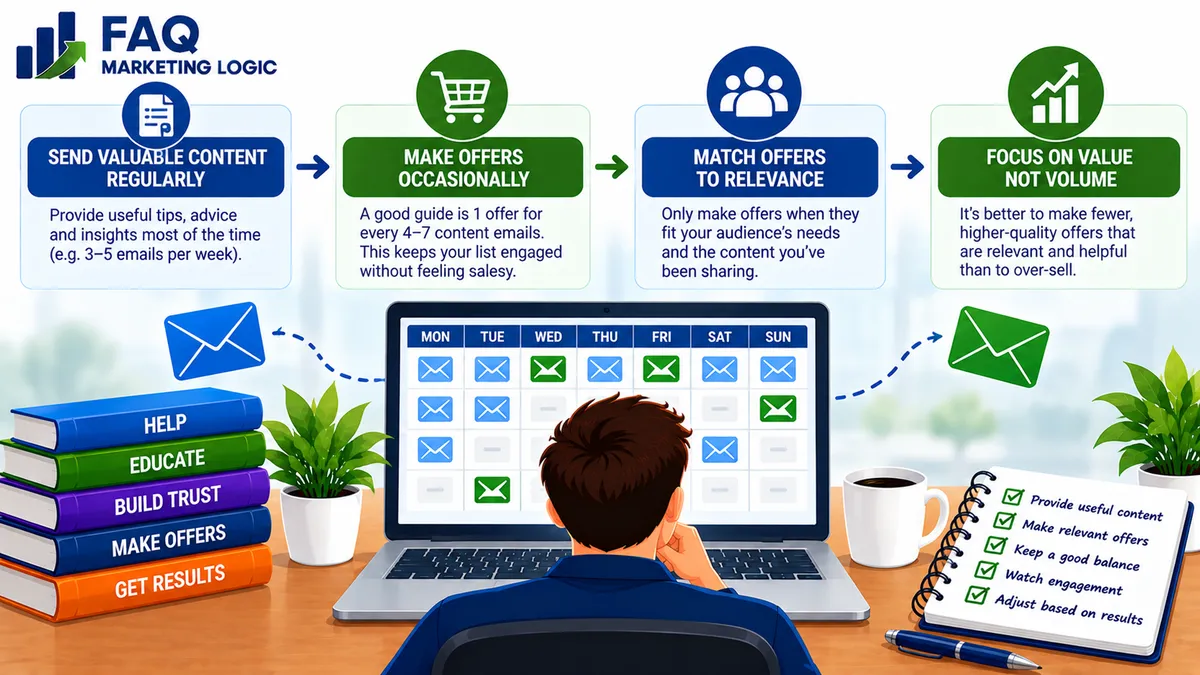
For example, if you send three emails each week, you might use two to share practical advice and one to introduce a relevant offer.
That isn't a fixed formula. It's simply a starting point that gives you room to educate subscribers while making it clear that your business also sells products.
Over time, you may discover that certain topics naturally lead towards particular offers. An email explaining a common mistake might introduce a workbook that helps avoid it, while a tutorial could recommend a more detailed training programme.
This approach often feels more natural than dividing every email into either a purely educational message or an aggressive sales promotion.
If you're looking for a more structured approach to combining useful emails with relevant offers, The Lazy Way To Email Riches explores email marketing as a practical income-building system.
Match The Offer To The Subscriber's Problem
Frequency alone doesn't determine whether subscribers welcome a promotion.
Imagine you've been sending emails about choosing and creating digital products. You then recommend a guide that helps readers validate their first product idea.
That recommendation follows naturally from the subject you've been discussing.
Now imagine sending the same subscribers an unrelated offer simply because you have an affiliate promotion available.
Even if you send fewer emails, the second approach may feel less useful because the connection isn't obvious.
Before making an offer, ask whether it addresses a problem your subscribers recognise and whether you've explained why it matters.
You don't need to hide the fact that you're selling. You need to make the recommendation relevant.
Use Different Types Of Promotional Emails
Not every sales email needs to follow the same structure.
One message might introduce a product and explain who it's designed to help. Another could address a common objection, demonstrate how the product works or answer questions potential buyers are likely to have.
You can also use a useful teaching email that naturally leads to a relevant offer.
For example, an email about improving subject lines could explain three common mistakes and then recommend more detailed email training for subscribers who want further help.
Each message should have a clear purpose rather than repeating the same sales pitch with a different subject line.
During a planned promotion, you may send several emails about one offer over a short period. That can be appropriate when subscribers understand the promotion and each message adds something useful.
Outside those periods, a more regular mixture of helpful content and suitable offers may be easier to maintain.
Let Subscriber Behaviour Guide Your Decisions
Instead of relying entirely on someone else's recommended schedule, pay attention to how your own subscribers respond.
Email clicks, replies, unsubscribes, complaints and purchases can all provide useful information.
For example, if promotional emails receive relevant clicks and generate sales without a noticeable increase in complaints or unsubscribes, your approach may be working.
If engagement declines and subscribers begin leaving after repeated promotions, review the frequency, relevance and quality of your messages.
Remember that a single email rarely tells the whole story. Look for patterns over several weeks rather than changing your approach after every campaign.
You can also separate subscribers according to their interests or previous actions, where you have suitable permission and data. This allows you to recommend products more selectively instead of sending every offer to everybody.
PRACTICAL EXAMPLE
Suppose you have an email list of 300 subscribers interested in creating and selling digital products.
You send three emails each week.
On Monday, you explain how to recognise a digital product idea that might have commercial potential. On Wednesday, you share a practical example of testing an offer before building the complete product.
On Friday, you introduce a relevant guide that helps readers choose and validate a product idea.
The Friday email doesn't arrive out of nowhere. It follows the problems and solutions you've been discussing throughout the week.
The following week, you might cover a different subject and recommend another suitable resource, or continue helping subscribers without introducing a new product.
You then review the results to see whether people are opening, clicking, replying and buying.
This gives you a repeatable starting point without assuming every subscriber wants the same number of promotional emails.
REAL TALK
There's a tendency to treat selling to an email list as something that needs an apology.
It doesn't.
People understand that businesses sell products. What they object to is receiving irrelevant promotions, exaggerated promises or endless reminders about offers that don't interest them.
If you've attracted subscribers with useful information and you're recommending something that genuinely helps them, making an offer is a reasonable part of the relationship.
The bigger mistake may be spending months building a list and then being too uncomfortable to tell people what you sell.
You don't need to promote constantly, but you do need to give interested subscribers opportunities to buy.
FAQ QUICK FIX
If you're unsure how often to make offers, use these five steps:
Check subscriber expectations. Make sure your email frequency and promotional content are consistent with what people signed up to receive.
Choose a manageable schedule. Start with a regular email rhythm you can maintain without sacrificing quality.
Include relevant offers. Recommend products that connect directly with the problems and interests you've been discussing.
Vary your promotional messages. Explain benefits, answer questions and address genuine concerns instead of repeating identical sales pitches.
Review the response. Look at clicks, sales, complaints and unsubscribes before adjusting your frequency.
The objective is to find a pattern that works for your subscribers and your business, not to follow an arbitrary promotional ratio.
COMMON MISTAKES
Mistake: Waiting until subscribers know you extremely well before making an offer.
Fix: Introduce relevant products naturally once subscribers understand what your emails provide.
Mistake: Following a fixed promotional ratio without considering your audience.
Fix: Use a starting schedule, then adjust it according to subscriber expectations and results.
Mistake: Repeating the same offer without adding anything useful.
Fix: Explain different benefits, answer genuine questions or provide practical examples.
Mistake: Promoting products simply because they're available.
Fix: Recommend offers that connect with your subscribers' interests and problems.
Mistake: Increasing email frequency whenever sales are disappointing.
Fix: Review the offer, message and audience fit before assuming more emails will solve the problem.
FAQ
Is It Okay To Sell In Every Email?
It can be appropriate for a list that explicitly expects frequent product recommendations. For a general educational list, making every message primarily promotional may weaken engagement. The important factors are relevance, expectations and the usefulness of each email.
How Many Promotional Emails Should I Send Each Week?
There's no fixed number. One relevant promotional email per week can be a practical starting point for some lists, but you should adjust according to your overall email frequency and subscriber response.
Will Making Offers Cause People To Unsubscribe?
Some subscribers may leave after receiving promotions. That doesn't automatically mean you've done something wrong. However, repeated increases in unsubscribes or complaints are reasons to review your approach.
Should I Send More Emails During A Product Launch?
You can increase promotional frequency during a clearly defined launch, particularly when each email provides useful information or addresses a different buying concern. Make sure the campaign remains consistent with subscriber expectations.
Should I Promote The Same Product More Than Once?
Yes, when there's a useful reason to revisit it. Different emails can explain the product's benefits, demonstrate its application or answer common questions without simply repeating the same message.
TRY THIS TODAY
Look at the last ten emails you've sent to your subscribers.
Identify how many provided useful information, how many introduced an offer and whether the promotions were relevant to the subjects you were discussing.
Then plan your next three emails around one problem your subscribers want to solve.
Use the first two to provide practical guidance and the third to introduce a suitable product or resource that helps them take the next step.
You now have a simple promotional sequence you can test and improve.
NEXT STEP
Once you've established a sensible offer frequency, the next challenge is making your promotional emails feel helpful rather than repetitive.
→ How Do I Promote Offers Without Annoying Subscribers?
For a broader approach to building an email system that combines useful communication with relevant promotions, explore The Lazy Way To Email Riches.
It provides a starting point for thinking about how email marketing can support sales without relying on constant promotional pressure.
QUICK RECAP
There isn't one ideal offer frequency for every email list.
Make offers regularly rather than avoiding them altogether.
Start with a manageable schedule and adjust it using real results.
Match promotions to subscriber interests and expectations.
Use helpful content to introduce relevant products naturally.
Avoid repeatedly sending the same sales message.
Review engagement and sales before increasing promotional frequency.
Good email marketing gives subscribers useful reasons to stay and clear opportunities to buy.
RELATED QUESTIONS
→ What Makes An Email Offer More Compelling?