How Do I Turn Email Subscribers Into Customers?
TL;DR
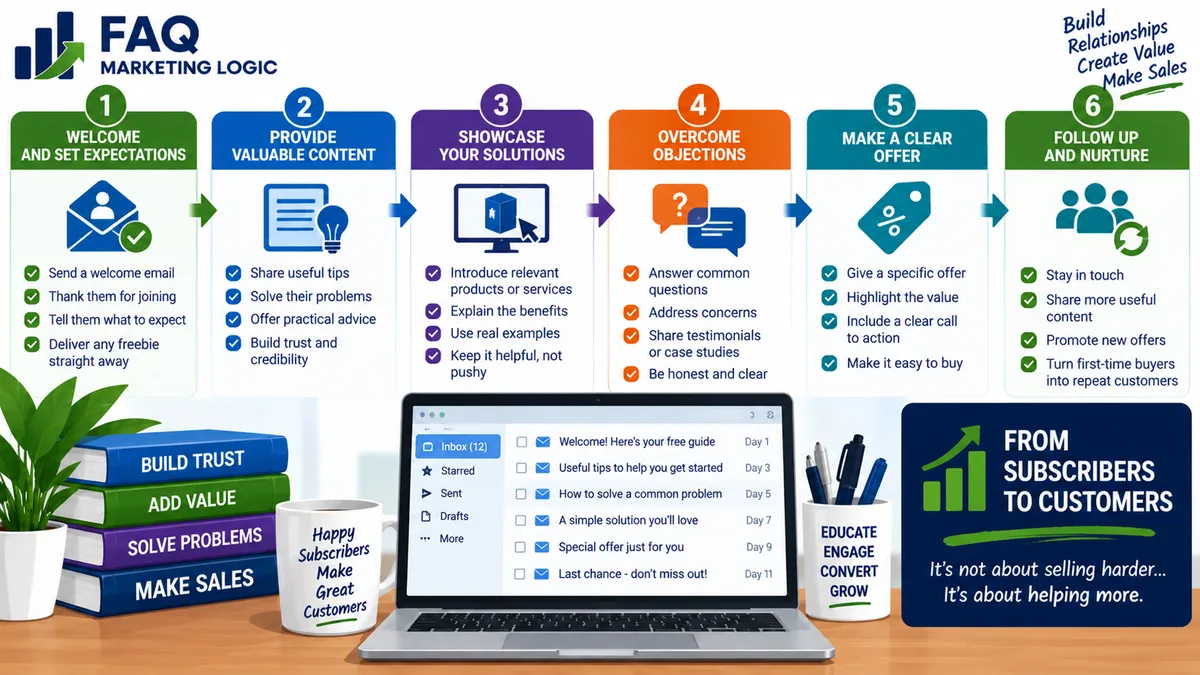
You turn email subscribers into customers by moving them from interest to trust to action.
That means sending more than promotional emails. Subscribers need to understand who you are, why your emails are useful, what problem your offer solves and why taking the next step makes sense.
The most effective email marketing usually combines useful content, relevant offers, clear calls-to-action and consistent follow-up.
A subscriber doesn't become a customer simply because they're on your list. You need to give them a reason to buy.
IN SHORT
Getting someone to subscribe is only the beginning.
They've raised their hand and said:
"I'm interested in this subject."
They haven't necessarily said:
"I'm ready to buy something."
Your emails help bridge that gap.
They can:
Build familiarity
Demonstrate usefulness
Explain problems
Introduce solutions
Answer objections
Recommend products
Create buying opportunities
Bring people back when the timing is better
The goal isn't to pressure every subscriber into buying as quickly as possible.
It's to help the right subscriber recognise when one of your offers is the logical next step.
REAL TALK
A large email list isn't automatically a valuable email list.
You could have 10,000 subscribers who rarely open, click or buy.
Another business could have 1,000 subscribers who regularly read the emails and respond to relevant offers.
Which list would you rather own?
Subscriber numbers are easy to notice.
Subscriber behaviour matters more.
The purpose of email marketing isn't simply to collect email addresses.
It's to build an audience you can communicate with and, where appropriate, turn some of those subscribers into customers.
Key Definition: What Does Turning Subscribers Into Customers Mean?
Turning subscribers into customers means using email communication to help people who have joined your list move towards making a purchase.
That process may include:
Subscriber → Engaged Reader → Prospect → Customer
Not everybody will move through those stages at the same speed.
Some subscribers may buy quickly.
Others may read your emails for weeks or months before purchasing.
Some will never buy.
Your job is to create a clear path for the people who do have the problem your offer solves.
Start With The Reason They Subscribed
Before trying to sell anything, ask:
Why did this person join my list?
Perhaps they wanted:
A free report
A checklist
A template
A discount
A newsletter
A free course
More information about a subject
An answer to a particular problem
That initial reason gives you an important clue about what they may want next.
Suppose someone downloads:
A Beginner's Guide To Building An Email List
A natural next offer might involve:
Email marketing
Lead generation
Email copywriting
Follow-up sequences
An unrelated offer about cryptocurrency trading would make far less sense.
The closer the offer is to the subscriber's original interest, the easier the transition from free information to paid solution can become.
What Should Happen Immediately After Someone Subscribes?
Start by delivering what you promised.
If they requested a report, give them the report.
If they registered for a course, explain how to access it.
If they joined a newsletter, tell them what to expect.
Your first emails can also establish:
Who you are
What you help with
What kinds of emails you'll send
How frequently you'll communicate
What they should do next
This creates a much stronger foundation than collecting an email address and immediately sending a stream of unrelated promotions.
Build Familiarity Before Expecting The Sale
People are generally more comfortable buying when they understand who they're dealing with.
Email gives you repeated opportunities to demonstrate:
What you know
How you think
How you explain things
What you recommend
What your business stands for
Whether your advice is useful
You don't need to manufacture a false relationship.
Simply be consistently useful and recognisable.
Over time, your name appearing in the inbox should mean something to the subscriber.
Send Emails That Solve Small Problems
One of the easiest ways to demonstrate value is to help before asking for money.
Your emails might provide:
A quick tip
A useful explanation
A common mistake
A short checklist
An example
A different way to think about a problem
A link to a useful article
You don't need to give away everything.
But subscribers should have evidence that opening your emails is worthwhile.
A useful free email can create the thought:
"If this is what they give away, the paid material might be worth looking at."
Connect Your Content To Your Offers
This is where many email marketers make things harder than necessary.
They send useful content for several weeks.
Then suddenly:
BUY MY PRODUCT!
The promotion feels disconnected from everything that came before it.
A smoother approach is to let the content naturally lead towards the offer.
For example:
Email topic: Why subscribers stop opening emails.
You explain several reasons.
Then you might say:
"Of course, getting subscribers to open your emails is only part of the job. The next challenge is turning that attention into revenue."
Now an email marketing offer makes sense.
The offer is continuing the conversation rather than interrupting it.
Make The Offer Relevant To The Problem
Before promoting anything, ask:
What problem does this product solve for this subscriber?
If you can't answer clearly, the offer may not be relevant enough.
Good email monetisation is less about finding opportunities to mention products and more about creating the right match between:
subscriber + problem + offer + timing.
That applies whether you're selling:
Your own product
A service
A membership
A course
A licensed product
An affiliate offer
The mechanism changes.
The principle doesn't.
Don't Be Afraid To Sell
There's another extreme to avoid.
Some marketers provide useful information week after week but rarely make an offer because they're worried subscribers will unsubscribe.
But if your business sells products and your subscribers joined because they're interested in the problems those products solve, relevant offers are part of the relationship.
The key word is:
relevant.
You don't need to apologise for recommending something that could genuinely help the reader.
Explain:
What it is
Who it's for
What problem it addresses
Why you're recommending it
What they should do next
Then allow the subscriber to decide.
Give People A Clear Call-To-Action
Don't make readers guess what you want them to do.
Compare:
"Anyway, you can find out more on the website."
with:
"Click here to see how the complete email marketing system works."
The second tells the reader exactly what happens next.
Your CTA could ask someone to:
Read an article
Watch a video
View a product
Register for something
Request more information
Start a trial
Make a purchase
The important thing is that the action is clear and connected to the email.
Use More Than One Email To Sell
A common mistake is sending one promotional email and assuming everyone who wants the product will buy.
People miss emails.
They get distracted.
They intend to return later.
They may need more information.
They may have an objection the first email didn't address.
A short promotional sequence could approach the same offer from several directions:
Email 1: Introduce the problem and solution.
Email 2: Explain an important benefit.
Email 3: Address a common objection.
Email 4: Give an example or answer questions.
Email 5: Remind the reader of the offer and next step.
You're not necessarily repeating the same email.
You're giving the subscriber different reasons to consider the same solution.
If you'd like to explore how email can be used to promote offers and turn subscriber attention into revenue, you can explore the email marketing approach here.
What About Subscribers Who Don't Buy?
Keep communicating with them if they remain engaged and want to receive your emails.
A subscriber might not buy because:
They don't need the product
They can't afford it right now
They aren't ready
They need more information
The timing is wrong
They prefer another solution
A "no" today doesn't necessarily mean "never".
This is one of email marketing's biggest advantages.
You can continue providing value and make another relevant offer later.
Should Every Email Sell Something?
No.
But every email should ideally have a purpose.
Some emails can:
Educate
Build engagement
Share useful content
Ask a question
Send readers to an article
Introduce an idea
Promote an offer
And some can combine these purposes.
For example, an educational email can teach something useful and naturally recommend a product that helps the reader go further.
You don't need an artificial wall between content emails and sales emails.
Useful content can sell.
Promotional emails can teach.
How Often Should I Promote Products?
There isn't a universal ratio.
The right frequency depends on:
Why people joined
What you promised
How often you email
What you're selling
The buying cycle
How relevant your promotions are
Subscriber engagement
Sending too few offers can mean leaving interested buyers without a clear next step.
Sending constant unrelated promotions can train people to ignore you.
Watch how subscribers respond rather than relying on an arbitrary rule such as "four content emails for every sales email".
Should I Sell My Own Products Or Affiliate Products?
You can do either.
Your own products can give you more control over:
Pricing
Positioning
Customer experience
Follow-up
Profit margins
Affiliate offers allow you to recommend products created by somebody else and earn a commission when qualifying sales are made.
The same relevance rule applies.
Don't promote something simply because it pays a commission.
Ask whether it makes sense for the audience you've built.
Segment Subscribers When It Helps
As your list grows, not every subscriber will be interested in the same thing.
Segmentation can help you send more relevant messages.
You might segment according to:
Lead magnet downloaded
Links clicked
Products purchased
Subjects of interest
Previous engagement
Suppose one subscriber repeatedly clicks articles about membership businesses while another reads everything about email marketing.
Those behaviours provide useful clues about what each person may want next.
You don't need dozens of complicated segments from day one.
Start simple and add segmentation when it helps you communicate more effectively.
What Happens After A Subscriber Buys?
Don't treat the purchase as the end of the email relationship.
Customers need communication too.
After someone buys, you might:
Confirm the purchase
Explain access
Help them get started
Provide support
Encourage product use
Ask for feedback
Introduce complementary offers later
You should also avoid repeatedly promoting the exact product they've already purchased when your email system can identify them as a customer.
The transition from subscriber to customer should improve the relevance of your communication.
Practical Example
Imagine you run a website helping beginners create digital products.
Someone subscribes to receive:
7 Questions To Answer Before Creating Your First Digital Product
Instead of immediately promoting a $97 product, you create a short follow-up journey.
Email 1: Deliver the checklist and explain the first thing to decide.
Email 2: Explain why beginners often choose subjects that are too broad.
Email 3: Show how a smaller product can be easier to create and sell.
Email 4: Introduce your product creation course as the structured next step.
Email 5: Answer the objection: "But I don't know enough to create a product."
Email 6: Remind them what the course helps them accomplish and give them a clear link.
The emails aren't random.
They take the subscriber from the original problem towards a relevant paid solution.
That's the role of a good email sequence.
Common Mistakes
Mistake: Promoting something immediately without connecting it to why the person subscribed.
Fix: Start with their original interest and lead naturally towards the next problem or solution.
Mistake: Sending useful content but never making an offer.
Fix: Give interested subscribers clear opportunities to become customers.
Mistake: Promoting unrelated products because the commission looks attractive.
Fix: Prioritise relevance to the subscriber.
Mistake: Relying on one promotional email.
Fix: Use follow-up to explain the offer from different angles.
Mistake: Treating every subscriber identically forever.
Fix: Use simple segmentation when behaviour shows different interests.
Mistake: Stopping useful communication after the sale.
Fix: Use email to support customers and deepen the relationship after purchase.
FAQ QUICK FIX
If subscribers are joining your list but rarely becoming customers, check these five things:
Why did they originally subscribe?
Does your offer solve a problem connected to that reason?
Have your emails demonstrated enough value and relevance?
Have you clearly explained what the product does and who it's for?
Have you actually asked them to take a specific next step?
If one of those links is missing, that's where I'd start.
FAQ
How Long Should I Wait Before Selling To A New Subscriber?
There's no fixed waiting period. If the offer is directly connected to why someone subscribed, it can be introduced early. What matters more than an arbitrary number of days is relevance and context.
Can I Promote A Product In My Welcome Sequence?
Yes. A welcome sequence can introduce relevant products as part of helping the subscriber understand what you offer. Avoid turning every welcome email into an unrelated sales pitch.
Why Do Subscribers Open My Emails But Not Buy?
Possible reasons include poor offer relevance, unclear value, weak positioning, insufficient trust, price concerns or an unclear CTA. Opens show attention, not necessarily buying intent.
Should I Remove Subscribers Who Never Buy?
Not simply because they haven't purchased. Someone can remain a useful, engaged subscriber for a long time before becoming a customer. However, consistently inactive subscribers are a separate list-management issue worth reviewing.
How Many Sales Emails Should I Send For One Offer?
There isn't a fixed number. Enough emails to explain the offer, address important questions and give interested subscribers reasonable opportunities to act is more useful than choosing an arbitrary sequence length.
Do I Need A Large Email List To Make Sales?
No. List size alone doesn't determine sales. Relevance, engagement, the strength of the offer and the relationship with subscribers all matter.
TRY THIS TODAY
Choose one offer you currently sell or promote.
Now write down:
Who is it for?
What problem does it solve?
Why would somebody on my list care about that problem?
What would they need to understand before considering the offer?
Then outline three emails:
Email 1: Explain the problem.
Email 2: Explain a useful part of the solution.
Email 3: Introduce the offer as the next step.
You've just created the beginnings of a simple subscriber-to-customer pathway.
Want To Turn More Of Your Subscribers Into Customers?
Building the list is only the beginning.
The real opportunity comes from knowing how to communicate with subscribers, make relevant offers and use email to generate sales without turning every message into a hard sell.
The Lazy Way To Email Riches explores how email can become a practical selling system rather than simply a way to send occasional messages to your list.
→ Discover The Email Marketing Approach
RELATED ARTICLES
→ What Makes An Email Offer More Compelling?
→ How Do I Promote Offers Without Annoying Subscribers?
→ How to Structure Sales Emails That Convert
QUICK RECAP
Turning subscribers into customers isn't about sending more sales pitches.
It's about creating a logical journey.
Start with why the person subscribed.
Deliver what you promised.
Build familiarity through useful communication.
Connect your content naturally to relevant offers.
Make the value of the offer clear.
Give subscribers a specific call-to-action.
Use follow-up rather than relying on one email.
Continue communicating with people who aren't ready to buy.
Segment when it improves relevance.
Keep communicating after somebody becomes a customer.
A subscriber has already shown interest.
Email gives you the opportunity to turn that initial interest into trust, action and eventually a customer relationship.
NEXT STEP
Once you've started turning subscribers into customers, the next step is improving the emails that actually present your offers.