
What Makes An Email Offer More Compelling?
TL;DR
A compelling email offer connects the right solution to a problem the subscriber already understands.
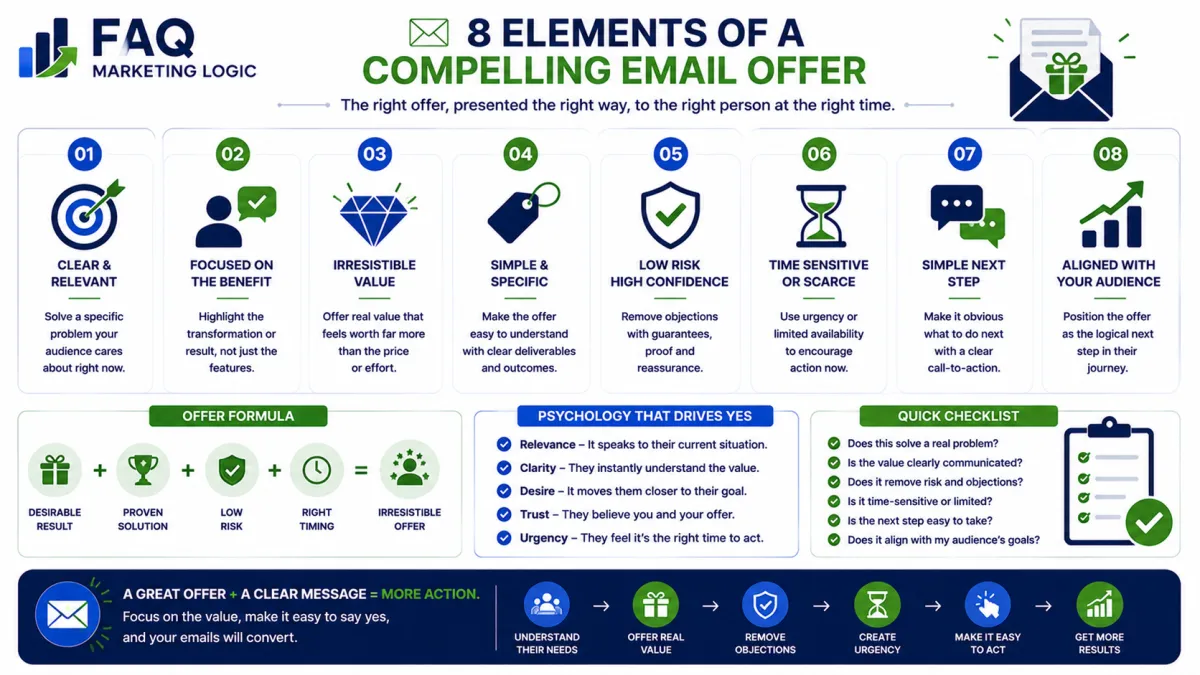
Strong email offers are relevant, specific, easy to understand, and presented at the right time. The goal is not to make the offer sound irresistible through hype. It is to make the value of taking the next step clear.
IN SHORT
A compelling email offer gives the reader a clear reason to act.
It should answer:
What am I getting?
How will it help me?
Why is it relevant to me?
Why should I consider it now?
What should I do next?
The stronger the connection between the subscriber's problem and your solution, the less persuasion you usually need.
REAL TALK
A clever email cannot rescue a weak offer.
You can write an attention-grabbing subject line.
Tell an engaging story.
Create a strong call-to-action.
But if the reader reaches the offer and thinks:
"I don't really need this."
the rest doesn't matter.
Before trying to improve your sales emails, make sure you're presenting something your subscribers actually want.
Better email marketing starts with better offer alignment.
Key Definition
An email offer is the product, service, opportunity, or next step presented to a subscriber through email.
The offer itself is not simply the product.
It includes:
What the customer receives.
The problem it solves.
The outcome it helps create.
The price or commitment required.
Any bonuses or additional value.
The reason to act.
A compelling offer makes that exchange easy to understand.
Start With Relevance
Relevance is one of the strongest forms of persuasion.
Imagine someone joined your list because they downloaded a guide about building an email list.
A course about email marketing is a logical recommendation.
A course about YouTube advertising probably isn't.
The second product might be excellent.
It simply doesn't match the reason that person joined your list.
This is why understanding subscriber intent matters.
The closer the offer is to the problem that originally attracted the subscriber, the more natural the promotion feels.
Make The Outcome Specific
Weak offers often describe what the customer receives.
Strong offers explain what those things help the customer achieve.
For example:
Weak:
"Get our 12-module email marketing course."
Stronger:
"Build a simple email system that turns new subscribers into engaged prospects and customers."
The twelve modules still matter.
But they're the delivery mechanism.
The customer is buying the result those modules are designed to help produce.
Reduce The Mental Work
Your subscriber shouldn't have to work out why the offer matters.
Make the connection explicit.
Explain:
Problem → Solution → Benefit → Next Step
If your reader has to reread several paragraphs to understand what you're selling, the offer is probably too complicated.
Clarity reduces friction.
Match The Offer To The Conversation
Good promotional emails don't suddenly change direction.
They create a logical progression.
For example:
You might explain why businesses struggle to generate sales from their email lists.
Then identify one of the causes.
Then explain how that problem can be solved.
Then introduce a product that helps implement the solution.
The offer becomes the continuation of the conversation rather than an interruption.
That's very different from writing an educational email and suddenly adding:
"By the way, buy this."
Give People A Reason To Act
A compelling offer should answer another important question:
Why should I do this now?
Sometimes there is a genuine reason:
A deadline.
Limited availability.
A live event.
An introductory price.
A genuine bonus period.
But urgency should be real.
You don't need artificial countdown timers or permanently "ending tonight" discounts.
If there isn't a legitimate deadline, focus on the cost of leaving the problem unresolved.
The reason to act can simply be that solving the problem sooner produces the desired result sooner.
Reduce Perceived Risk
Buying involves uncertainty.
The reader may wonder:
Will this work for me?
Is it worth the money?
Can I actually use it?
Is this company trustworthy?
Your email doesn't necessarily need to answer every objection, but it should reduce enough uncertainty for the reader to take the next step.
You can do that with:
Testimonials.
Specific examples.
Demonstrations.
Guarantees.
Clear explanations.
Relevant proof.
The bigger the commitment, the more reassurance people usually need.
Don't Try To Sell Everything In The Email
An email doesn't always need to complete the entire sale.
Sometimes its job is simply to generate enough interest for the subscriber to visit the sales page.
That distinction matters.
Trying to cram every feature, benefit, testimonial, bonus, guarantee, and objection into one email can overwhelm the reader.
Instead, decide what the email needs to achieve.
Often that means:
Create relevance → Build interest → Encourage the click
Then let the sales page do the heavier selling.
Practical Example
Imagine you're promoting a £27 guide about writing better sales emails.
One email says:
"Our Email Marketing Guide Is Now Available"
and then lists ten chapters.
Another begins by discussing why subscribers can open emails regularly but still never buy anything.
It explains that getting attention and creating buying intent are different skills.
Then it introduces the guide as a practical way to learn how to structure emails that move readers towards an offer.
Same product.
Same price.
Different presentation.
The second version connects the product to a recognised problem.
That makes the offer more compelling without changing the product itself.
Common Mistakes
Mistake: Leading with the product rather than the problem.
Fix: Establish why the offer matters before explaining what it contains.
Mistake: Listing features without explaining their value.
Fix: Connect features to useful outcomes.
Mistake: Promoting unrelated products to everyone.
Fix: Match offers to subscriber interests wherever practical.
Mistake: Manufacturing urgency.
Fix: Use genuine reasons to act or explain the benefit of solving the problem sooner.
Mistake: Trying to close the entire sale inside every email.
Fix: Know whether the email's job is to generate a purchase or earn the next click.
FAQ Quick Fix
Before sending a promotional email, ask:
Is the offer relevant?
Does it connect naturally to what this subscriber cares about?Is the outcome clear?
Can the reader quickly understand how the offer helps?Is the value specific?
Have you explained benefits rather than simply listing features?Is there enough trust?
Have you reduced the most important uncertainty?Is the next step obvious?
Does the reader know exactly what to do?
If those five elements are present, you have the foundations of a compelling email offer.
FAQ
Q: Should every email contain an offer?
No. Some emails should educate, build relationships, share useful content, or simply maintain communication.
Q: Should I include the price in the email?
It depends on the offer and the purpose of the email. Including the price can qualify clicks, while withholding it may allow the sales page to establish value first.
Q: Do bonuses make an email offer more compelling?
They can, but only when they complement the main product. Random bonuses can make an offer feel more complicated rather than more valuable.
Q: How many products should I promote in one email?
Usually one primary offer. Multiple unrelated offers divide attention and make the desired next step less clear.
Q: Can I promote the same offer more than once?
Yes. Subscribers won't necessarily see, open, or act on the first promotion. You can approach the same relevant offer from different angles without repeating the same email.
TRY THIS TODAY
Look at the next product you plan to promote.
Before writing the email, complete this sentence:
"This is particularly useful for someone who wants to ______ because it helps them ______."
If you struggle to complete that sentence clearly, don't write the promotion yet.
Clarify the offer first.
RELATED ARTICLES
→ How to Structure Sales Emails That Convert
→ How Do I Turn Subscribers Into Buyers?
→ What Emails Actually Drive Sales?
QUICK RECAP
Compelling email offers rely on:
Relevance.
Clear outcomes.
Specific value.
Logical timing.
Reduced risk.
One obvious next step.
You don't make an offer stronger by shouting louder.
You make it stronger by making the connection between the reader's problem and your solution easier to understand.
NEXT STEP
Once the offer is relevant and compelling, you still need to earn the subscriber's attention before they can see it.
The next step is improving the first thing they see in their inbox.
Read: