
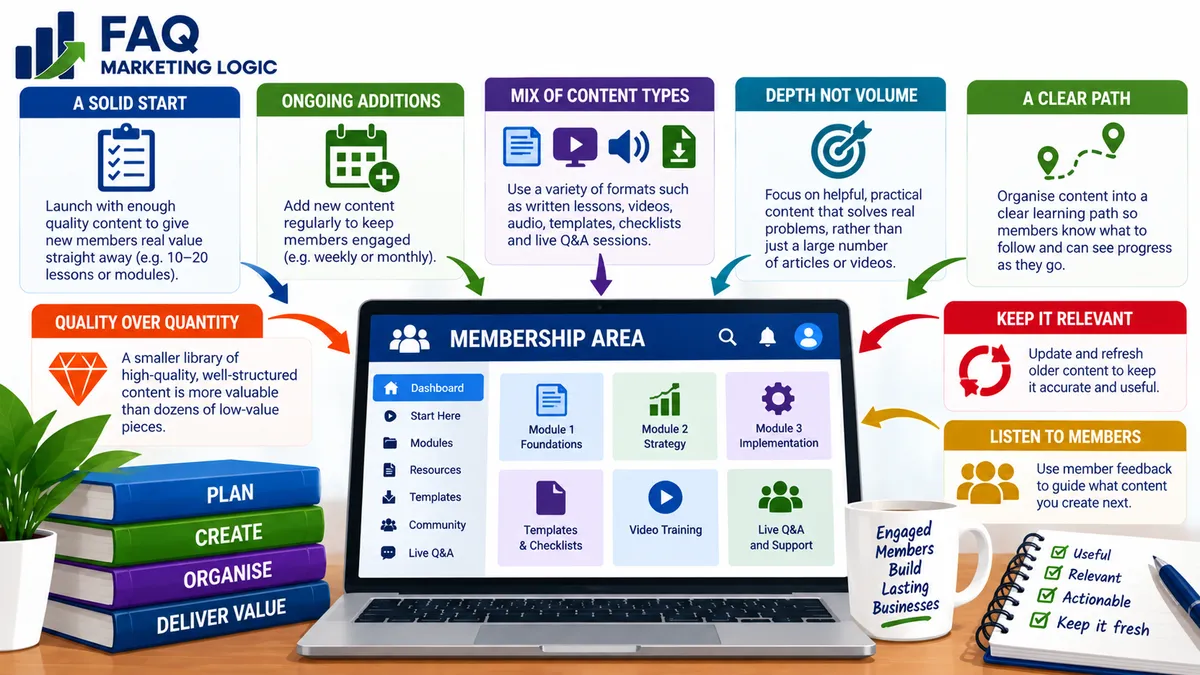
How Much Content Does A Membership Need?
TL;DR
A membership needs enough content to help members achieve the reason they joined, not an endless stream of new material.
One of the biggest mistakes membership owners make is assuming they must constantly create new courses, videos, downloads and resources to justify the monthly fee. That can overwhelm members and create an exhausting content treadmill for the owner.
Instead, concentrate on useful core content, a clear path through it and ongoing reasons to remain a member. Those reasons might include support, community, accountability, updates, new resources or continued access.
More content doesn't automatically create more value.
IN SHORT
It's easy to imagine a membership needs an enormous library before anyone will pay for it.
So you start creating.
Ten videos become twenty.
Twenty become fifty.
Then you add worksheets, checklists, interviews and another course because the membership still doesn't feel "big enough".
Before long, you've created a mountain of material and haven't actually launched anything.
There's a simpler way to think about it.
Ask:
What does a member need to get started and make meaningful progress?
Build around that first.
You can improve the membership as you learn what members genuinely need.
REAL TALK
Your members probably don't want another 200 hours of content.
They already have more information available than they can consume.
What they often want is help deciding:
What should I do first?
What should I do next?
What can I ignore?
A smaller membership that gives somebody a clear route forward can be considerably more useful than an enormous library where they don't know where to begin.
The goal isn't to impress people with the size of your content library.
It's to help them use the membership successfully.
Key Definition: What Is Membership Content?
Membership content is the material, resources and experiences provided to members as part of their ongoing subscription.
Depending on the membership, this could include:
Training
Videos
Written guides
Templates
Checklists
Workshops
Live calls
Q&A sessions
Community discussions
Software or tools
Research
Updates
Resource libraries
But content is only one part of the membership experience.
People may also remain members because of:
Support
Community
Accountability
Convenience
Continued access
Regular updates
Access to expertise
That's why asking "How much content do I need?" can sometimes be the wrong starting question.
A better question is:
"What ongoing value do members need?"
If you'd like to explore how memberships can create recurring income without relying on an endless supply of new content, you can explore the recurring-income approach here.
Do I Need Lots Of Content Before Launching?
Usually not.
You need enough to fulfil the promise you're making to your first members.
Suppose you're creating a membership that helps beginners learn email marketing.
You might think you need courses covering:
List building
Lead magnets
Welcome sequences
Copywriting
Automation
Segmentation
Deliverability
Promotions
Analytics
Advanced funnels
before you're allowed to launch.
But perhaps your first members really need:
A clear process for getting their first email marketing system working.
You could begin with the essential material needed to accomplish that.
Then expand according to what members actually need rather than trying to predict every possible question before anybody joins.
Start With A Core Path
One of the most useful things you can give a new member is direction.
Instead of presenting:
"Here are 87 resources. Good luck."
create a starting path.
For example:
Step 1: Start here.
Step 2: Set this up.
Step 3: Complete this.
Step 4: Use this resource.
Step 5: Move on to this when you're ready.
That immediately makes the membership feel more manageable.
It also means you don't need dozens of resources simply to create the impression of value.
Organisation itself creates value.
Does A Membership Need New Content Every Month?
Not necessarily.
This is one of the most important distinctions to understand.
A membership needs ongoing value.
That isn't automatically the same thing as ongoing content.
Consider a software membership.
Customers may continue paying because they keep using the software.
A community membership may retain members because they value the conversations and connections.
A coaching membership might provide ongoing value through regular calls and support.
A resource membership might provide updates when something genuinely changes.
New content can certainly be part of a membership.
It just doesn't have to become:
"I must create another course because it's the first of the month."
Why Can Too Much Content Become A Problem?
More content sounds like greater value.
But members don't experience value by counting files.
They experience it by getting something useful from what you've provided.
Too much content can create:
Confusion
Decision fatigue
Overwhelm
Lack of progress
A growing backlog
The feeling of falling behind
Imagine joining a membership and immediately discovering 400 training videos.
You might initially think:
"Wow, look how much I'm getting."
A week later you might think:
"I'm never going to get through this."
Quantity has started working against the member.
Should I Drip Content Or Give Everything Immediately?
Either can work.
With immediate access, members can explore everything at their own pace.
That works particularly well when:
Content isn't dependent on a strict sequence
Members have different needs
The library is easy to navigate
People may need specific resources immediately
Dripping content can be useful when:
Lessons need to be completed in order
You want to reduce overwhelm
Members benefit from focusing on one stage at a time
The membership follows a structured programme
Don't drip content simply to stop someone from accessing what they've paid for.
Use it when the sequence genuinely improves the experience.
How Often Should I Add New Material?
There is no universal schedule.
It depends on the promise you've made.
If you advertise:
"A new training workshop every month"
then members reasonably expect a new workshop every month.
If the membership promises:
"Access to our complete resource library plus regular updates when needed"
the expectation is different.
Your marketing determines part of the workload.
Be careful about promising a content schedule that becomes difficult to sustain.
It's much easier to add an unexpected useful resource than explain why the weekly masterclass you promised has quietly become monthly.
What Content Should I Create Next?
Let members help answer that.
Pay attention to:
Questions they ask
Problems they encounter
Support requests
Community discussions
Resources they use most
Content they rarely use
Reasons they cancel
Suggestions they make
Suppose five members ask the same question.
That might justify:
A short tutorial
A checklist
An FAQ
A template
A live workshop
Now you're creating content in response to real demand.
That's usually more useful than sitting alone trying to invent another twelve months of content.
Can I Reuse Existing Content?
Potentially, yes.
You don't necessarily need to create everything specifically for the membership.
You may already have:
Guides
Videos
Templates
Articles
Checklists
Recordings
Courses
Some could become part of the membership if you own the necessary rights and they remain relevant.
You might also reorganise existing material into a clearer learning path.
The value can come from how the material is selected and structured, not simply whether it was created yesterday.
What About Live Content?
Live sessions can add ongoing value without requiring another permanent course every month.
For example:
Q&A calls
Workshops
Group coaching
Member discussions
Reviews
Implementation sessions
These can also reveal what members need help with.
A recurring question from live sessions might eventually become a permanent resource inside the membership.
That creates a useful cycle:
Members ask → you answer → useful answers become resources → future members benefit.
Should I Keep Every Piece Of Content Forever?
No.
A membership library can become less useful when outdated material is allowed to accumulate indefinitely.
Occasionally review it.
You may need to:
Update content
Combine resources
Replace outdated tutorials
Remove irrelevant material
Improve navigation
Simplify sections
Think of the membership as a curated resource, not a storage cupboard.
Removing something can sometimes improve the membership more than adding something.
How Do I Know If Members Are Getting Enough Value?
Don't judge this purely by how much you're publishing.
Look at what members actually do.
Useful signals can include:
Resource usage
Attendance at calls
Community participation
Questions
Feedback
Renewals
Cancellations
Progress
Support requests
If members regularly use a small number of resources and achieve what they came for, adding another hundred resources may accomplish very little.
Ask members what they find useful.
Their answers may surprise you.
Why Do Members Stay?
Content can be part of the answer.
But it isn't always the main answer.
Members may stay because they value:
Access
They want continued access to resources they regularly use.
Community
They value being around people working towards similar goals.
Support
They can ask questions when they become stuck.
Accountability
The membership helps them keep moving.
Updates
They want current information without researching everything themselves.
Convenience
Everything they need is organised in one place.
Understanding why members stay is much more useful than assuming they need another course every month.
What Is The Content Treadmill?
The content treadmill happens when the owner feels forced to create increasing amounts of new material simply to justify the membership fee.
It can look like this:
Month 1: New course.
Month 2: Another course.
Month 3: New workshop plus templates.
Month 4: Another course because you haven't released enough lately.
Eventually, the owner is exhausted and the members are overwhelmed.
Neither side is benefiting.
A stronger model asks:
"What will genuinely help members this month?"
Sometimes the answer is new content.
Sometimes it's better support.
Sometimes it's improving an existing resource.
Sometimes it's nothing new at all.
Practical Example
Imagine you're building a $29-per-month membership for people starting small online businesses.
You could spend six months creating:
100 videos
20 guides
50 templates
12 mini-courses
A huge resource library
Or you could begin with:
Start Here: A simple business roadmap.
Module 1: Choose a workable business model.
Module 2: Create a simple offer.
Module 3: Find potential customers.
Module 4: Make the first sales.
Resources: A small collection of useful worksheets and templates.
Ongoing: One monthly Q&A plus member support.
Now you have something people can actually navigate.
As members progress, their questions tell you what needs to be added next.
Six months later, the membership might contain considerably more material.
But every addition has a reason for being there.
Common Mistakes
Mistake: Waiting until you've created a huge library before launching.
Fix: Start with enough content to deliver the core promise and help members make meaningful progress.
Mistake: Assuming new content automatically increases value.
Fix: Concentrate on usefulness, organisation and outcomes.
Mistake: Promising too much new content.
Fix: Choose a publishing schedule you can sustain.
Mistake: Never removing outdated resources.
Fix: Treat the membership as a curated collection and maintain it.
Mistake: Creating content without listening to members.
Fix: Use questions, feedback and behaviour to guide future resources.
Mistake: Confusing ongoing content with ongoing value.
Fix: Remember that support, community, access and accountability can also give members reasons to stay.
FAQ QUICK FIX
If you're wondering whether your membership contains enough content, ask:
Can a new member understand where to start?
Is there enough material to deliver the main promise?
Can members make meaningful progress using what's already there?
Is there a clear reason to remain a member?
Can I sustainably deliver what I've promised?
If those answers are yes, you may already have enough content to begin.
You can add more when there is a genuine reason to add it.
FAQ
How Much Content Should I Have Before Launching A Membership?
There is no fixed amount. You need enough to deliver the initial promise and give members a useful starting experience. That could be a relatively small, well-structured collection rather than a huge library.
Do Members Expect New Content Every Month?
Only if you've created that expectation. Some memberships promise monthly content, while others provide ongoing value through access, support, community, tools or updates.
Is More Membership Content Better?
Not necessarily. Excessive content can make it harder for members to know what to use. Relevance and organisation are usually more important than volume.
Should I Create All My Membership Content In Advance?
Usually not. Creating the core material first and allowing real member questions to influence future content can prevent you from spending months producing resources nobody needs.
Can I Use Old Content Inside A Membership?
Yes, if you have the rights to use it and it remains useful and accurate. Existing content can often become more valuable when organised into a clearer system.
What If Members Consume Everything Quickly?
That isn't automatically a problem. Ask whether they achieved the result they joined for and what continuing value the membership provides. You don't need to create filler simply to give them more things to consume.
TRY THIS TODAY
If you're planning a membership, write down the main result members are joining to achieve.
Then ask:
What is the minimum useful path from where they are now to that result?
List only the resources required to support that path.
Next, create a second list:
Things I could add later if members actually need them.
Keeping those lists separate can save you months of unnecessary content creation.
Want To Build Recurring Income Without Living On A Content Treadmill?
A membership can create recurring revenue, but that doesn't mean you should spend every month desperately trying to produce more material.
The stronger approach is to understand what members value, give them good reasons to stay and build a membership you can continue delivering without making it unnecessarily complicated.
Make Cash Like Clockwork explores how recurring-income and membership models can be structured into a sustainable online business.
→ Show Me How Recurring Income Works
RELATED ARTICLES
→ Should I Start A Membership Business?
→ What Is Recurring Revenue And How Does It Work?
→ How Do I Scale Without Losing Simplicity?
QUICK RECAP
A membership doesn't need an enormous content library.
Start with enough material to deliver the core promise.
Give members a clear path through the content.
Don't confuse ongoing content with ongoing value.
Avoid overwhelming members with unnecessary resources.
Don't promise a publishing schedule you can't sustain.
Let real member questions guide future content.
Reuse suitable existing material where appropriate.
Remove or update resources that become outdated.
Remember that support, community, accountability and access can also create retention.
Build a membership that's sustainable for both the member and the owner.
The goal isn't to give members the most content possible.
It's to give them the right content and a good reason to keep using the membership.
NEXT STEP
Once you've decided what your membership genuinely needs to contain, the next step is making sure the price reflects the value you're providing without making the business difficult to sustain.