
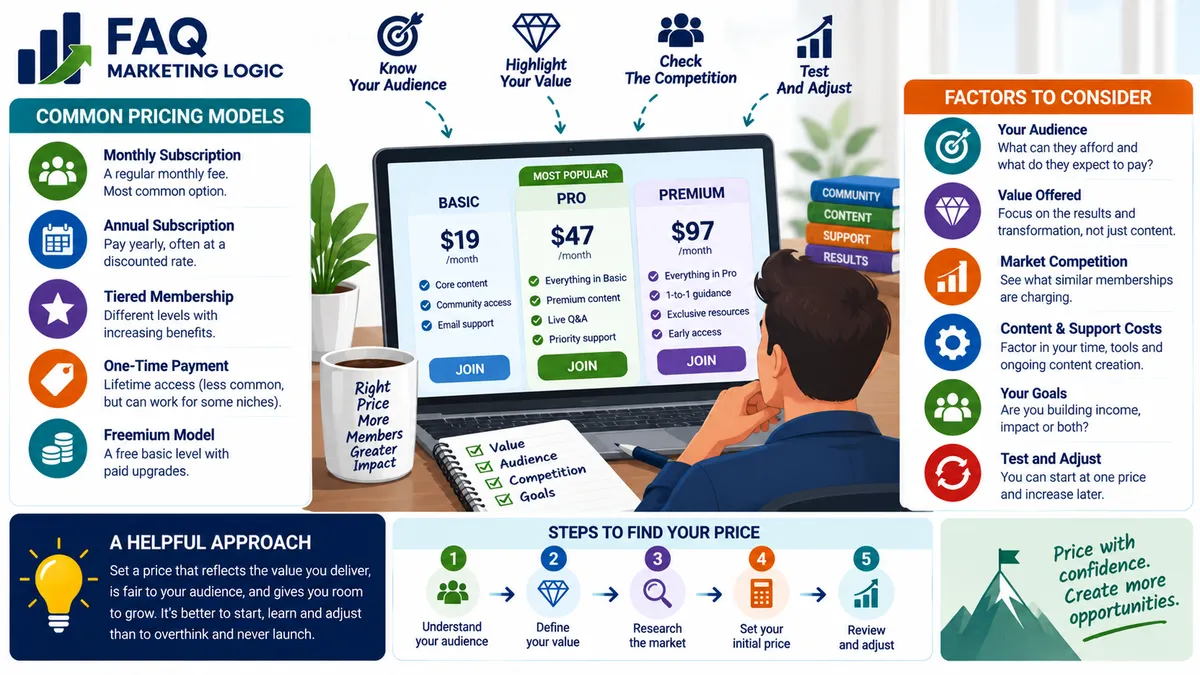
What Should I Charge For A Membership?
TL;DR
There is no single correct price for a membership.
Your price should reflect the value members receive, the problem you help solve, how frequently they use the membership, what alternatives cost and what you need to deliver it sustainably.
Don't choose a price simply because another membership charges $10, $27 or $97 per month. Start with the value of your particular offer, choose a sensible initial price, then use real member behaviour and feedback to refine it.
IN SHORT
Membership pricing can feel difficult because you're not asking someone to buy once.
You're asking them to make an ongoing purchasing decision.
A $30 product is one $30 decision.
A $30-per-month membership could become a $360 annual commitment if the member stays for a year.
That means prospective members aren't only thinking:
"Is this worth $30?"
They're also thinking:
"Will this continue being worth $30 every month?"
That's why good membership pricing depends on ongoing value, not simply the amount of content sitting inside the members' area.
REAL TALK
It's tempting to start by looking at competitors.
One membership charges $9.
Another charges $47.
Someone else is charging $197.
That doesn't tell you what your membership should cost.
Their audience may be different.
Their offer may be different.
Their level of support may be different.
Their costs may be different.
And their members may receive a completely different type of value.
Instead of asking:
"What does everybody else charge?"
start with:
"Why would someone continue paying for this?"
Once you can answer that clearly, pricing becomes much easier.
Key Definition: What Is Membership Pricing?
Membership pricing is the recurring amount customers pay to maintain access to a membership's products, services, resources, community or other benefits.
Memberships may charge:
Monthly
Quarterly
Annually
At another recurring interval
Some memberships also offer several pricing levels, with different benefits attached to each.
The important point is that the price isn't simply paying for access today.
Members are deciding whether the continued access remains valuable enough to justify the continued payment.
What Determines How Much You Can Charge?
Several factors influence an appropriate membership price.
The Value Of The Outcome
Start with what the member gains.
A membership helping somebody pursue an enjoyable hobby may be valuable, but it's different from a membership helping a business solve an expensive commercial problem.
The stronger and more valuable the outcome, the easier it may be to justify a higher price.
That doesn't mean making exaggerated promises.
It means understanding the real value of the problem you're helping members solve.
The Type Of Membership
Not all memberships deliver value in the same way.
A membership might provide:
Training
New resources
Software
Community access
Group support
Templates
Research
Coaching
Discounts
Ongoing services
A simple resource library and a membership providing regular personal support have very different delivery requirements.
Their pricing doesn't need to be the same.
The Amount Of Support
Support can dramatically affect both value and cost.
If members receive access to you personally through coaching calls, reviews, feedback or individual assistance, your capacity becomes part of the pricing decision.
A membership based primarily on digital resources may be able to serve far more people without increasing your workload at the same rate.
How Frequently Members Receive Value
A member doesn't necessarily need a new product every week.
But they do need a reason to continue subscribing.
That value could come from:
New content
Continued access
Community
Convenience
Accountability
Support
Updated information
Tools they regularly use
The question isn't:
"How much new stuff am I adding?"
It's:
"Why does remaining a member continue to make sense?"
If you'd like to explore how recurring offers can be structured around ongoing value rather than simply adding endless content, you can explore the recurring-income approach here.
Should A Membership Be Cheap To Attract More People?
Not necessarily.
Lower pricing can reduce the initial barrier to joining, but it also changes the economics of the membership.
Imagine one membership costs $10 per month.
To generate $1,000 in monthly recurring revenue, you would need:
100 paying members.
At $25 per month, you would need:
40 paying members.
At $50 per month, you would need:
20 paying members.
That doesn't mean $50 is automatically better.
A higher price could reduce the number of people willing to join.
The point is that membership pricing affects how many customers you need, what they expect and what you can afford to provide.
Cheap isn't automatically easier.
Should I Charge Monthly Or Annually?
You can offer either or both.
Monthly pricing usually creates a smaller initial commitment.
That can make it easier for someone to try the membership, but it also gives them a regular opportunity to reconsider whether they want to stay.
Annual pricing creates a larger upfront commitment but may provide the member with a lower effective monthly cost.
For example:
Monthly: $30 × 12 = $360 per year
You might offer:
Annual: $300 per year
The annual member effectively receives two months compared with paying $30 every month.
But you don't have to offer an annual discount, and you shouldn't choose one automatically.
Consider your cash flow, retention, delivery costs and what makes sense for your members.
Should I Offer Different Membership Levels?
Sometimes.
Tiered pricing can work when there are genuinely different levels of value.
For example:
Basic — $19/month
Access to training and resources.
Plus — $49/month
Training, resources and group support.
Premium — $99/month
Everything above plus additional direct help.
But don't create three tiers simply because other membership businesses do.
Every additional option creates another decision for the customer and more complexity for you.
For a new membership, one clear offer at one clear price may be much easier to launch and manage.
Should I Base The Price On How Much Content I Provide?
No.
More content doesn't automatically create more value.
A membership containing 500 videos isn't necessarily more useful than one containing 20 carefully selected resources.
In fact, too much material can become a problem.
Members can start thinking:
"I'll never get through all of this."
Price the membership around the usefulness of the experience and outcome, not the number of files sitting inside it.
What Should I Look At When Comparing Competitor Prices?
Competitor research can still be useful.
Just don't copy the number.
Look at:
What they promise
Who they serve
What's included
How much support they provide
Whether they offer monthly and annual plans
Whether they use different tiers
How established the business is
How their offer differs from yours
This gives you market context.
It doesn't give you your final price.
How Do I Know If My Membership Price Is Too High?
Price resistance can be a signal, but don't assume every lost sale means the price is wrong.
Someone might decide not to join because:
The value isn't clear
They don't understand the membership
The offer isn't relevant to them
They don't trust the business yet
They don't expect to use it regularly
The timing is wrong
They genuinely can't afford it
Dropping the price won't necessarily fix those problems.
Before reducing it, ask whether you've clearly communicated why the membership is worth continuing to pay for.
How Do I Know If My Membership Price Is Too Low?
A price can become a problem when the revenue doesn't support what you're promising.
Suppose a low-priced membership includes:
Regular live calls
Personal feedback
Individual support
New training
Community management
If the price doesn't generate enough revenue to deliver those things sustainably, the membership can become exhausting as it grows.
A recurring-income business needs to work for both sides.
Members need ongoing value.
You need a model you can continue delivering.
Should I Start With A Founding Member Price?
This can be useful when launching a new membership.
An initial group of founding members can help you learn:
What members actually use
Which benefits matter most
What questions arise
Where the experience needs improving
Why people stay
Why people cancel
You might offer those early members a favourable price in return for joining while the membership is developing.
But be clear about the arrangement.
If founding members keep their original price permanently, say so.
If the price will increase later, explain when and how.
Don't manufacture false urgency.
Should I Raise My Membership Price Later?
Potentially.
Your membership may become more valuable as you:
Improve the resources
Add useful features
Develop better support
Understand members more deeply
Build stronger results
Improve the overall experience
Your costs may also change.
You don't have to choose a perfect lifetime price on day one.
A sensible initial price gives you somewhere to start.
Real-world experience gives you information to improve the decision later.
What Matters More Than The Monthly Price?
Retention.
A membership isn't successful simply because people join.
They need a reason to stay.
Consider two memberships.
Membership A: $50 per month, but members frequently cancel after the first month.
Membership B: $30 per month, but members regularly remain for much longer.
Looking only at the monthly price could make Membership A appear stronger.
But recurring revenue depends on the relationship between:
New members
Monthly price
Retention
Cancellations
Delivery costs
That's why the highest possible monthly price isn't necessarily the goal.
A better goal is a price that supports a membership people join, value and continue using.
Practical Example
Imagine you're creating a membership for people learning a particular online skill.
It includes:
A structured training library
One new practical resource each month
A private member community
A monthly group Q&A
You initially consider charging $10 per month because you think a low price will make the membership easier to sell.
Then you consider what you're actually providing.
There is ongoing training, new material, community management and your time on the monthly Q&A.
You decide to test $29 per month instead.
At 50 members:
50 × $29 = $1,450 per month
At 100 members:
100 × $29 = $2,900 per month
Those figures aren't an earnings promise. They simply demonstrate how pricing and member numbers interact.
You would still need to account for cancellations, payment fees, taxes, marketing and the costs of delivering the membership.
But now you're making the pricing decision based on the business model, rather than choosing the lowest number you think people will accept.
Common Mistakes
Mistake: Copying a competitor's price.
Fix: Use competitor pricing for context, then evaluate your own value, audience and delivery model.
Mistake: Starting as cheaply as possible.
Fix: Choose a price that can support the membership you're promising to deliver.
Mistake: Pricing according to the amount of content.
Fix: Concentrate on useful outcomes and ongoing value.
Mistake: Creating too many pricing tiers.
Fix: Start simply unless different levels genuinely serve different customer needs.
Mistake: Concentrating on sign-ups instead of retention.
Fix: Pay attention to how long members stay and why they continue paying.
FAQ QUICK FIX
If you're struggling to choose a membership price, answer these five questions:
What ongoing result or benefit does the member receive?
How frequently are they likely to use the membership?
How much personal support is involved?
What do credible alternatives cost?
Can I sustainably deliver what I'm promising at this price?
Then choose a sensible starting price.
You don't need to predict the perfect price forever.
You need a price you can test with real customers.
FAQ
What's A Good Starting Price For A Membership?
There isn't a universal starting price.
A simple digital resource membership could have very different economics from a specialist membership providing regular coaching or business support.
Start with the value, audience and delivery model rather than an arbitrary industry number.
Is $10 A Month Too Cheap For A Membership?
Not necessarily.
It depends on what members receive and whether the economics work at that price.
A $10 membership may need considerably more members than a higher-priced offer to produce the same revenue.
Should Annual Membership Be Cheaper Than Paying Monthly?
It can be.
Some businesses reward annual commitment with a lower effective monthly price.
But it isn't compulsory. Calculate what makes sense for your membership rather than automatically copying the common “two months free” model.
Can I Increase The Price For New Members Without Increasing It For Existing Members?
Yes, if that fits your business model.
Some membership businesses allow existing members to retain their original rate while new members join at the new price.
Whatever approach you choose, communicate pricing changes clearly.
Should I Show The Membership Price On The Sales Page?
In most straightforward membership offers, clear pricing helps prospective members understand the commitment they're considering.
Hiding the price can create unnecessary uncertainty unless there's a genuine reason the price requires a conversation or customised quote.
What If Nobody Joins At My First Price?
Don't immediately assume the number is wrong.
Review the offer, audience, positioning, value communication and traffic as well.
A price reduction won't fix an offer that people don't understand or want.
TRY THIS TODAY
If you're planning a membership, don't start by choosing the price.
Write down:
Who it's for
What ongoing problem it helps solve
Why someone would remain a member
What you'll need to deliver each month
How much direct support you'll provide
Then test three possible prices.
For each one, calculate how many active members you would need to reach your target monthly revenue.
That simple exercise can make the consequences of your pricing decision much clearer.
Want To Build Recurring Income Without Guessing How It Should Work?
Choosing the price is only one part of building a successful membership.
You also need to think about the offer, ongoing value, member retention and how the different parts of a recurring-income business fit together.
If you'd like to explore a practical approach to building recurring income, I've got a free resource that will show you more.
→ Show Me How Recurring Income Works
RELATED ARTICLES
→ Should I Start A Membership Business?
→ What Is Recurring Revenue And How Does It Work?
→ How Do I Increase Average Order Value?
QUICK RECAP
There is no universal perfect membership price.
Price around ongoing value, not the amount of content.
Consider the audience, outcome, support and delivery costs.
Don't automatically copy competitors.
Cheap pricing can mean needing considerably more members.
Higher pricing needs sufficient value to justify it.
Monthly and annual options can serve different purposes.
Don't create multiple tiers unless they genuinely improve the offer.
Pay attention to retention as well as acquisition.
Choose a sensible starting price and improve it using real-world evidence.
The question isn't simply:
"How much can I charge?"
A better question is:
"What price makes this valuable for the member and sustainable for the business?"
NEXT STEP
Once you've decided how your membership could be priced, the next step is making sure the business can grow without becoming unnecessarily complicated.