
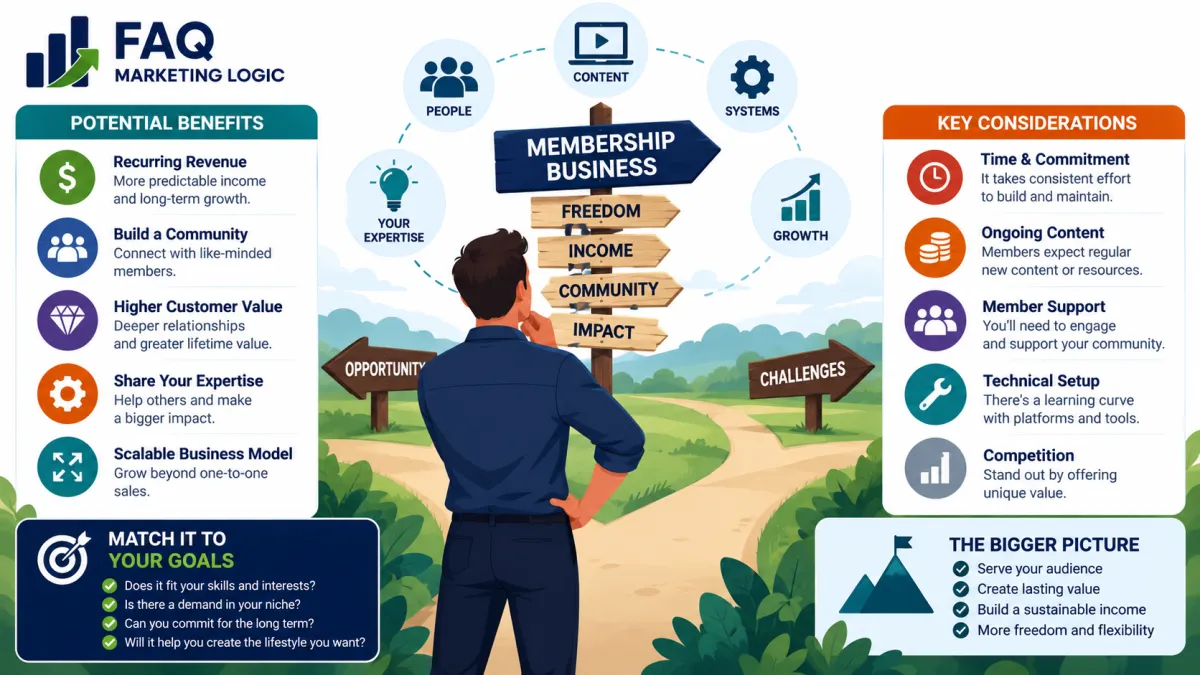
Should I Start A Membership Business?
TL;DR
A membership business can be a good choice if you can provide ongoing value that gives people a reason to keep paying, rather than simply delivering something once and moving on.
Memberships can create recurring revenue and make income more predictable, but they also come with an important responsibility: you have to keep giving members a reason to stay.
The question isn't simply whether you can start a membership. It's whether your idea naturally supports an ongoing customer relationship.
IN SHORT
Most online businesses concentrate on making the first sale.
A membership business adds another question:
What can I provide that customers would willingly continue paying for?
That could be ongoing training, resources, support, community access, new content, software, research or another continuing benefit.
Get that right and a membership can turn individual transactions into recurring revenue.
Get it wrong and you'll constantly be trying to replace members who leave.
REAL TALK
Recurring revenue sounds attractive.
Make a sale once and continue receiving payments each month. What's not to like?
But that's only half the story.
The first payment gets somebody into your membership. What happens afterwards determines whether they stay.
A successful membership therefore isn't just about attracting members. It's about creating something useful enough that customers continue to see value in paying for it.
That's why I wouldn't start a membership simply because recurring revenue sounds appealing.
I'd start one because the product, audience and value you provide make an ongoing relationship sensible.
Key Definition: What Is A Membership Business?
A membership business gives customers continued access to specified products, services, resources or benefits in return for recurring payments.
Those payments might be:
Monthly
Quarterly
Annually
At another agreed interval
What customers receive varies enormously.
A membership might provide training, specialist information, resources, tools, community access, support or a combination of different benefits.
The important distinction is that the customer isn't simply buying one product and leaving.
They're paying to continue the relationship.
If you'd like to explore how this type of recurring-income model can work in practice, you can explore the recurring-income approach here.
Why Start A Membership Business?
One of the biggest attractions is recurring revenue.
With a conventional one-off product, you might make a $30 sale today. If you want another $30 tomorrow, you generally need another sale.
A membership changes that relationship.
If somebody pays $30 per month and remains a member, the original customer can potentially generate further revenue without you having to sell them the same membership again every month.
As your membership grows, that can create a more predictable revenue base.
It doesn't eliminate the need for marketing, but it means every month's revenue doesn't necessarily have to begin at zero.
What Could You Offer Through A Membership?
There isn't one standard membership model.
Some businesses provide new material regularly. Others give members access to an existing library combined with ongoing additions or support.
Examples might include:
Training and educational resources
Templates and tools
Specialist research or reports
Regular workshops
Coaching or group support
Private communities
Resource libraries
Software or online tools
Industry updates
New digital products
The important question isn't:
"What can I put inside a membership?"
Almost anything can go inside one.
A better question is:
"What would my customers continue finding useful?"
That distinction matters.
Does A Membership Need New Content Every Month?
Not necessarily.
This is one of the misconceptions that can make a membership seem more intimidating than it needs to be.
You don't automatically need to create a mountain of new content every month.
The value might come from access to existing resources, ongoing support, tools, updates, community participation or a combination of these.
Even where new content is part of the membership, more isn't automatically better.
Giving members so much material that they can't possibly use it can actually reduce the perceived value because the membership starts to feel overwhelming.
What matters is providing enough continuing value for members to feel that remaining subscribed is worthwhile.
Who Is A Membership Business Suitable For?
A membership can work particularly well when customers have a continuing problem, interest or objective.
For example, somebody learning a skill rarely masters it after reading one article.
A business owner may need new ideas, strategies and resources as their business develops.
Someone working towards a particular goal may value continued guidance, tools or support.
In situations like these, the customer's need continues over time.
That's a useful signal that a membership could make sense.
When Might A Membership Be The Wrong Choice?
Not every product needs to become a subscription.
If the customer's problem can be completely solved with a single product or transaction, forcing an ongoing payment model onto it may create little additional value.
You should also think carefully about a membership if you don't want the responsibility of providing an ongoing service.
Recurring revenue comes with recurring expectations.
Customers will expect the benefits they were promised for as long as they're paying.
If you prefer creating individual products, selling them and then moving on to the next project, a conventional product business might suit you better.
Why Member Retention Matters
Suppose you have 100 members paying $25 per month.
That gives you:
100 × $25 = $2,500 per month
Now imagine you gain 10 new members next month but lose 10 existing members.
You've made new sales, but your membership hasn't actually grown.
This is why membership businesses need to pay attention to retention as well as acquisition.
Attracting new members matters.
Giving existing members reasons to stay matters just as much.
What Makes Members Stay?
People generally remain members while the value they receive continues to justify the cost.
That doesn't mean constantly adding more and more material.
Retention can come from things such as:
Useful resources
Regular improvements
Continuing education
Convenience
Support
Community
New opportunities
Time savings
Progress towards a goal
The exact reason depends on the membership.
The important thing is to understand why your particular member would want to remain subscribed next month.
If you can't answer that question, that's something to solve before launching.
How Much Should A Membership Cost?
There's no universal membership price.
A membership could cost a few dollars per month or hundreds, depending on what it provides, who it's for and the value customers receive.
Rather than starting with:
"What do other memberships charge?"
start with:
"What am I providing, who is it for and what is that worth to them?"
You also need to consider the economics of delivering the membership.
If a low monthly price requires large amounts of your personal time, the model may become difficult to sustain as membership grows.
Price and delivery therefore need to work together.
Practical Example
Imagine you've created several useful training products for a particular audience.
You could continue selling each product separately.
Alternatively, you might create a membership that gives customers access to the training library, adds a new practical resource each month and includes a monthly question-and-answer session.
Suppose the membership costs $25 per month.
With 20 members:
20 × $25 = $500 per month
With 50 members:
50 × $25 = $1,250 per month
With 100 members:
100 × $25 = $2,500 per month
Those figures aren't a promise of what a membership will make. They simply illustrate how recurring payments can accumulate as the number of retained members increases.
The real challenge is creating enough ongoing value for those members to want to remain members.
Common Membership Mistakes
Mistake: Starting a membership purely because you want recurring revenue.
Fix: Begin with the continuing value customers will receive. Recurring revenue should be the result, not the entire reason the membership exists.
Mistake: Trying to create too much content.
Fix: Concentrate on useful content and benefits rather than sheer volume.
Mistake: Focusing entirely on getting new members.
Fix: Pay attention to why existing members stay, use what you provide and eventually leave.
Mistake: Underpricing a membership that requires lots of personal involvement.
Fix: Consider the time and resources required to deliver what you've promised.
Mistake: Making the membership unnecessarily complicated.
Fix: Start with a clear core benefit and a manageable delivery model. You can improve it as you learn what members actually value.
FAQ QUICK FIX
Question: I like the idea of recurring revenue, but I don't know whether my business needs a membership.
Quick Fix: Ask yourself one question:
"What useful reason would my customer have to continue paying me next month?"
If you can answer that clearly, you may have the basis of a membership.
If you can't, don't force the model. Look for the continuing problem or benefit first.
FAQ
Do I Need A Large Audience To Start A Membership?
No.
A smaller audience with a clearly defined need can be more valuable than a large audience with little interest in what you're offering.
You can also start relatively small and develop the membership as you learn what members value.
Do I Need A Community?
No.
Community can be an important benefit for some memberships, but it isn't compulsory.
The value could come from information, resources, tools, training, support or another ongoing benefit.
Should I Offer Monthly Or Annual Membership?
You can offer either or both.
Monthly membership usually creates a smaller initial commitment, while annual membership can provide greater upfront revenue and remove the monthly cancellation decision for a longer period.
The right choice depends on your offer and audience.
Is Membership Income Passive?
Usually not.
Some membership models require less ongoing work than others, but members are paying for continuing value.
There will normally be some combination of delivery, customer support, maintenance, marketing and retention work involved.
Can I Add A Membership To An Existing Business?
Yes.
You don't necessarily need to build an entirely new business around a membership.
A membership can sometimes become the next stage for existing customers who want continuing support, resources or access after purchasing an initial product or service.
TRY THIS TODAY
Take your current business idea, product or area of expertise and complete this sentence:
"Someone would continue paying me each month because..."
Try to come up with three genuinely useful answers.
Don't start with the content you want to create.
Start with the reason the customer would want to stay.
If you struggle to find one, that's useful information too. It may mean a one-off product is a better fit.
Want To Explore A Recurring Income Model?
A membership can create more predictable revenue, but there's more to making one work than simply charging customers every month.
You need to think about what to offer, how to price it, how to attract members and, importantly, how to give them reasons to stay.
If you'd like to explore a practical approach to turning one-off customers into recurring subscribers, I've got a free resource that will show you more.
→ Show Me How Recurring Income Works
RELATED ARTICLES
→ What Is Recurring Revenue And How Does It Work?
→ How Do I Increase Average Order Value?
→ How Do I Grow Without Increasing Complexity?
QUICK RECAP
A membership business exchanges continuing value for recurring payments.
Recurring revenue can make income more predictable.
Not every product or business needs a membership.
The model works best when customers have an ongoing need, interest or objective.
You don't necessarily need to create large amounts of new content every month.
Retaining existing members is just as important as attracting new ones.
Start by identifying why somebody would want to remain a member.
NEXT STEP