What Is Recurring Revenue And How Does It Work?
TL;DR
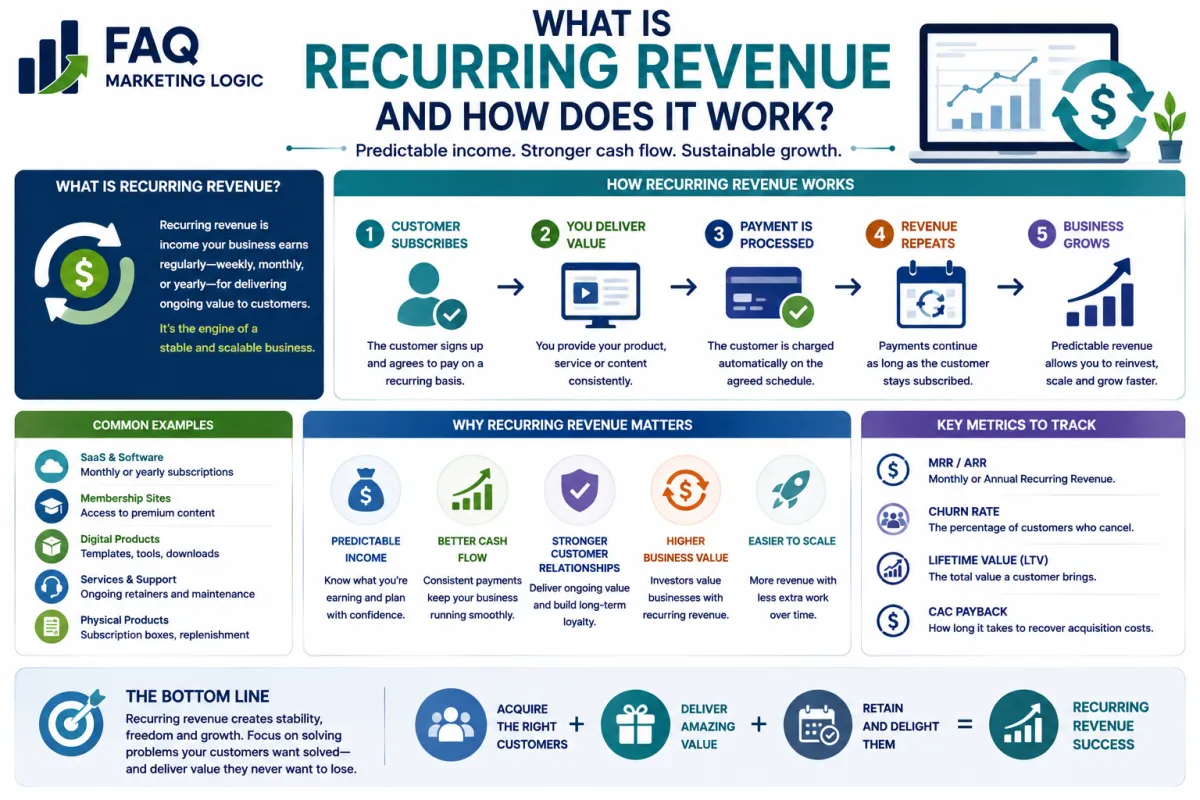
Recurring revenue is income that customers pay repeatedly rather than through a single one-off purchase. Common examples include memberships, subscriptions, software, retainers and ongoing services.
For an online business, recurring revenue can make income more predictable because you don't have to start every month with zero sales. But it only works when customers continue receiving enough value to justify staying.
The goal isn't simply to get people to subscribe. It's to create an offer they want to continue paying for.
IN SHORT
A traditional sale happens once.
You sell a $50 product and receive 50.
With recurring revenue, the customer agrees to pay regularly for continued access to a product, service or benefit.
For example, 100 customers paying $20 per month would generate $2,000 in recurring monthly revenue before cancellations, fees and other costs.
That doesn't make recurring revenue automatic or guaranteed. Customers can cancel, and you still need to attract new customers.
But it changes the business model because every month doesn't necessarily begin at zero.
REAL TALK
One of the hardest parts of running an online business is constantly needing the next sale.
You make a sale today.
Great.
Tomorrow, you need another one.
That can create a cycle of continual promotion, launches and customer acquisition.
Recurring revenue doesn't eliminate marketing, but it can change the economics of the business. Instead of every customer representing one transaction, some customers may continue generating revenue for several months or longer.
That's why recurring income can become such a powerful scaling tool.
But there's a catch.
If customers don't have a reason to stay, recurring revenue quickly becomes recurring cancellations.
Key Definition: What Is Recurring Revenue?
Recurring revenue is income generated from customers who make repeated payments at regular intervals in exchange for continued access to a product, service or benefit.
Payments might be collected:
Monthly
Quarterly
Annually
At another agreed interval
The defining feature is that the relationship continues beyond the first transaction.
If you're interested in building this type of income into your own business, you can explore a recurring-income model here.
What Are Some Examples Of Recurring Revenue?
Recurring revenue isn't limited to one type of online business.
Common models include:
Membership Sites
Customers pay regularly for continued access to training, resources, a community or other member benefits.
Subscription Services
Customers pay at regular intervals to continue receiving a product or service.
Software Subscriptions
Many online software businesses charge monthly or annual fees for continued access to their tools.
Retainers
Consultants, freelancers and agencies may charge clients a recurring fee for an agreed amount of ongoing work.
Paid Newsletters
Subscribers pay for continued access to specialist information, analysis or content.
Continuity Programmes
Customers receive new products, training or resources regularly while their subscription remains active.
The right model depends on what you're selling and, more importantly, whether the customer has an ongoing reason to pay for it.
How Does Recurring Revenue Work?
The basic model is straightforward.
A customer discovers your offer and decides to join.
Instead of purchasing something once, they agree to an ongoing payment arrangement.
The business then continues providing the promised value while the customer continues paying.
For example:
20 members × $25 per month = $500 monthly recurring revenue
If another 10 members join the following month and nobody leaves:
30 members × $25 = $750 monthly recurring revenue
In reality, some customers will cancel while new customers join. That's why recurring-revenue businesses need to think about both acquisition and retention.
Getting customers through the door is only half of the job.
Why Is Recurring Revenue Attractive?
One of its biggest advantages is greater predictability.
If most of your income comes from individual product sales, revenue can vary considerably from month to month.
A recurring model can give you a base of existing customer revenue before new sales are added.
That can make it easier to:
Forecast revenue
Plan expenditure
Invest in growth
Understand customer value
Reduce dependence on constant launches
Build longer customer relationships
Recurring revenue can therefore support a more sustainable business scaling strategy.
It isn't necessarily about becoming bigger as quickly as possible.
It's about making some of your revenue more repeatable.
Recurring Revenue Doesn't Mean Passive Revenue
This distinction is important.
A recurring payment doesn't automatically create passive income.
If you're running a membership, customers may expect new material, support, community management or regular updates.
A recurring service may require ongoing delivery.
Software requires maintenance.
A paid newsletter requires content.
The objective is therefore not to create an offer you can forget about.
It's to build an offer where the ongoing value can be delivered efficiently enough for the recurring model to make business sense.
Retention Matters As Much As Acquisition
Imagine you gain 20 new members every month but lose 18 existing members.
Technically, you're still growing.
But you're working extremely hard to add only two net members.
Now imagine gaining the same 20 new members while losing only five.
The economics look very different.
This is why successful recurring-revenue businesses pay close attention to retention.
Customers generally continue paying when they:
Use what they're receiving
Understand its value
Continue making progress
Receive something they would miss if they left
Feel the offer remains relevant to them
A recurring business isn't built simply by getting people to join.
It's built by giving the right people good reasons to remain customers.
Can Recurring Revenue Help You Scale?
Potentially, yes.
Suppose you sell a $30 digital product.
Every $30 of revenue requires another sale.
Now suppose you have a $30 monthly membership.
A customer who remains for six months could generate $180 rather than $30.
That doesn't automatically make the membership the better business model. It may cost more to support and deliver.
But it demonstrates why recurring revenue can be an important scaling lever.
Before simply chasing more traffic, it can be worth asking whether there is an opportunity to create more long-term value from existing customer relationships.
Practical Example
Imagine you sell training products teaching a particular skill.
Customers buy the beginner programme, complete it and then leave.
You could continually concentrate on finding more people to buy that first programme.
Alternatively, you might discover that customers want continued help after completing it.
That could create an opportunity for a membership providing:
Monthly advanced training
New resources
Templates
Q&A sessions
Community support
The original product still has a purpose.
But instead of the customer relationship automatically ending after the first purchase, there's now a logical next step.
That's recurring revenue built around continued customer need, rather than simply attaching a subscription to something.
COMMON MISTAKES
Mistake: Turning Any Product Into A Subscription
Not everything needs recurring billing.
Fix: Ask whether customers genuinely need continued access, support, content or another ongoing benefit.
Mistake: Concentrating Only On New Members
Constant acquisition can hide poor retention.
Fix: Monitor why customers stay as carefully as why prospects join.
Mistake: Creating Too Much Content
Membership owners sometimes assume more content automatically creates more value.
Fix: Focus on helping customers achieve the result they joined for rather than overwhelming them with material.
Mistake: Treating Recurring Revenue As Guaranteed Income
Customers can cancel and circumstances change.
Fix: Treat recurring revenue as more predictable income, not permanent income.
FAQ QUICK FIX
Problem: You like the idea of recurring revenue but don't know whether it fits your business.
Quick Fix: Look at what customers need after buying your current product or service.
Ask:
“Is there an ongoing problem, benefit or result they would reasonably pay me to continue helping them with?”
If the answer is no, don't force a subscription model.
If the answer is yes, you may have the beginnings of a recurring-revenue offer.
FAQ
What is the difference between recurring revenue and repeat sales?
Repeat sales happen when a customer independently decides to purchase again. Recurring revenue usually involves an ongoing agreement where payments continue at defined intervals until the arrangement ends.
Is recurring revenue guaranteed?
No. Customers can cancel, payments can fail and new customer acquisition can change. Recurring revenue can make income more predictable, but it isn't guaranteed.
Do I need a membership site to create recurring revenue?
No. Memberships are one model. Recurring revenue can also come from subscriptions, retainers, software, continuity programmes and other ongoing services.
Is recurring revenue better than selling one-off products?
Not automatically. One-off products can be highly profitable and simpler to operate. The better model depends on your offer, customers, delivery requirements and business goals.
Can a small online business use recurring revenue?
Yes. You don't need thousands of customers. A relatively small number of customers paying regularly can create a useful recurring-revenue base if the offer provides enough ongoing value.
TRY THIS TODAY
Look at your current products or services and write down what typically happens after the customer gets the result they originally paid for.
Do they need:
Continued support?
More advanced training?
Fresh resources?
Regular updates?
Ongoing access?
Help with the next stage?
Don't start by asking:
“What membership could I create?”
Start by asking:
“What do my customers genuinely need next?”
That's a much stronger foundation for recurring revenue.
Want To Explore A Recurring Income Model?
Recurring revenue can give an online business greater predictability, but there are several decisions to make: what to offer, how much to charge, how to deliver it and, importantly, how to give customers a reason to stay.
If you'd like to explore a practical approach to turning one-off customers into recurring subscribers, I've got a free resource that will show you more.
→ Show Me How Recurring Income Works
RELATED ARTICLES
→ How Do I Grow Without Increasing Complexity?
→ How Do I Increase Average Order Value?
Quick Recap
Recurring revenue means generating repeated payments from customers in return for continued value.
To make the model work:
Identify an ongoing customer need.
Create an offer that addresses that need.
Choose an appropriate recurring payment structure.
Deliver continuing value efficiently.
Attract suitable customers.
Give those customers good reasons to stay.
Monitor both acquisition and retention.
Recurring revenue isn't about putting a monthly price on something.
It's about creating a customer relationship worth continuing.
Next Step
Once you understand how recurring revenue works, the next question is whether this type of business model actually suits what you want to build.
→ Should I Start A Membership Business?