
How Do I Build Trust With New Email Subscribers?
TL;DR
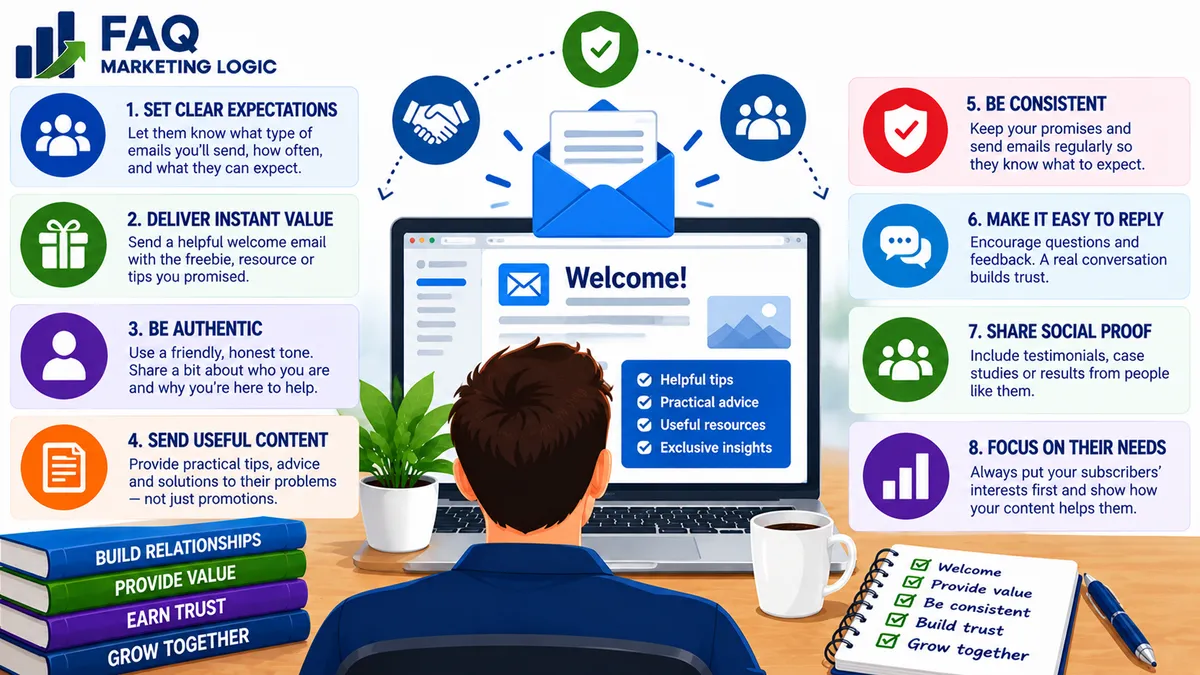
You build trust with new email subscribers by delivering what you promised, being useful before asking for too much, communicating consistently and making it clear who your emails are from.
The first few emails matter because subscribers are still deciding whether joining your list was worthwhile.
Don't try to impress them with constant promotions or overwhelm them with information. Give them a clear reason to keep opening your emails.
Trust grows when what you say before someone subscribes matches what happens after they subscribe.
IN SHORT
Someone joining your email list doesn't automatically trust you.
They've simply given you permission to contact them.
That's an important distinction.
A new subscriber may have discovered you through:
A Blog Post
A Free Guide
A Search Result
A Recommendation
A Social Post
An Advertisement
A Product Purchase
They may know very little about you.
Your early emails therefore have a simple job:
Turn initial interest into familiarity and confidence.
Do that well and subscribers are more likely to continue opening, reading and eventually responding to your offers.
REAL TALK
Email trust isn't built by telling subscribers you're trustworthy.
It's built by repeatedly giving them reasons to believe it.
If you promise a free guide, deliver it.
If you say you'll send practical advice, send practical advice.
If your signup page promises one thing but your emails immediately become a stream of unrelated promotions, you've created a mismatch.
Subscribers notice that quickly.
Trust is largely about expectations being met consistently.
Key Definition: What Is Email Subscriber Trust?
Email subscriber trust is the confidence a subscriber develops that opening your emails will be worthwhile and that you will use their permission responsibly.
That confidence usually develops gradually.
A subscriber begins to recognise:
Who you are
What you talk about
What your emails are like
Whether your advice is useful
Whether your recommendations are relevant
Whether you respect their attention
Each email adds to that impression.
Start With The Promise That Got Them To Subscribe
Trust starts before the first email is sent.
Look at the promise on your signup page.
Perhaps you offered:
A free guide showing beginners how to choose an online business model.
Your first email shouldn't suddenly be about an unrelated advanced marketing tool.
Start by fulfilling the original promise.
This creates a simple sequence:
Promise → Delivery → Positive Experience
If the subscriber receives exactly what they expected, you've passed the first small trust test.
Make Your First Email Immediately Recognisable
A subscriber may join your list and then receive dozens of other emails during the same day.
Don't assume they'll remember you.
Your first email should quickly remind them:
Who you are
Why they're receiving the email
What they requested
Where they can access it
What they can expect next
You don't need a long introduction.
You simply need enough context for the subscriber to think:
"Yes, I remember signing up for this."
That reduces confusion and helps establish familiarity.
Deliver What You Promised Quickly
If someone joined to receive something, make accessing it easy.
Don't make them hunt through several emails or complete unnecessary extra steps.
If you promised a guide, checklist, video or resource, tell them clearly how to get it.
The subscriber has just trusted you with their email address.
Delivering promptly shows that the exchange works both ways.
Set Expectations Early
One of the easiest ways to build trust is to tell subscribers what happens next.
For example:
"Over the next few days, I'll send you a few practical ideas for choosing and building a simple online business."
Now the subscriber knows:
More emails are coming
Roughly what they'll contain
Why they're worth watching for
This makes future emails feel expected rather than random.
You don't need to promise an exact publishing schedule unless you intend to maintain one.
Just give subscribers a reasonable idea of what being on your list means.
Be Useful Before Trying To Sell Everything
There's nothing wrong with making offers by email.
Email marketing is a commercial tool.
But a new subscriber who has barely heard from you may not yet understand:
What you know
How you can help
Whether your recommendations are relevant
Whether your products are suitable
Useful early emails help answer those questions.
Teach something.
Explain something.
Solve a small problem.
Help the subscriber make a decision.
That gives them a reason to pay attention beyond the free resource that originally attracted them.
Don't Confuse Value With Giving Everything Away
Providing value doesn't mean every email needs to contain a 2,000-word tutorial.
A useful email might contain:
One practical tip
One useful distinction
One common mistake
One short example
One question worth considering
One helpful resource
The objective is not to overwhelm subscribers with free information.
It's to make opening your emails feel worthwhile.
Let Subscribers Get To Know Your Point Of View
Information alone doesn't build the strongest relationship.
Your subscribers can find information almost anywhere.
What they can't find everywhere is your way of explaining it.
You might explain why you prefer simple funnels over complicated ones.
You might challenge a common assumption.
You might describe a lesson you've learned from experience.
You might explain why you approach a problem differently.
This helps subscribers understand what you stand for and how you think.
Over time, familiarity can become trust.
Write Like A Person, Not A Corporation
Even if your emails come from a business, they don't need to sound like a legal department wrote them.
Compare:
"We endeavour to provide subscribers with actionable marketing insights designed to facilitate improved commercial outcomes."
with:
"I'll show you a few simple ways to make your marketing easier to understand and easier to act on."
The second feels more natural because it sounds like one person communicating with another.
Clear language makes it easier for subscribers to understand you.
And understanding supports trust.
Don't Pretend You Know Everything
Trying to sound like the world's leading authority on every subject can have the opposite effect.
You can be useful without claiming absolute expertise.
It's perfectly reasonable to say:
"This approach works particularly well when..."
rather than:
"This is the only strategy that works."
Likewise, if something depends on the audience, offer or situation, say so.
Credibility often increases when you're willing to acknowledge limits and context.
Use Proof Carefully
Proof can help build confidence.
Depending on your business, that might include:
Customer Feedback
Testimonials
Results
Examples
Demonstrations
Case Studies
But proof should be genuine and relevant.
Don't exaggerate what something proves.
A testimonial shows what happened for that particular customer. It doesn't guarantee the same outcome for everyone.
Clear, credible proof is more useful than extravagant claims.
Keep Your Promotions Relevant
Trust doesn't disappear simply because you make an offer.
Subscribers generally understand that businesses sell things.
Problems begin when every email suddenly seems designed to extract money.
A useful promotion should make sense based on:
Why the subscriber joined
What you've been discussing
The problem they're trying to solve
Their likely stage of progress
If you've spent several emails helping beginners understand email marketing, recommending a relevant email resource can feel like a logical next step.
An unrelated promotion may feel completely different.
Explain Why You're Recommending Something
Don't just say:
"Buy this."
Help subscribers understand why you're mentioning it.
For example:
"If you want to go deeper into this and see the complete process, this is the resource I'd look at next."
That small amount of context makes the recommendation easier to evaluate.
You're not simply presenting a link.
You're explaining why it might be relevant.
Don't Manufacture Urgency
If an offer genuinely ends on Friday, say so.
If a bonus genuinely disappears at midnight, explain it.
But constantly creating artificial deadlines can weaken trust.
Subscribers eventually learn whether your deadlines mean anything.
The same applies to scarcity.
If there are genuinely only 20 places, that's useful information.
If there are supposedly only 20 places every week, subscribers may become sceptical.
Make It Easy To Unsubscribe
It might sound strange to discuss unsubscribing in an article about building trust.
But giving people control matters.
Someone who no longer wants your emails should be able to leave easily.
Trying to hide the unsubscribe option doesn't create a stronger email list.
A smaller list of people who actually want your emails is generally more useful than a larger list of people who feel trapped on it.
Consistency Matters More Than Constant Emailing
You don't need to email every day simply to prove you're active.
But disappearing for six months and then suddenly sending five promotional emails can make subscribers wonder:
"Who is this?"
Consistency helps maintain familiarity.
That could mean:
Several emails during an initial welcome sequence
Weekly emails
Regular useful updates
Emails when you genuinely have something worthwhile to say
Choose a rhythm that fits your business and that you can realistically maintain.
Don't Change Your Identity Every Few Emails
If subscribers joined a list from Dean and suddenly start receiving messages from several unfamiliar sender names, that can create uncertainty.
Keep the sender identity recognisable.
The same applies to your general tone.
You don't need every email to sound identical, but subscribers should gradually develop a sense of who they're hearing from.
Familiarity reduces friction.
Encourage Small Interactions
Trust doesn't have to develop entirely through one-way communication.
You can occasionally ask subscribers:
"What's the biggest problem you're having with this?"
Or:
"Which of these two areas would you like me to cover next?"
Replies and simple interactions can help turn the list from a broadcasting channel into a relationship.
They can also give you valuable insight into what subscribers actually need.
Don't Overload New Subscribers
There's often a temptation to show new subscribers everything you have.
Here's the blog.
Here's the course.
Here's the membership.
Here's the YouTube channel.
Here's another free guide.
Here's today's special offer.
Here's a survey.
Here's another product.
Too many choices can weaken the welcome experience.
Give subscribers one sensible next step at a time.
You can introduce other resources later.
Trust Is Built Across A Sequence
Your first email matters.
But it doesn't need to accomplish everything.
Think of the first few emails as a progression.
Email 1: Deliver what was promised and establish who you are.
Email 2: Provide something genuinely useful.
Email 3: Help solve another related problem or challenge a misconception.
Email 4: Introduce another useful resource or relevant next step.
Email 5: Make a relevant offer when appropriate.
That's only an example, not a rigid formula.
The principle is that trust develops through multiple positive interactions, rather than one perfect welcome email.
Practical Example
Imagine someone finds one of your articles about starting an online business and requests a beginner's guide.
The first email delivers the guide immediately and reminds them why they're receiving it.
The second explains one common mistake beginners make when choosing a business model.
The third helps them narrow their options.
The fourth explains a simple way to test an idea before investing heavily in it.
By this point, the subscriber has received several useful emails that all connect logically to the reason they joined.
If you then recommend a relevant product, the offer doesn't appear from nowhere.
It feels like the next part of the conversation.
That's very different from delivering the free guide and immediately sending three unrelated promotions.
Common Mistakes
Mistake: Assuming someone trusts you simply because they subscribed.
Fix: Treat the subscription as permission to begin building the relationship.
Mistake: Failing to deliver what was promised quickly.
Fix: Make the requested resource easy to access.
Mistake: Sending unrelated promotions immediately.
Fix: Keep early emails connected to the reason the subscriber joined.
Mistake: Trying too hard to sound authoritative.
Fix: Be clear about what you know, what you recommend and where context matters.
Mistake: Overwhelming subscribers with resources and choices.
Fix: Give them one logical next step at a time.
Mistake: Disappearing for months.
Fix: Establish a communication rhythm you can realistically maintain.
FAQ QUICK FIX
Want to know whether your welcome experience builds trust?
Subscribe to your own list using a different email address.
Then experience it exactly as a new subscriber would.
1. Check the signup promise.
What did you say they would receive?
2. Check the first email.
Is it obvious who sent it and why?
3. Check delivery.
Can the subscriber easily access what you promised?
4. Read the next few emails.
Do they logically continue the conversation?
5. Look at the first promotion.
Does it feel relevant, or does it suddenly change direction?
That simple exercise can reveal problems that are difficult to notice when you're looking at the sequence from the business owner's side.
FAQ
How Quickly Should I Email A New Subscriber?
Your initial welcome or delivery email should normally arrive promptly after signup, particularly if you've promised immediate access to a resource.
Should I Sell To New Email Subscribers Straight Away?
You can make relevant offers to new subscribers, but the offer should fit their expectations and the reason they joined. Building some familiarity and delivering the promised value first can make the transition more natural.
How Many Welcome Emails Should I Send?
There is no universal number. A welcome sequence should be long enough to deliver what was promised, establish expectations, provide useful information and guide the subscriber towards an appropriate next step.
Do I Need To Email Subscribers Every Day?
No. The right frequency depends on your audience, content and business. Consistency and relevance matter more than emailing simply to maintain a daily schedule.
Does Giving Away Free Content Build Trust?
It can, if the content is genuinely useful and relevant. But trust also comes from reliability, clarity, consistency and making appropriate recommendations.
Can Promotional Emails Build Trust?
Yes. A useful, relevant recommendation can strengthen trust when you clearly explain why you're making it. Problems arise when promotions are misleading, excessive or disconnected from what subscribers expected.
TRY THIS TODAY
Read the first three emails a new subscriber receives from you.
Don't read them as the business owner.
Read them as someone who has only just discovered you.
Ask:
Do I immediately know who this is?
Did I receive what I was promised?
Is each email relevant to why I subscribed?
Am I learning anything useful?
Do I understand what will happen next?
Am I being asked to do too much too quickly?
Would I want to open email number four?
If the answer to that last question is uncertain, you've found something worth improving.
RELATED ARTICLES
→ What Is The Best Welcome Email To Send First?
→ Why Do Subscribers Stop Opening Emails?
→ How Can I Make My Emails Clearer and More Direct?
QUICK RECAP
Trust with new email subscribers develops over time.
Deliver what you promised.
Make your first email recognisable.
Set expectations early.
Give subscribers useful information.
Write clearly and naturally.
Don't exaggerate your authority or proof.
Keep promotions relevant.
Explain why you're recommending something.
Avoid false urgency and scarcity.
Communicate consistently.
Give subscribers control.
Avoid overwhelming them with choices.
Let the relationship develop across several emails.
A subscriber doesn't need to believe everything you say after one email.
They simply need enough positive experiences to think:
"Opening the next email is probably worth my time."
That's how email trust starts.
NEXT STEP
Once you've established trust with a new subscriber, the next challenge is keeping that relationship active rather than allowing engagement to fade.
→ How Do I Re-Engage Inactive Subscribers?