
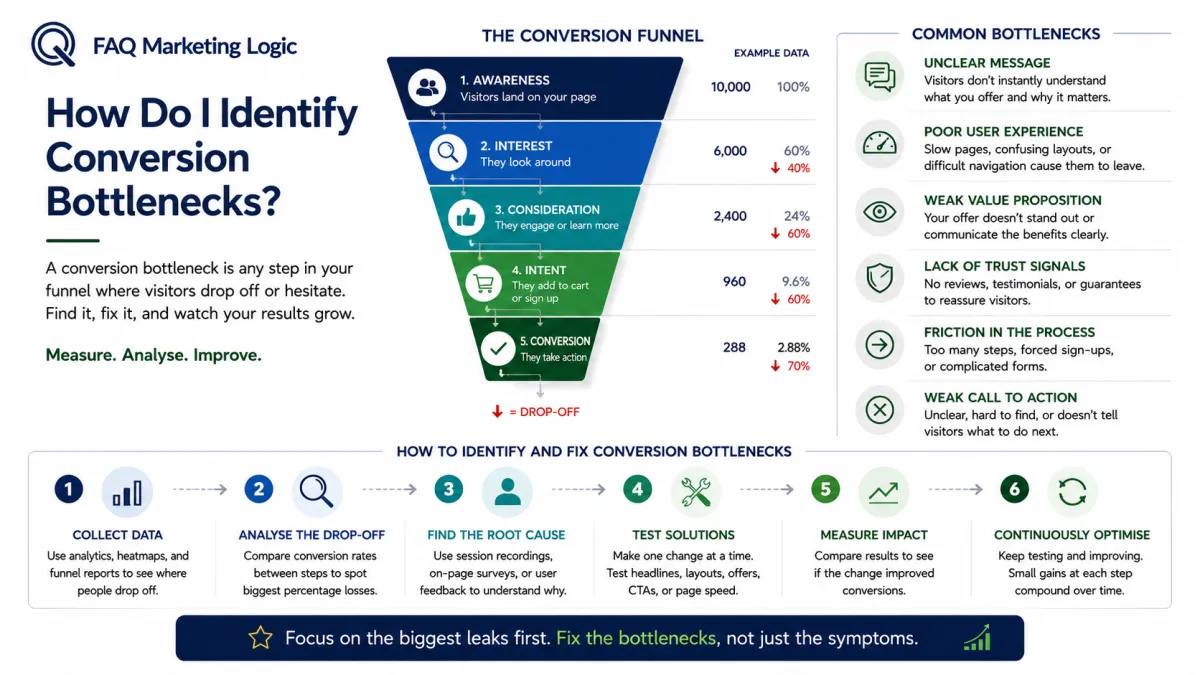
How Do I Identify Conversion Bottlenecks?
TL;DR
You identify conversion bottlenecks by tracking where people stop progressing through your marketing process and improving the weakest step first.
IN SHORT
Every business has a bottleneck.
It might be:
Low website traffic
Poor landing page conversions
Weak email engagement
Low sales
Finding the biggest bottleneck allows you to focus your efforts where they will have the greatest impact.
REAL TALK
Many business owners try to improve everything at once.
They redesign pages.
Rewrite emails.
Change offers.
Launch new campaigns.
The result is often lots of activity but very little improvement.
Growth usually comes from solving one major problem at a time.
Definition
A conversion bottleneck is the stage in your marketing process where the highest percentage of people stop moving towards becoming customers.
Every marketing system has a weakest link. Improving that link often produces the biggest increase in overall conversions.
Map Your Customer Journey
Before you can improve conversions, you need to understand the journey visitors take.
For example:
Discover your website
Visit a landing page
Join your email list
Read your emails
Visit your sales page
Become a customer
Each step creates an opportunity for people to continue—or leave.
Find Where People Drop Off
Look for the stage where the biggest percentage of visitors stop progressing.
Common bottlenecks include:
Plenty of visitors but very few email subscribers
Lots of subscribers but very few email opens
High email engagement but very few sales
Strong interest but poor checkout completion
The weakest stage usually deserves your attention first.
Improve One Stage At A Time
Avoid changing everything simultaneously.
Instead:
Identify the bottleneck.
Improve that stage.
Measure the results.
Move to the next bottleneck.
Small improvements across several stages often create significant overall growth.
Measure Before You Guess
Good decisions come from data rather than assumptions.
Track simple metrics such as:
Landing page conversion rate
Email open rate
Click-through rate
Sales conversion rate
Numbers help reveal where problems exist.
Example
Imagine your website receives 1,000 visitors each month.
Only 15 people join your email list.
However, once they subscribe, they regularly open your emails and some go on to buy.
The problem isn't your email marketing.
It's your landing page.
Improving the signup page could double your subscribers without attracting a single additional visitor.
Common Mistake
Mistake: Trying to improve every part of your marketing at the same time.
Fix: Identify the biggest bottleneck and improve that first.
Focused improvements usually produce faster results.
FAQ Quick Fix
To identify your biggest bottleneck:
Map your customer journey.
Measure each stage.
Find where people stop progressing.
Improve that stage.
Measure again.
RELATED ARTICLES
QUICK RECAP
Conversion bottlenecks become easier to solve when you:
Measure performance
Focus on one stage
Improve systematically
Track results
Small improvements often create significant growth.
NEXT STEP
Once you've identified your bottleneck, the next step is understanding which conversion metrics deserve the most attention.
Read: