
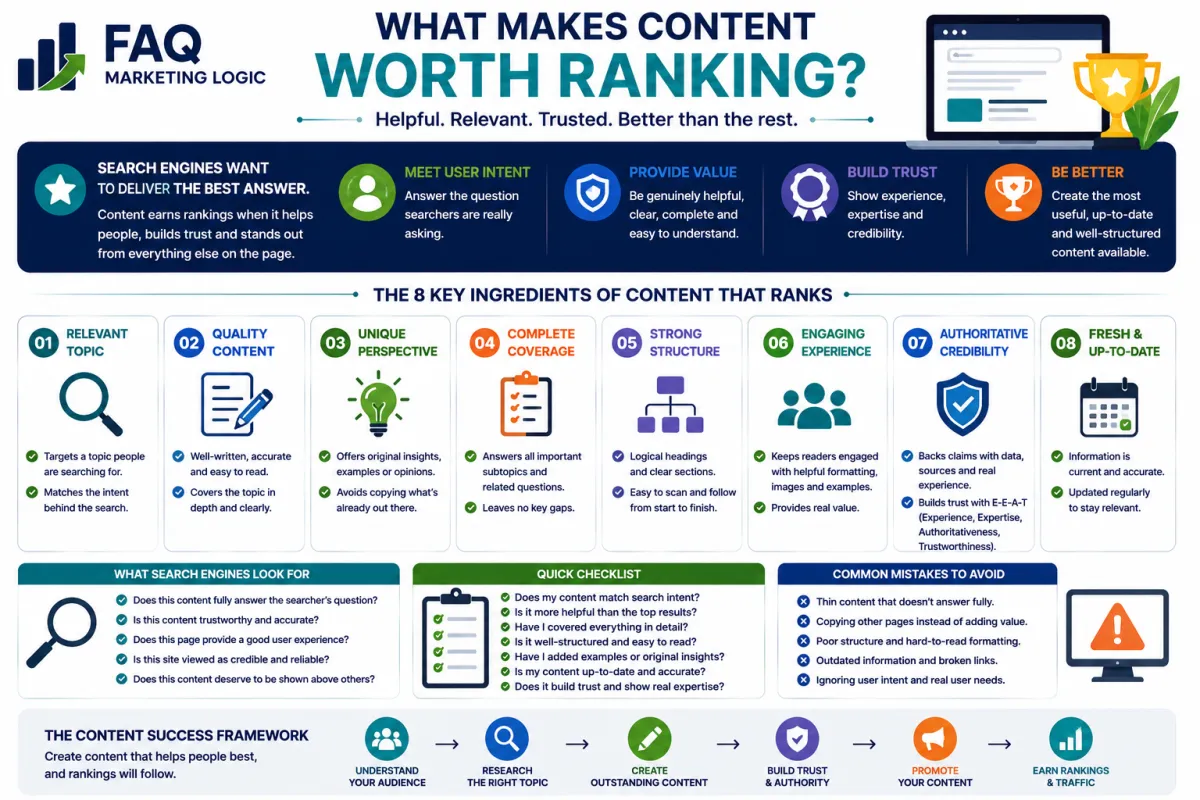
What Makes Content Worth Ranking?
TL;DR
Content is worth ranking when it gives searchers a useful, trustworthy, and satisfying answer to what they're actually trying to find.
There isn't one trick that makes content rank.
Strong pages usually combine clear search intent, genuinely useful information, sufficient depth, good structure, relevant supporting evidence where needed, and a website that demonstrates knowledge of the wider subject.
Don't create content simply because you want a ranking.
Create the page that deserves to be found.
IN SHORT
Content becomes a stronger candidate for search visibility when it:
Matches search intent.
Answers the question clearly.
Provides genuine value.
Covers the subject sufficiently.
Demonstrates experience or knowledge where relevant.
Is easy to understand.
Connects logically with related content.
Offers something useful rather than merely repeating existing pages.
Search engines don't owe every published article a ranking.
Your page has to compete with other possible answers.
REAL TALK
Publishing isn't the achievement.
Being useful is.
It's easy to fall into this pattern:
Choose keyword.
Write article.
Add keyword to title.
Add keyword to headings.
Press publish.
Wait for Google.
But there's a question missing:
Why should this particular page rank?
If ten other websites already answer the question more clearly, more thoroughly, and more usefully, adding another version of the same information doesn't automatically improve the search results.
SEO shouldn't begin with:
"How do I make Google rank this?"
Start with:
"How can I make this one of the most useful answers available for the person searching?"
That's a much healthier foundation.
Key Definition
Rank-worthy content is content that satisfies the needs behind a search query well enough to be a credible candidate for prominent search visibility.
That doesn't mean there is a fixed checklist that guarantees rankings.
Search engines consider many signals when selecting and ordering results.
The important distinction is between:
Content created to target a keyword
and:
Content created to satisfy the person behind that keyword.
The strongest pages try to do both.
Start With Search Intent
Before writing, understand what the person actually wants.
Consider someone searching:
"How long does it take to get website traffic?"
They probably don't want a 4,000-word history of search engines.
They want to understand:
Typical expectations.
Why results vary.
Which traffic sources work faster.
What affects the timeframe.
What they should do while waiting.
That's search intent.
The keyword tells you what they typed.
Intent tells you what they need.
If your page answers a different question from the one the searcher intended, excellent writing won't solve the mismatch.
Answer The Main Question Early
Don't make visitors work through a long introduction before receiving an answer.
If the page asks:
"Should I Focus On One Traffic Source Or Many?"
give the reader the core answer near the beginning.
You can then explain:
Why.
When exceptions apply.
How to choose.
What mistakes to avoid.
What to do next.
This works particularly well for question-led content.
The reader gets immediate value while the rest of the article provides depth and context.
Useful Depth Beats Arbitrary Length
Longer content isn't automatically better.
Neither is shorter content.
The right length depends on what the question requires.
A definition may need a few hundred words.
A beginner's guide may need several thousand.
The important question is:
"Have I given the reader enough information to understand and act on the answer?"
Depth can come from:
Clear explanations.
Examples.
Comparisons.
Practical steps.
Definitions.
Common mistakes.
Relevant FAQs.
Important qualifications.
Don't add paragraphs simply to increase word count.
Add information because it improves the answer.
Give The Reader Something Useful
One of the easiest ways to produce forgettable content is to say what everybody else already says without adding anything useful.
Suppose every article about email subject lines says:
Keep them short.
Create curiosity.
Personalise them.
Test them.
You could repeat those points.
Or you could explain:
Why relevance matters more than cleverness.
How subject lines and sender reputation work together.
When curiosity becomes clickbait.
How preview text complements the subject.
Why open rates shouldn't be considered in isolation.
The second approach gives the reader more to work with.
You don't need a revolutionary new theory.
You need to improve the usefulness of the answer.
Demonstrate Knowledge Rather Than Claiming Expertise
Anyone can write:
"We're experts in digital marketing."
That sentence proves very little.
Expertise becomes more credible when the content itself demonstrates understanding.
That can come from:
Explaining difficult ideas simply.
Recognising exceptions.
Providing realistic examples.
Avoiding exaggerated claims.
Distinguishing between similar concepts.
Acknowledging limitations.
Using reliable sources when factual evidence is needed.
Useful content earns trust through what it contains.
It doesn't need to keep announcing how authoritative it is.
Accuracy Matters
A page can be beautifully structured and still be poor content if the information is wrong.
Check factual claims.
Be especially careful with:
Statistics.
Research findings.
Legal or financial information.
Platform features.
Technical recommendations.
Claims that change over time.
When evidence is important, use appropriate reliable sources.
And when something isn't certain, say so.
"It depends" can be a perfectly useful answer when you then explain what it depends on.
False certainty doesn't make content stronger.
Make The Page Easy To Understand
Useful information loses value when it's difficult to consume.
Structure helps readers find what they need.
Use:
Descriptive headings.
Short, readable paragraphs.
Lists when genuinely useful.
Definitions for unfamiliar terms.
Examples to explain abstract ideas.
Clear progression between sections.
The goal isn't to decorate the page.
It's to reduce the effort required to understand it.
This can also make individual passages easier for search and AI systems to interpret because the context around each answer is clearer.
Cover Connected Questions
A strong article often answers the obvious follow-up questions.
For example, an article explaining how search engines discover content might naturally need to explain:
What crawling means.
What indexing means.
How sitemaps help.
Why internal links matter.
Why discovery doesn't guarantee ranking.
Those supporting answers make the main explanation more complete.
But stay disciplined.
Don't turn every article into an entire course.
If a related question deserves its own page, answer enough to provide context and then connect the reader to the deeper resource.
That's how useful content clusters grow without every page becoming repetitive.
Original Value Doesn't Necessarily Mean Original Research
You don't need to conduct a university study every time you publish an article.
Original value can come from:
A clearer explanation.
A practical framework.
First-hand experience.
A useful comparison.
A better example.
Combining information logically.
Answering a neglected follow-up question.
Applying established knowledge to a specific audience.
Ask:
"What does this page give the reader that they wouldn't get from simply reading the first generic answer?"
That question can improve content considerably.
Build Authority Around The Subject
One excellent article can rank.
But building a useful collection of connected content gives your website something more valuable: subject depth.
Imagine two websites.
Website A publishes one article about email marketing among hundreds of unrelated subjects.
Website B has detailed resources covering:
Building an email list.
Welcome emails.
Email frequency.
Subject lines.
Engagement.
Segmentation.
Sales emails.
Monetisation.
Website B provides a much deeper resource for someone exploring email marketing.
This is the principle behind topical authority.
Individual pages matter.
But the knowledge surrounding those pages matters too.
Internal Links Add Context
Internal links help connect related information.
A page about topical authority might naturally link to:
How many posts are needed.
What content gets discovered.
How internal linking works.
Those links help visitors continue learning.
They also show how your website's subjects relate to one another.
Internal linking shouldn't be random.
The best link answers:
"What is the reader likely to need next?"
That's useful architecture rather than simply adding links for SEO.
Keep Content Current
A page doesn't become permanently useful on the day it's published.
Some information changes.
Products evolve.
Platforms change.
Examples become outdated.
New questions emerge.
Older content can therefore benefit from periodic review.
That doesn't mean rewriting every article every month.
Prioritise pages where:
Information has changed.
Search impressions are increasing.
Rankings are close to improving.
The article has become outdated.
Better supporting content now exists.
Maintaining useful content is part of publishing it.
Practical Example
Imagine two articles targeting the same question:
"How many blog posts do I need before seeing results?"
Article A says:
You should publish 30–50 blog posts because Google likes websites with lots of content.
It repeats that recommendation several times and finishes.
Article B explains:
There is no universal number.
Content quality and competition matter.
Topic coverage matters.
New sites can take time to establish visibility.
Ten strong connected articles may outperform fifty unrelated ones.
Search impressions can provide early evidence before significant clicks appear.
Publishing should be guided by coverage and usefulness rather than hitting an arbitrary quota.
Article B provides the reader with a way to think about the problem.
That's the difference between filling a page and answering a question.
Common Mistakes
Mistake: Writing for a keyword rather than the person searching it.
Fix: Identify the intent behind the query before creating the page.
Mistake: Assuming longer automatically means better.
Fix: Use enough depth to answer the question properly without padding.
Mistake: Rewriting what already ranks without adding value.
Fix: Look for ways to make your answer clearer, more practical, or more complete.
Mistake: Making unsupported claims.
Fix: Verify factual information and qualify claims where appropriate.
Mistake: Publishing isolated articles.
Fix: Build connected coverage around important subjects.
Mistake: Treating publication as the finish line.
Fix: Review and improve valuable content as your site and the subject develop.
FAQ QUICK FIX
Before publishing an article, ask:
1. Does it match search intent?
Make sure you're answering the question the searcher actually has.
2. Is the main answer easy to find?
Don't hide it beneath unnecessary introduction.
3. Does the page provide enough depth?
Cover what someone genuinely needs to understand the subject.
4. Have I added useful value?
Avoid creating another generic version of what already exists.
5. Are factual claims accurate?
Check anything that requires evidence or may have changed.
6. Is the content easy to understand?
Use structure to reduce effort for the reader.
7. Does it connect with related content?
Give the article a logical place within your wider subject coverage.
8. Is there a useful next step?
Help readers continue when they need more information.
FAQ
Q: How long does content need to be to rank?
There is no minimum word count that guarantees rankings. Content should be long enough to satisfy the searcher's need without adding unnecessary material.
Q: Does using more keywords improve rankings?
Repeating keywords unnecessarily doesn't make content more useful. Use natural terminology that helps explain the subject accurately and clearly.
Q: Can AI-generated content rank?
The method used to produce a draft is less important than the usefulness, accuracy, originality, and overall quality of the finished content. AI shouldn't replace editorial judgement or factual checking.
Q: Does every article need to be completely original?
The facts behind many subjects are already well established. The opportunity is to provide original value through clearer explanations, experience, examples, frameworks, analysis, or application.
Q: Is topical authority a ranking factor?
Search visibility is influenced by many systems and signals rather than a single switch labelled "topical authority." Building deep, connected coverage can nevertheless make a website more useful and establish stronger context around a subject.
TRY THIS TODAY
Choose one article from your website that's already receiving search impressions.
Read it as if you'd never seen your website before.
Then ask:
"If I searched this exact question, would I be satisfied with this answer?"
Not:
"Did I use the keyword enough?"
Not:
"Is it 2,000 words?"
Not:
"Did I add enough headings?"
Would you genuinely be pleased that Google showed you this page?
If the answer isn't an easy yes, you've found an article worth improving.
RELATED ARTICLES
→ What Content Gets Discovered Most Easily?
→ How Do I Build Topical Authority?
→ How Do I Build Topical Authority Faster?
QUICK RECAP
Content becomes more worthy of search visibility when it:
Matches intent.
Answers clearly.
Provides useful depth.
Adds genuine value.
Demonstrates knowledge.
Remains accurate.
Is easy to understand.
Connects with relevant supporting content.
Is maintained when necessary.
There is no formatting trick that guarantees rankings.
The strongest foundation remains remarkably simple:
Create an answer worth finding.
NEXT STEP
A strong page shouldn't exist in isolation.
Once you've created useful content, connecting it properly to the rest of your website can help visitors and search engines understand where it belongs.
Read: