
What Makes A Digital Product Easy To Sell?
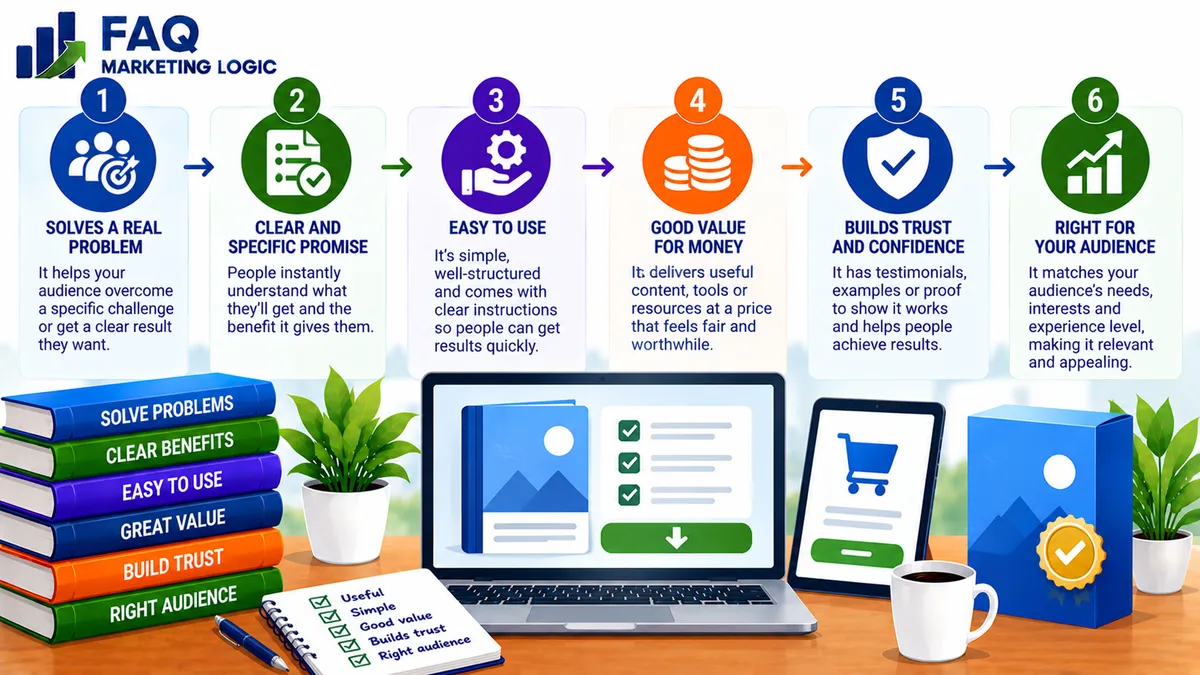
A digital product becomes easier to sell when it solves a recognisable problem, promises a clear and believable result, and gives customers a good reason to choose it.
The format, size and amount of content matter less than how useful the product appears to the intended buyer.
People rarely purchase a digital product simply because it contains a lot of information. They buy because they believe it will help them achieve something worthwhile.
The simplest way to improve a digital product's appeal is to make the problem, solution and value immediately understandable.
IN SHORT
An easy-to-sell digital product usually has five important characteristics:
It addresses a specific problem or goal.
It appeals to an identifiable audience.
It offers a clear and realistic outcome.
It is straightforward to understand and use.
Its price feels reasonable compared with the value provided.
This doesn't mean every useful product will sell automatically. Marketing, trust, timing and competition still influence purchasing decisions.
However, when customers can quickly understand what a product does and why they might need it, much of the uncertainty surrounding the purchase disappears.
WHY THIS WORKS
Start With A Problem People Already Recognise
One of the biggest mistakes in digital product creation is beginning with the information you want to provide rather than the problem someone wants to solve.
You might have enough knowledge to create a 200-page guide covering every aspect of email marketing.
But a beginner struggling to write their first welcome email may not want a complete marketing education.
They want to know what to write, what to include and how to send something that makes a good first impression.
A shorter, focused product addressing that problem may be more appealing than a comprehensive course covering subjects they don't yet need.
This is why recognising an existing problem matters.
When people already understand their difficulty, you don't have to spend as much time explaining why the subject deserves attention.
You can concentrate on showing how your product helps.
Make The Outcome Clear
Customers need to understand what they're likely to gain from purchasing your product.
Consider the difference between these two descriptions:
"An extensive collection of digital marketing resources."
And:
"A practical guide to planning and writing your first five welcome emails."
The first describes a collection of information. The second describes a recognisable task and a specific outcome.
That doesn't guarantee the second product will sell better, but it gives potential customers a clearer reason to consider it.
A useful product promise should explain what the buyer will be able to understand, create, improve or accomplish.
Avoid promising results you cannot reasonably support.
For example, a guide can help someone learn how to create a sales page, but it cannot guarantee that every reader will make a particular number of sales.
Clear, realistic promises build more confidence than exaggerated claims.
Choose A Specific Audience
A product designed for everybody can become difficult to explain because different customers have different needs.
For example, a course called "Everything You Need To Know About Online Business" might appeal to several audiences, but it's unclear where a beginner should start or what the course will help them achieve.
A product called "Your First Digital Product: From Idea To Finished Guide" has a more identifiable audience.
It's intended for people who want to create their first information product.
That focus influences the content, examples, instructions and sales message.
You don't necessarily need an extremely narrow niche. However, you should understand who the product is for and what stage they're at.
A beginner usually needs different explanations from an experienced business owner.
When you know the intended customer, you can remove unnecessary information and concentrate on what matters to them.
Understanding your customer also helps you choose a business model that suits the opportunity. Our Online Business Foundations guide explains how to approach those early decisions, from identifying a suitable model to developing an offer people understand.
Make The Product Easy To Use
A useful product isn't necessarily a complicated one.
Digital products can include reports, guides, templates, checklists, workbooks, training videos and software.
The best format depends on what the customer needs to accomplish.
If someone wants to understand a subject, a guide may be appropriate.
If they need to complete a practical task, a checklist or workbook might be more useful.
If they're learning a process that involves several stages, a short course could provide the necessary structure.
The important question is whether the format helps customers achieve the intended result.
Adding more modules, bonuses and supporting materials doesn't automatically increase value.
Sometimes extra content creates another problem: the customer doesn't know where to begin.
A product that offers a clear starting point and manageable steps may be easier to understand, complete and recommend.
Reduce The Amount Of Work Before The First Result
People are often more willing to purchase when they can see a practical route from buying the product to using it.
Imagine two products teaching beginners how to develop a digital product idea.
The first provides several hours of general training before asking the customer to complete any exercises.
The second begins with a simple worksheet that helps them identify three possible product ideas.
Both might contain useful information, but the second provides an earlier opportunity to make progress.
This doesn't mean every product needs to deliver instant results.
Some subjects require considerable learning and practice.
However, breaking the process into manageable steps makes the product feel less overwhelming.
A useful first action can help customers build confidence and encourage them to continue.
Match The Price To The Value And The Buyer
Price influences how easily a product sells, but cheaper doesn't always mean more appealing.
A $9 checklist might be appropriate for solving a small, immediate problem.
A detailed training programme that helps someone develop a valuable professional skill may justify a considerably higher price.
The important thing is the relationship between the price, the problem and the value customers expect to receive.
You should also consider the intended audience.
Someone exploring their first online business idea may be reluctant to spend hundreds of dollars before they understand the process.
An experienced business owner trying to solve an expensive operational problem may view the same amount differently.
Pricing should reflect the usefulness of the product, the alternatives available and the confidence customers have in the promised outcome.
Don't automatically lower your price because sales are slow.
The problem may be unclear positioning, insufficient trust or an offer that doesn't match the intended audience.
Build Confidence Before Asking For The Sale
Even a well-designed product can struggle if customers don't trust the person or business selling it.
A clear sales page should explain what the product includes, who it's intended for and what customers can reasonably expect.
Useful examples, previews, accurate descriptions and genuine customer feedback can all help buyers make informed decisions.
If there are limitations, explain them.
For example, if a product assumes some previous experience or requires particular software, customers should know before purchasing.
Clarity reduces the risk of disappointment and unnecessary refund requests.
You don't need exaggerated claims or complicated persuasion techniques to make a useful product appealing.
You need to help the customer understand whether it's suitable for their situation.
Consider Whether You Need To Create Everything Yourself
Creating a digital product from scratch isn't the only option.
Depending on the business model, you may be able to license existing material and adapt it into a product that serves a particular audience.
For example, licensed training material could provide the foundation for a beginner's guide, provided the licence permits the intended modifications and resale.
However, licensing doesn't remove the need to understand your market.
You still need to check the quality of the material, confirm your rights and make sure the finished product solves a genuine problem.
If you're exploring this approach, the Product Licensing Formula introduces the idea of obtaining rights to market and sell existing products.
The advantage isn't that licensed products automatically sell.
It's that suitable licensing arrangements may reduce the amount of original development work required, allowing you to concentrate on positioning, presentation and marketing.
PRACTICAL EXAMPLE
Imagine you're considering creating a digital product about starting an online business.
Your original idea is a 150-page ebook called "The Complete Guide To Making Money Online."
It covers affiliate marketing, digital products, freelancing, membership sites, advertising and several other subjects.
The information may be useful, but the product has a problem.
It's difficult to explain exactly who should buy it and what they'll achieve after reading it.
You decide to focus on one part of the subject.
Your revised product is called "Choose Your First Online Business Model."
It helps beginners compare several practical options, understand the main requirements and select a model that suits their available time, skills and resources.
You include a comparison worksheet and a simple decision-making checklist.
The product is now easier to describe.
The intended customer is clearer, the problem is more specific and the buyer can understand what they'll be working towards.
You haven't necessarily created more content.
You've created a more focused offer.
That doesn't guarantee sales, but it gives you a stronger foundation for testing whether people actually want the product.
REAL TALK
It's tempting to believe that creating a bigger product makes it more valuable.
More pages, more videos, more bonuses and more modules can certainly make an offer look substantial.
But none of those things guarantees that customers will want it.
A product containing 50 hours of training can be less appealing than a practical workbook if the workbook helps someone solve the problem they're dealing with today.
The difficulty is that creators often judge products by the work involved in producing them.
Customers judge them by the usefulness they expect to receive.
Those are two very different perspectives.
Before adding another chapter or bonus, ask whether it makes the product easier to use or simply makes the package larger.
The goal isn't to produce the most content.
It's to create something that helps the right customer achieve a worthwhile result.
COMMON MISTAKES
Mistake: Creating the product before checking demand.
You spend weeks developing something without establishing whether people recognise the problem or want the proposed solution.
Fix: Research the questions, frustrations and existing alternatives in your market before committing to full development.
Mistake: Trying to appeal to everybody.
Your product covers so many subjects that potential customers struggle to understand whether it's intended for them.
Fix: Identify the primary audience and concentrate on the result that matters most to them.
Mistake: Adding content instead of improving usefulness.
You keep expanding the product because you believe more information automatically means greater value.
Fix: Remove unnecessary material and organise the remaining content around practical progress.
Mistake: Competing only on price.
You repeatedly discount the product without addressing the reasons customers hesitate.
Fix: Review the offer, positioning, trust signals and explanation of value before changing the price.
Mistake: Assuming licensed content will sell automatically.
You obtain resale rights and immediately begin promoting the material without considering the audience or its quality.
Fix: Check the licence, review the content and establish how the product meets a genuine market need.
FAQ QUICK FIX
Want to make an existing digital product easier to sell?
Start by reviewing the offer rather than immediately rewriting the entire product.
1. Identify the intended customer.
Write down who the product is for and what they already know about the subject.
2. Define the main problem.
Explain the specific difficulty or goal that makes someone interested in the product.
3. Clarify the outcome.
Describe what the customer should be able to understand or accomplish after using it.
4. Simplify the presentation.
Remove unnecessary explanations and make the product's main benefit immediately clear.
5. Check the buying experience.
Make sure the sales page explains what's included, the price, any important requirements and how the product is delivered.
These changes won't guarantee more sales, but they can make the offer easier for suitable customers to evaluate.
FAQ
What Type Of Digital Product Is Easiest To Sell?
There's no single format that's easiest for every market. Products that address clear problems and provide practical value are often easier to explain. The most suitable format depends on what customers need to achieve.
Do Digital Products Need To Be Long To Be Valuable?
No. Value depends on usefulness rather than length. A short guide, template or checklist can be valuable when it helps someone complete an important task.
Should I Create A Digital Product For Beginners?
Beginners can be a suitable audience because they often need clear explanations and structured guidance. However, you still need to identify a specific problem and confirm that people are willing to pay for the solution.
Can I Sell A Digital Product Without Being An Expert?
You don't necessarily need to be a recognised authority, but you must be able to provide accurate, useful information or obtain suitable rights to quality material. Avoid making claims or teaching subjects beyond your competence.
Is It Easier To Sell A Cheap Digital Product?
Not always. Lower prices may reduce the financial commitment, but customers still need to understand the value. A poorly positioned product can struggle at any price.
Can Licensed Digital Products Be Profitable?
Yes, potentially. Profitability depends on licensing costs, permitted uses, product quality, marketing expenses, pricing and customer demand. Buying a licence doesn't guarantee that the product will sell.
TRY THIS TODAY
Choose one digital product you're considering creating, licensing or selling.
Write down the answers to these questions:
Who is the product intended for?
What specific problem does it solve?
Why would someone want to solve that problem now?
What practical result can the customer reasonably expect?
What makes the product different from available alternatives?
Is the format appropriate for the intended customer?
Can someone understand the offer in less than a minute?
What evidence would help a potential buyer trust the product?
Is the price reasonable for the value being offered?
Now write a single sentence using this structure:
"This product helps [specific audience] achieve [clear outcome] by providing [practical solution]."
For example:
"This workbook helps first-time digital product creators choose a suitable product idea by comparing their skills, available resources and potential customer needs."
If you struggle to complete that sentence, your offer may need more focus.
Improving that clarity is often a better starting point than creating additional content.
Want To Explore Product Licensing Further?
Creating a useful digital product doesn't always mean writing every page or recording every lesson yourself.
Product licensing provides another option: obtaining appropriate rights to existing material that you can market and sell.
However, the same principles still apply.
You need to understand the intended audience, evaluate the product's quality and make sure the licence allows what you plan to do.
If you'd like to explore how this approach works, there's a free resource that introduces the product licensing business model.
→ Discover How Product Licensing Works
RELATED ARTICLES
→ How Do I Know If A Digital Product Is Worth Selling?
→ How Do I Turn Skills Into A Sellable Offer?
→ What Makes An Online Offer Simple Enough To Launch?
QUICK RECAP
A digital product becomes easier to sell when customers can understand its purpose and recognise its value.
Start with a problem people already want to solve.
Identify the audience most likely to benefit.
Explain a clear and believable outcome.
Choose a format that suits the task.
Help customers make progress without unnecessary complexity.
Price the product according to its value and market.
Build trust through accurate descriptions and useful evidence.
Check demand before investing heavily in development.
Remember that licensing can reduce creation work but doesn't guarantee sales.
A successful digital product doesn't need to contain everything someone could possibly learn about a subject.
It needs to provide the right information or tools to help the intended customer move forward.
The easier your product is to understand, the easier it becomes for customers to decide whether it's right for them.
NEXT STEP
Once you've developed a clear product idea, the next challenge is deciding whether to create the material yourself or use an existing product as your starting point.