What Causes Low Conversion Rates?
TL;DR
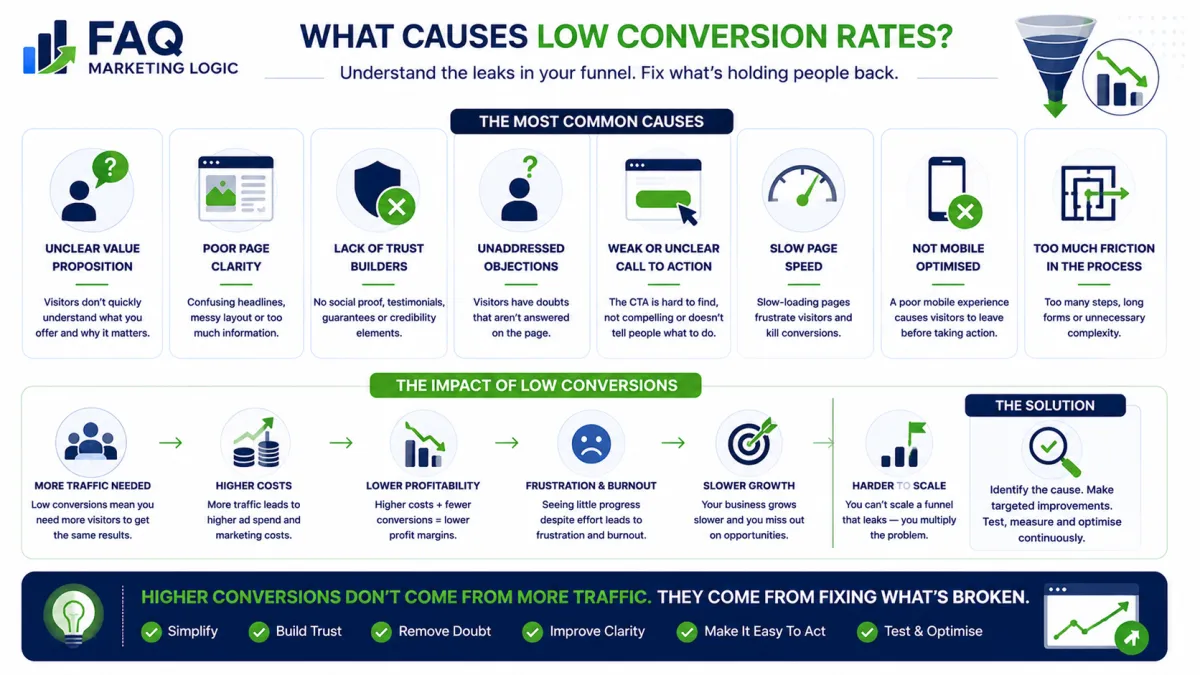
Low conversion rates are usually caused by unclear messaging, lack of trust, poor user experience, or asking visitors to take action before they're ready.
IN SHORT
Many business owners assume low conversions mean they need more traffic.
In reality, the problem often lies with what happens after visitors arrive.
If people don't understand your offer, don't trust your business, or find your website difficult to use, they'll often leave without taking action.
Improving conversions usually means removing obstacles rather than attracting more visitors.
REAL TALK
It can be frustrating to see visitors arriving on your website but leaving without subscribing or buying.
Many beginners respond by changing everything at once.
Unfortunately, that makes it difficult to know what actually caused the problem.
Successful businesses take a different approach.
They identify the biggest barrier, improve it, measure the results, and then move on to the next opportunity.
Conversion optimisation is an ongoing process, not a one-time project.
Key Definition
A conversion rate is the percentage of visitors who complete the primary action you want them to take.
A low conversion rate simply means that relatively few visitors are taking that action.
The goal isn't perfection—it's continuous improvement over time.
Unclear Messaging
Visitors should immediately understand:
What you're offering.
Who it's for.
Why it matters.
What they should do next.
If your message is confusing or overly complicated, many people will leave before reading further.
Clarity is one of the fastest ways to improve conversions.
Lack Of Trust
People are naturally cautious online.
Without evidence that your business is genuine, visitors may hesitate.
Trust-building elements include:
Customer testimonials
Reviews
Case studies
Guarantees
Professional branding
Helpful educational content
The more confidence visitors have, the more likely they are to take action.
Too Much Friction
Every unnecessary step creates another opportunity for someone to leave.
Common examples include:
Long forms
Too many buttons
Confusing navigation
Slow-loading pages
Complicated checkout processes
Simplifying the user experience often improves conversions significantly.
Weak Calls To Action
Visitors need clear direction.
If your call to action is vague or difficult to find, people may simply leave without doing anything.
Effective calls to action are:
Clear
Visible
Relevant
Action-focused
People shouldn't have to guess what happens next.
Asking Too Much Too Soon
Some visitors are ready to buy immediately.
Most aren't.
Trying to close the sale before building trust often reduces conversions.
Instead, guide visitors through a logical journey by:
Providing useful information.
Answering common questions.
Demonstrating expertise.
Building confidence.
Introducing offers naturally.
Relationships often convert better than pressure.
Example
Imagine a visitor arrives on your landing page after searching for advice about email marketing.
Instead of finding a clear explanation of your solution, they're presented with several offers, long paragraphs of technical jargon, and an immediate request to buy an expensive course.
Feeling overwhelmed and uncertain, they leave within seconds.
Now imagine the same visitor lands on a page with a clear headline, a simple explanation of the problem, a free guide, testimonials, and one obvious next step.
The second experience removes confusion, builds trust, and makes taking action feel much easier.
Common Mistake
Mistake: Assuming low conversions are caused by low traffic.
Fix: Analyse what happens after visitors arrive and focus on removing confusion, reducing friction, and building trust before investing in more traffic.
Improving your existing conversion rate often delivers a better return than simply attracting more visitors.
FAQ Quick Fix
If your conversion rate is low:
Clarify your message.
Build more trust.
Simplify the user experience.
Strengthen your call to action.
Improve one element at a time.
RELATED ARTICLES
→ The Complete Beginner's Guide To Conversion Optimisation
→ How Do I Know If My Landing Page Is Working?
→ How Do I Identify Conversion Bottlenecks?
QUICK RECAP
Low conversion rates are commonly caused by:
Unclear messaging
Lack of trust
Too much friction
Weak calls to action
Asking for commitment too early
Small improvements made consistently usually produce the biggest long-term gains.
NEXT STEP
The Conversion pillar is now complete.
You've learned how to:
Improve landing pages
Build stronger offers
Diagnose conversion problems
Increase trust
Optimise funnels
Measure and improve performance
The next step is building the systems that allow you to apply these improvements consistently.
Continue to the Systems (Execution) pillar and start with: