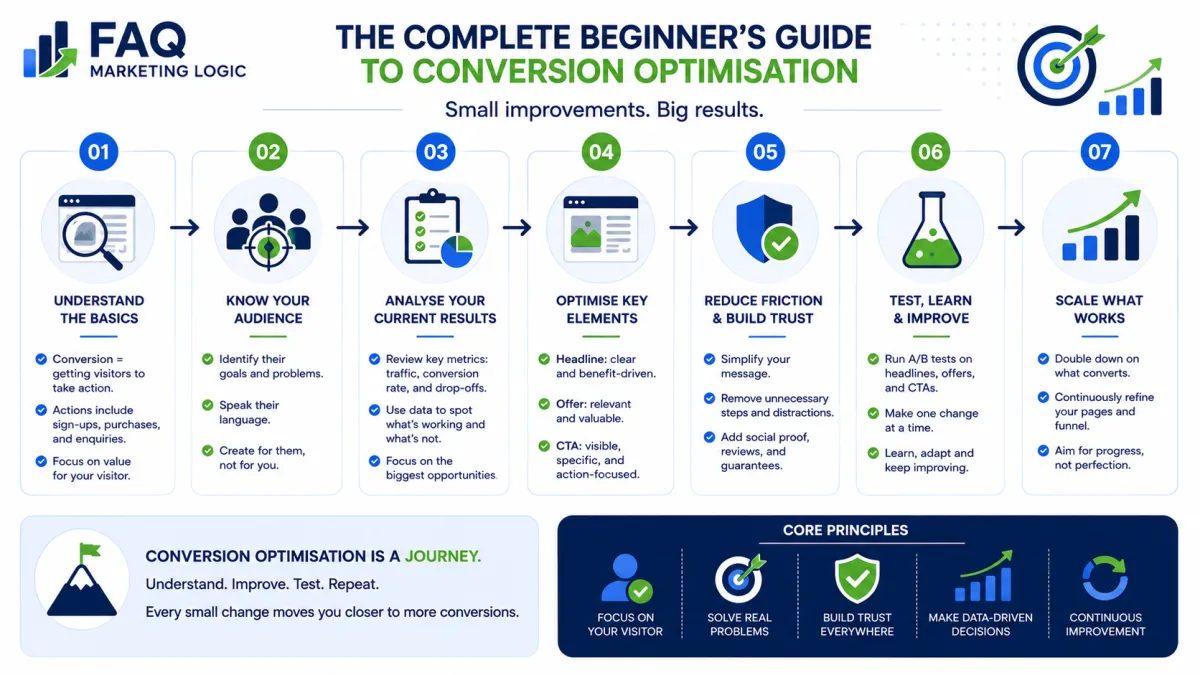
The Complete Beginner's Guide To Conversion Optimisation
TL;DR
Conversion optimisation is the process of improving your website and marketing so that more visitors take the action you want, whether that's joining your email list, requesting a quote, or making a purchase.
Introduction
Driving traffic to your website is only half the battle.
If visitors arrive but leave without taking action, your marketing isn't reaching its full potential.
That's where conversion optimisation comes in.
Rather than constantly chasing more visitors, conversion optimisation helps you get better results from the people already visiting your website.
For beginners, this is often the fastest and most cost-effective way to grow an online business.
In this guide, you'll learn what conversion optimisation is, why it matters, what influences conversions, and the practical steps you can take to improve your results.
Key Definition
Conversion optimisation is the process of increasing the percentage of website visitors who complete a desired action.
That action might be:
Joining your email list
Downloading a guide
Booking a consultation
Requesting a quote
Purchasing a product
The goal isn't simply to attract more visitors.
It's to help more of your existing visitors become subscribers, leads, or customers.
Why Conversion Optimisation Matters
Many beginners assume they have a traffic problem.
In reality, they often have a conversion problem.
Imagine two websites that each receive 1,000 visitors every month.
Website A converts 1% of visitors.
Website B converts 3%.
Without attracting a single extra visitor, Website B generates three times as many leads or sales.
Small improvements in conversion rates can have a significant impact on business growth.
What Influences Conversions?
Visitors make decisions based on several factors working together.
The most important include:
Clarity
Visitors should immediately understand:
What you offer
Who it's for
Why it matters
Confusing websites lose visitors quickly.
Trust
People buy from businesses they trust.
Trust is built through:
Helpful content
Testimonials
Reviews
Guarantees
Professional presentation
Consistent messaging
Every positive interaction increases confidence.
Relevance
Your message should match the visitor's problem.
The more relevant your content feels, the more likely people are to continue reading and eventually take action.
Simplicity
Every additional step creates friction.
Simple pages, straightforward navigation, and clear calls to action make it easier for visitors to move forward.
Understanding The Customer Journey
Conversions rarely happen instantly.
Most people move through several stages before buying.
These stages often include:
Discovering a problem
Looking for information
Comparing possible solutions
Building trust
Making a decision
Good marketing supports visitors through every stage instead of asking for a sale immediately.
Common Conversion Goals
Not every website is trying to sell directly.
Typical conversion goals include:
Email subscriptions
Product purchases
Consultation bookings
Contact form enquiries
Webinar registrations
Free trial sign-ups
Every page should have one primary goal.
Trying to achieve multiple goals often weakens all of them.
How To Improve Conversions
Start with the basics.
Focus on making your website:
Easier to Understand
Use simple language.
Explain benefits before features.
Remove unnecessary jargon.
Easier to Trust
Include:
Testimonials
Case studies
Customer reviews
Guarantees
Clear contact information
Trust reduces hesitation.
Easier to Use
Reduce unnecessary clicks.
Make buttons obvious.
Keep forms short.
Remove distractions.
Small usability improvements often produce measurable results.
Easier to Measure
Track:
Conversion rates
Button clicks
Form submissions
Bounce rates
Landing page performance
What gets measured can be improved.
Example
Imagine your landing page receives 2,000 visitors each month.
Currently, 40 people join your email list.
That's a conversion rate of 2%.
By improving your headline, simplifying your form, adding testimonials, and making your call to action clearer, your conversion rate increases to 4%.
Without increasing traffic, you now gain 80 subscribers every month instead of 40.
That's the power of conversion optimisation.
Common Mistakes
Many beginners:
Focus only on getting more traffic.
Ignore visitor behaviour.
Make too many changes at once.
Overcomplicate their pages.
Ask visitors to make decisions too quickly.
Improvement usually comes from making small, thoughtful changes over time.
FAQ Quick Fix
To improve conversions:
Make your message clear.
Build trust throughout the page.
Keep navigation simple.
Use strong calls to action.
Measure your results.
Improve continuously.
Conclusion
Conversion optimisation isn't about manipulating people.
It's about making it easier for visitors to understand your offer, trust your business, and take the next logical step.
When you consistently remove confusion and reduce friction, conversions naturally improve.
Even small improvements can produce significant long-term growth.
RELATED ARTICLES
→ Why Are Visitors Leaving My Page Without Taking Action?
→ How Do I Identify Conversion Bottlenecks?
→ What Conversion Metrics Matter Most?
QUICK RECAP
Successful conversion optimisation focuses on:
Clarity
Trust
Relevance
Simplicity
Measurement
Continuous improvement
Improving conversions allows your existing traffic to generate better results.
NEXT STEP
Now that you understand the fundamentals of conversion optimisation, the next step is learning how to tell whether your own landing pages are performing effectively.
Read: