
How Do I Know When An Offer Needs Improving?
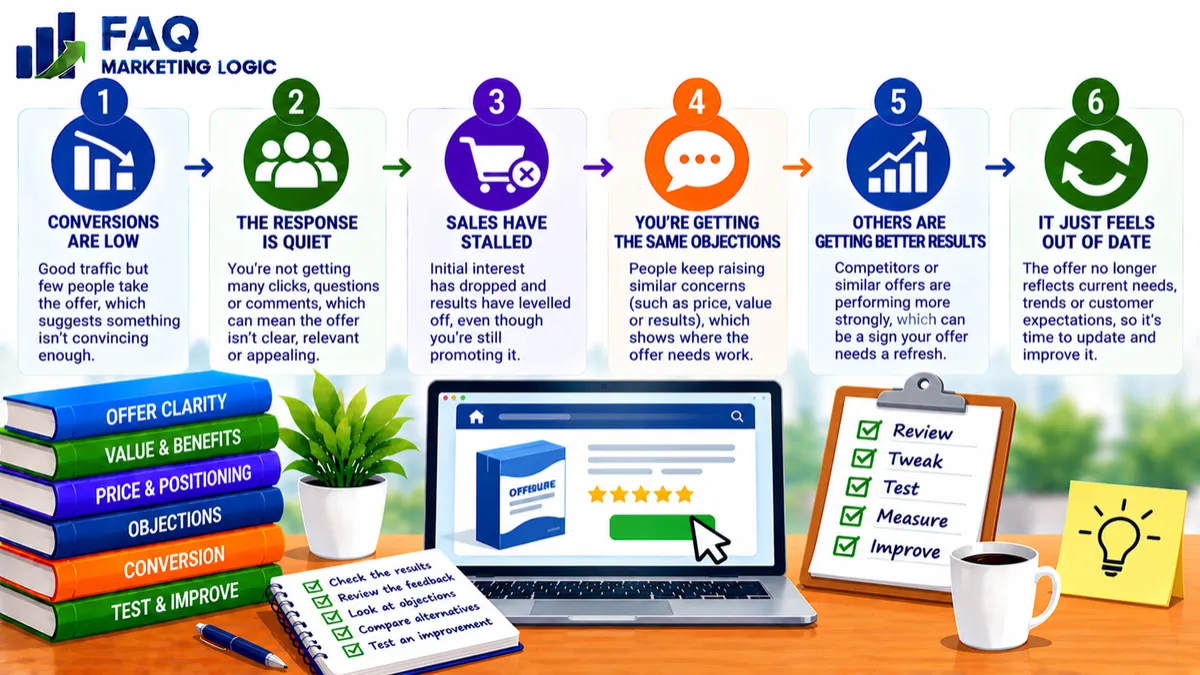
An offer may need improving when people show interest but don't buy, customers misunderstand what they're getting, or sales remain disappointing despite attracting suitable visitors.
However, poor sales don't automatically mean the product is wrong. The problem could be your pricing, positioning, sales message or the way you explain the value.
Before rebuilding an offer or creating something new, identify what's preventing people from recognising its benefits. Often, a small, carefully chosen improvement can make an existing offer easier to understand and more appealing.
IN SHORT
Every offer starts with an assumption about what customers want and what they're willing to pay for it.
You identify a problem, create a solution and present it to potential buyers.
But the first version won't always communicate its value as clearly as it could.
Perhaps visitors don't understand who the product is intended for. Maybe the benefits aren't obvious, the price feels difficult to justify or customers are uncertain about what happens after purchasing.
These are all reasons to investigate whether your offer needs improving.
The important distinction is between an offer that needs adjusting and a product that doesn't address a worthwhile need.
Improving the presentation of a useful product can make a difference. Rewriting a sales page won't solve a fundamental lack of demand.
WHY THIS WORKS
Look For Interest That Doesn't Turn Into Sales
One of the clearest warning signs is when people appear interested in your offer but rarely purchase.
For example, your emails might generate clicks, or your articles might regularly send visitors to a product page.
That suggests the subject has attracted attention.
However, if relatively few visitors buy, something may be preventing them from taking the next step.
The problem could be unclear benefits, unsuitable pricing, missing information or a mismatch between the visitor's expectations and the offer itself.
Before changing anything, examine what happens between the initial interest and the purchasing decision.
Our article How Do I Identify Conversion Bottlenecks? explores how to find the points where potential customers stop progressing.
The important thing is not to assume that every unsuccessful visit represents a problem.
Some people are researching, comparing alternatives or simply aren't ready to purchase.
You're looking for patterns that suggest a genuine obstacle.
Check Whether Customers Understand The Value
An offer can contain useful information and still be difficult to sell.
This often happens when the sales message concentrates on what customers receive rather than what the product helps them accomplish.
Imagine you're selling a digital training programme.
Your sales page explains that it contains eight modules, twenty videos and several downloadable worksheets.
Those details describe the contents, but they don't necessarily explain why someone should want them.
A potential customer may still wonder what they'll be able to do after completing the programme.
A stronger explanation connects the product's features with a recognisable problem and a useful outcome.
For example, instead of simply listing a collection of marketing templates, you might explain how they help someone prepare consistent promotional messages without starting from a blank page.
The templates haven't changed.
You've made their practical value easier to understand.
This is closely connected with How Do I Improve My Offer Positioning?, which explores how to communicate an offer to the audience most likely to benefit from it.
Sometimes an offer doesn't need more features.
It needs a clearer explanation of why the existing features matter.
Pay Attention To Repeated Questions
Customer questions can reveal information your sales page isn't communicating effectively.
Perhaps people repeatedly ask whether your product is suitable for beginners.
Others might want to know whether they need specialist software, how long the training takes or whether the purchase includes future updates.
These questions don't necessarily indicate that your product is inadequate.
They may simply reveal information customers need before making a decision.
If several people ask the same question, consider whether the answer should appear more clearly in your sales material.
You might add a short explanation, improve the product description or clarify what's included.
However, avoid turning every customer question into another lengthy sales page section.
Focus on information that genuinely helps people decide whether the offer is suitable.
The objective is to remove unnecessary uncertainty without overwhelming visitors.
Review Your Pricing Without Automatically Lowering It
When an offer isn't selling, reducing the price can seem like the obvious solution.
But price is only one part of the purchasing decision.
A customer may consider a £29 product expensive if they don't understand what it will help them achieve.
The same customer might consider a more expensive product worthwhile when the benefits are clear and relevant.
That doesn't mean higher prices always work better.
It means you need to consider price alongside perceived value, market expectations and the alternatives available.
If customers consistently describe your product as expensive, investigate what they're comparing it with.
Are they comparing it with free information? Do they understand the difference between your offer and a cheaper alternative? Are you promising more than the product realistically delivers?
Our article How Should I Price My First Offer? (Without Guessing) provides a useful starting point for evaluating price.
Sometimes the answer is a pricing adjustment.
At other times, the more useful improvement is explaining the value more clearly.
Make Sure You're Attracting The Right Audience
An offer may struggle because it's being presented to people who don't need it.
For example, a beginner's guide to creating digital products is unlikely to appeal strongly to experienced publishers who already have established product catalogues.
That doesn't mean the guide is unsuitable.
It means the marketing message may be reaching the wrong audience.
Before rewriting your offer, consider where your visitors are coming from and what they're expecting.
Are your articles attracting people who face the problem your product addresses?
Does the promotional message match the information on the sales page?
Are you introducing the offer at a suitable stage in the customer's journey?
A mismatch can occur when an article promises one type of solution but the linked product addresses something different.
Improving the connection between the audience, the message and the product can be more effective than changing the product itself.
Consider Whether The Offer Has Become Too Complicated
Sometimes an offer becomes less appealing as you add more to it.
You begin with a straightforward product designed to solve one problem.
Then you introduce additional bonuses, extra modules, alternative packages and several different purchasing options.
Each addition seems useful individually.
But together, they can make the offer difficult to understand.
A potential customer may struggle to identify what they're buying or which option is appropriate.
If your offer has grown complicated, consider whether you can simplify the presentation.
Make the main product and its purpose immediately clear.
Explain additional resources only where they genuinely strengthen the offer.
Our article What Makes A Simple Offer Convert Better? explores why straightforward offers can sometimes be easier for customers to evaluate.
The goal isn't necessarily to remove valuable content.
It's to make the buying decision easier to understand.
Use Customer Feedback To Identify Genuine Improvements
Your existing customers can provide useful clues about what needs attention.
They may tell you which parts of a product helped most, where they struggled or what they expected to receive.
This information can reveal opportunities to improve the product itself rather than simply changing the marketing.
For example, customers might appreciate your training but find the first lesson difficult to follow.
You could improve the introduction or provide a simple getting-started checklist.
Alternatively, buyers might consistently praise one particular feature that receives little attention in your sales copy.
That could be an opportunity to strengthen the offer's positioning.
However, avoid rebuilding a product around every individual suggestion.
Look for repeated themes and consider whether the proposed changes would benefit your intended audience.
Know When To Improve The Offer And When To Change Direction
Not every offer can be rescued through better copywriting, pricing or additional bonuses.
Sometimes the underlying problem is that the audience doesn't value the solution enough to purchase it.
Perhaps the need isn't particularly urgent, the market is too small or customers already have alternatives that meet their requirements.
This is why testing matters.
If you've attracted suitable visitors, explained the benefits clearly, addressed reasonable concerns and tested sensible improvements without meaningful progress, you may need to reconsider the offer itself.
Our article When Should I Pivot My Business Idea? explores when a change in direction may be more appropriate than continuing with the original approach.
You don't need to abandon an offer after a disappointing week.
But you also shouldn't continue making changes indefinitely without considering whether the product addresses a problem people genuinely want solved.
Consider Whether A Different Product Model Would Work Better
Sometimes improving an offer involves reconsidering how the product is developed or delivered.
For example, someone creating every digital product from scratch may find that development takes too much time compared with the revenue generated.
An alternative could involve licensing suitable existing products and adapting them for a particular audience, provided the licensing terms allow the intended use.
That doesn't eliminate the need for market research, useful positioning or effective marketing.
However, it can provide another approach to product development.
If you're interested in exploring that model, our article What Is Product Licensing And How Does It Work? explains how licensing works and what to consider before using it in your business.
The important point is to choose a product model that supports the needs of your customers and the practical requirements of your business.
PRACTICAL EXAMPLE
Imagine you're selling a digital guide designed to help beginners choose their first online business idea.
The guide costs £27.
Your sales page receives 500 visitors during a month, but only five people purchase.
That produces £135 in revenue from a 1% conversion rate.
You initially consider reducing the price.
However, after reviewing the sales page, you notice that most of the copy describes the guide's chapters rather than the decisions it helps readers make.
You also discover that several visitors have asked whether the guide is suitable for people with no previous business experience.
Instead of changing the price immediately, you make three improvements.
First, you rewrite the opening to explain who the guide is intended for and what problem it addresses.
Second, you replace the long chapter list with a clearer explanation of the practical decisions readers will work through.
Third, you add a short section explaining what beginners need before getting started.
You then monitor the results.
If the conversion rate increases from 1% to 2% with the same number of visitors, monthly sales rise from five to ten.
At £27 per purchase, revenue would increase from £135 to £270.
These figures are illustrative rather than a prediction.
The example shows how improving the explanation of an existing offer can create an opportunity to increase sales without changing the product or immediately lowering its price.
REAL TALK
It's tempting to assume that disappointing sales mean you need a better product.
You start thinking about adding bonuses, recording extra lessons or creating another version of what you already sell.
But sometimes the product isn't the problem.
The problem is that potential customers don't understand why they need it.
On the other hand, it's equally easy to spend weeks rewriting a sales page for a product that nobody particularly wants.
That's why you need to separate the offer from the way it's being presented.
Ask whether the problem is worth solving, whether the product provides a suitable solution and whether the marketing communicates that value clearly.
If the product addresses a genuine need, improvements to the offer may help.
If the underlying demand isn't there, more persuasive copy won't necessarily change the outcome.
The objective isn't to keep polishing an offer indefinitely.
It's to make sensible improvements based on what you can observe and learn.
COMMON MISTAKES
Mistake: Assuming poor sales always mean the price is too high.
You immediately discount the product without investigating why people aren't purchasing.
Fix: Review the offer's positioning, benefits, audience and purchasing experience before changing the price.
Mistake: Adding more bonuses to make the offer attractive.
You introduce extra material without considering whether it helps customers achieve their intended outcome.
Fix: Concentrate on the value of the main product and add supporting resources only when they serve a clear purpose.
Mistake: Changing several things at once.
You rewrite the headline, alter the price, introduce bonuses and change the checkout process simultaneously.
Fix: Prioritise one meaningful improvement at a time so the results are easier to interpret.
Mistake: Ignoring customer questions.
You continue using the same sales message even though potential buyers repeatedly ask for clarification.
Fix: Use recurring questions to identify missing or confusing information.
Mistake: Continuing to improve an offer with little evidence of demand.
You keep adjusting the presentation without examining whether customers actually want the product.
Fix: Review audience needs, buying behaviour and customer feedback before investing further resources.
FAQ QUICK FIX
Want to know whether your offer needs improving?
Start with these five checks.
1. Review the sales figures.
Look at how many suitable visitors reach your offer and how many purchase.
2. Examine the sales message.
Can someone quickly understand who the product is for, what problem it addresses and what they'll receive?
3. Identify common objections.
Review customer questions, enquiries and feedback for recurring concerns.
4. Choose one improvement.
This might involve clarifying the benefits, simplifying the offer, adjusting the price or improving the purchasing experience.
5. Measure the results.
Give the change a reasonable opportunity to produce useful information before deciding what to do next.
You don't need to rebuild the entire offer immediately.
Start by identifying the most likely obstacle.
FAQ
How Do I Know If My Offer Isn't Working?
Look for patterns such as low sales despite relevant traffic, repeated customer confusion or consistent objections that your sales material doesn't address. However, make sure you have enough information before drawing conclusions.
Should I Improve My Product Or My Sales Page First?
It depends on the problem. If customers are satisfied but potential buyers don't understand the offer, improving the sales page may be appropriate. If buyers consistently struggle with the product itself, improving the product deserves priority.
Can Changing The Price Improve Sales?
Yes, but not always. A lower price may attract more purchases while reducing revenue per sale. A higher price may increase revenue per purchase but reduce demand. Evaluate the overall results rather than assuming either approach is better.
How Often Should I Review My Offers?
Review performance regularly, particularly after launching a new product or making a significant change. Avoid reacting to every short-term fluctuation, especially when sales volumes are small.
Should I Add Bonuses To An Offer That Isn't Selling?
Only when the bonuses genuinely strengthen the solution. Adding unrelated material can make the offer more complicated without addressing the reason customers hesitate.
When Should I Stop Improving An Offer?
Consider changing direction when repeated, sensible improvements produce little progress and the available evidence suggests weak demand or a poor fit with your intended audience.
TRY THIS TODAY
Choose one product or service that isn't performing as well as you'd like.
Open its sales page and read it from the perspective of someone who has never encountered your business before.
Ask yourself:
Is it immediately clear who the offer is intended for?
Does the opening explain the problem it helps solve?
Are the benefits more prominent than the list of features?
Can visitors understand exactly what they'll receive?
Is the price presented with enough context?
Are common customer questions answered?
Does the page contain unnecessary information?
Is the purchasing process straightforward?
Does the offer match the expectations created by your marketing?
Do I have evidence that customers want this solution?
Now identify the single area most likely to create uncertainty or hesitation.
Make one practical improvement.
You might rewrite the opening paragraph, clarify the intended audience, improve the explanation of a key benefit or answer a frequently asked question.
Record what you've changed and monitor the results.
The objective isn't to make the offer perfect.
It's to make it easier for suitable customers to recognise whether the product meets their needs.
Want To Explore Product Licensing Further?
Improving an existing offer is often a sensible alternative to constantly creating new products.
However, there may also be occasions when you want to expand your product range or explore a different approach to developing information products.
Product licensing offers one possibility.
Instead of creating every resource entirely from scratch, you can obtain appropriate rights to existing products and develop offers around them, subject to the terms of the licence.
If you'd like to understand how that approach works, Product Licensing Formula introduces the model and how it can be used within an information publishing business.
→ Discover How Product Licensing Works
RELATED ARTICLES
→ How Can I Test an Offer Without Creating It First?
→ What Makes an Online Offer Simple Enough to Launch?
→ How Do I Simplify My Business Model?
QUICK RECAP
An offer may need improving when customers struggle to understand its value, suitable visitors aren't purchasing or recurring questions reveal gaps in the sales message.
Review sales performance before making changes.
Separate product problems from marketing problems.
Explain the benefits rather than simply listing features.
Use customer questions to identify uncertainty.
Review pricing without automatically discounting.
Make sure you're reaching the right audience.
Simplify offers that have become unnecessarily complicated.
Use customer feedback to identify worthwhile improvements.
Test meaningful changes and monitor the results.
Recognise when a different offer may be more appropriate.
You don't always need a new product to improve sales.
Sometimes you need to make the value of your existing offer easier to recognise.
The best improvement is the one that removes a genuine obstacle between the right customer and a useful solution.
NEXT STEP
Once you've identified what needs improving, the next challenge is making changes based on actual customer behaviour rather than guesswork.