How Do Search Engines Discover New Content?
TL;DR
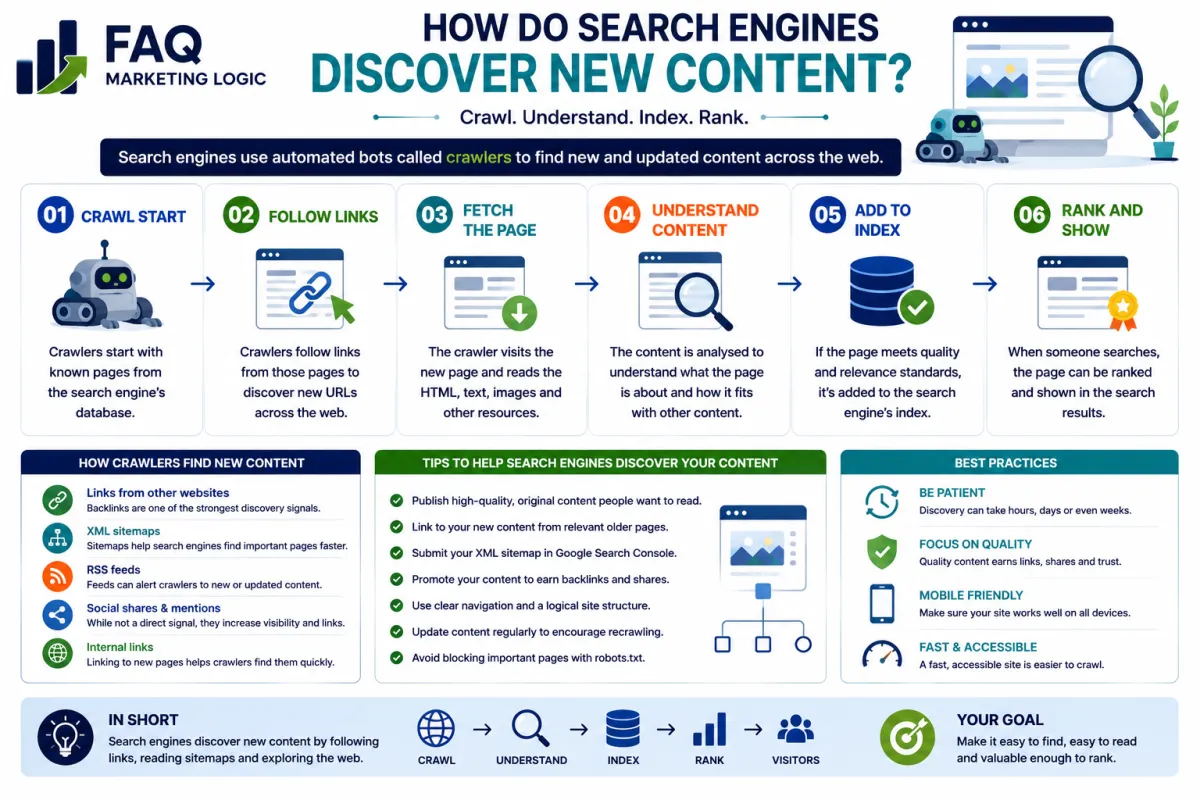
Search engines discover new content primarily by following links, revisiting websites they already know, and processing information supplied through tools such as XML sitemaps.
Publishing a page doesn't guarantee that a search engine will immediately find, index, or rank it.
Make discovery easier by maintaining a clear website structure, linking new content from existing pages, keeping your sitemap current, and avoiding isolated pages that nothing else on your site points to.
IN SHORT
Search engines typically discover new pages through:
Internal links.
Links from other websites.
XML sitemaps.
Previously discovered pages.
Website crawling.
Discovery is only the first stage.
A search engine still needs to crawl and process the page before deciding whether it belongs in its searchable index.
And being indexed does not guarantee rankings.
Think:
Discovery → Crawling → Processing → Indexing → Ranking
Each stage has a different job.
REAL TALK
Publishing a blog post doesn't mean Google immediately knows it exists.
You can press Publish, open the page yourself, and see everything working perfectly.
But as far as a search engine is concerned, you've simply created another URL somewhere on the internet.
It needs a route to find it.
That's why site structure and internal linking matter.
A new article connected to the rest of your website is much easier to discover than a page sitting alone with nothing pointing towards it.
Don't just publish.
Connect.
Key Definition
Search engine discovery is the process through which a search engine becomes aware that a URL exists and may be worth crawling.
Discovery can happen when a search engine encounters:
A link from another page.
An entry in an XML sitemap.
A link from another website.
A previously known URL that has changed.
Other signals available to its crawling systems.
Discovery should not be confused with indexing.
A search engine can know a page exists without deciding to include that page in its searchable index.
How Search Engines Find Pages
Search engines use automated systems commonly called crawlers, spiders, or bots to explore the web.
A crawler can visit a known page, examine the links it contains, and follow those links to other pages.
Those pages may contain more links.
The process continues.
You can picture this as a network rather than a filing cabinet.
One page connects to another.
That page connects to several more.
Those connections provide pathways through the website.
This is one reason internal links are more than navigation for human readers.
They also help search engines understand where content exists and how pages relate to one another.
Internal Links Help New Pages Get Found
Suppose you publish:
How Do Search Engines Discover New Content?
If the only way to reach that article is by typing its exact URL into a browser, you've created an isolated page.
Now imagine you link to it from:
Your Traffic pillar page.
A related article about website traffic.
Another relevant SEO article.
You've created several routes into the page.
A crawler revisiting any of those known pages can encounter the new link and potentially discover the article.
This is why adding a new post to the appropriate pillar or category page should be part of the publishing process rather than something you remember several weeks later.
XML Sitemaps Provide Another Route
An XML sitemap is a machine-readable file that lists URLs you want search engines to know about.
It helps search engines identify pages available for crawling, particularly on websites with lots of content or pages that may not be easily discovered through normal navigation.
But a sitemap isn't a magic indexing button.
Including a URL tells a search engine:
"This page exists and I would like you to know about it."
It does not mean:
"You must index this page and rank it."
That distinction is important.
Sitemaps support discovery.
They don't guarantee search visibility.
Links From Other Websites Can Introduce New Pages
Search engines also discover content by crawling links across different websites.
If another website links to one of your pages, that link provides another potential discovery route.
This doesn't mean you need backlinks before a page can be found.
A well-connected website with a functioning sitemap can provide plenty of internal discovery routes.
External links simply provide additional pathways across the wider web.
What Happens After Discovery?
This is where terminology can become confusing.
Finding a URL is not the same as ranking it.
A simplified process looks like this:
1. Discovery
The search engine becomes aware that the URL exists.
2. Crawling
Its crawler visits the URL and retrieves the page where permitted.
3. Processing
The search engine analyses the page and tries to understand its content, structure, and relationships.
4. Indexing
The search engine may decide that the page is suitable for inclusion in its searchable index.
5. Ranking
When someone performs a relevant search, indexed pages can be evaluated against other possible results.
This means a page can be:
Discovered but not yet crawled.
Or:
Crawled but not indexed.
Or:
Indexed but barely visible in search results.
Those are different situations and may require different responses.
Why Might Search Engines Not Crawl A Page Immediately?
Search engines don't have unlimited resources.
The web contains an enormous number of pages, with new and updated content appearing constantly.
A crawler therefore has to decide:
Which sites to revisit.
Which URLs to crawl.
How frequently to return.
Which pages appear important enough to prioritise.
A new or relatively small website may not be revisited as frequently as a large, established publication that changes constantly.
That doesn't automatically indicate a problem.
It can simply mean discovery and crawling take time.
Why Might A Discovered Page Not Be Indexed?
Discovery doesn't guarantee indexing.
A search engine may decide not to index a page immediately, or at all.
Possible reasons include:
The page is very similar to other content.
The content provides little additional value.
The page appears incomplete or low quality.
Technical directives prevent indexing.
The search engine selects another URL as the preferred version.
The page has few internal connections.
The search engine hasn't processed it fully yet.
This is why publishing more URLs isn't necessarily the answer when indexing is slow.
Sometimes the better question is:
"Does this page deserve a place in the index?"
Make New Content Easy To Reach
A healthy website should make important content accessible through logical paths.
For example:
Homepage → Pillar Page → Supporting Article
and:
Supporting Article → Related Article
This creates a connected content structure.
A visitor interested in a subject can continue exploring.
A search engine can also follow those relationships.
Pages buried several layers deep or disconnected from the rest of the website are harder to discover and understand.
Avoid Orphan Pages
An orphan page is a page with no internal links pointing to it from other pages on the website.
The URL may still appear in a sitemap.
Someone may still access it directly.
But it isn't properly connected to the site's navigational structure.
For important content, that's rarely desirable.
When publishing a new article, ask:
"Where does this belong?"
Then link it from the appropriate:
Pillar page.
Supporting article.
Relevant navigation or category structure.
That simple habit helps prevent your content library becoming a collection of disconnected pages.
Does Submitting A URL Speed Things Up?
Search engine webmaster tools may allow site owners to request crawling or indexing for individual URLs.
That can be useful, particularly after publishing or making important changes.
But it shouldn't become the foundation of your discovery strategy.
If every new page relies entirely on manual submission, the website's internal discovery structure may need attention.
Ideally, search engines should be able to encounter new content naturally through your site architecture and sitemap.
Manual requests are a useful tool.
They're not a substitute for a well-connected website.
Practical Example
Imagine you publish three new articles this week.
Article A
You publish it and do nothing else.
No internal links point to it.
Article B
You publish it and add it to your XML sitemap.
Article C
You publish it, add it to the appropriate pillar page, link to it from a relevant existing article, and include it in the sitemap.
All three URLs exist.
But Article C provides search engines with the clearest discovery paths.
It also gives human visitors logical ways to reach the content.
That's the model to aim for.
Not:
Publish → Wait → Hope
But:
Publish → Connect → Check → Improve
Common Mistakes
Mistake: Assuming publishing automatically means indexing.
Fix: Treat discovery, crawling, indexing, and ranking as separate stages.
Mistake: Creating articles without adding internal links.
Fix: Connect every important new page to the existing site structure.
Mistake: Believing an XML sitemap guarantees indexing.
Fix: Use the sitemap to support discovery while making sure the content itself deserves indexing.
Mistake: Constantly submitting the same URL for indexing.
Fix: Investigate whether there is a content, structural, or technical reason the page isn't progressing.
Mistake: Publishing more content because existing pages haven't been indexed.
Fix: Improve the quality and connectivity of the pages you've already created before simply increasing volume.
FAQ QUICK FIX
When you publish a new page:
1. Add it to the correct pillar or category.
Give the page a clear place within your site structure.
2. Add relevant internal links.
Create pathways from established pages to the new content.
3. Check your XML sitemap.
Make sure important indexable URLs are represented correctly.
4. Check indexing instructions.
Confirm you haven't accidentally told search engines not to index the page.
5. Check the page works properly.
Make sure the URL loads and important content is accessible.
6. Allow time for discovery and crawling.
Don't assume a delay automatically means something is broken.
7. Monitor what happens.
Use search engine reporting tools to see whether the page progresses from discovery towards indexing and visibility.
FAQ
Q: How long does Google take to discover a new page?
There is no fixed timeframe. Discovery and crawling can vary depending on the website, its structure, how frequently it is crawled, and how the new page is connected.
Q: Does submitting a sitemap guarantee Google will index my pages?
No. A sitemap helps search engines discover URLs but does not guarantee crawling, indexing, or ranking.
Q: Can Google find a page with no internal links?
It may discover the URL through a sitemap, external link, or another source, but important pages should still be properly connected through internal links.
Q: Is being crawled the same as being indexed?
No. Crawling means the search engine retrieved the page. Indexing means it subsequently decided the page could be included in its searchable index.
Q: Should every page on my website be indexed?
Not necessarily. Some pages, such as certain utility, private, duplicate, or campaign pages, may deliberately be kept out of search results.
TRY THIS TODAY
Choose one of your newest articles.
Now ask:
"How many ways can a visitor or search engine reach this page without knowing its URL?"
Check:
The pillar page.
Related articles.
Site navigation where appropriate.
Your sitemap.
If the only answer is:
"Through the sitemap"
you probably have an internal-linking opportunity.
RELATED ARTICLES
→ What Content Gets Discovered Most Easily?
→ How Do I Build Topical Authority?
→ Should I Update Old Posts or Publish New Ones?
QUICK RECAP
Search engines discover new content through pathways such as:
Internal links.
External links.
XML sitemaps.
Previously known pages.
But discovery is only the beginning.
A useful way to think about the process is:
Discovery → Crawling → Processing → Indexing → Ranking
Help search engines by creating a logical, connected website.
And remember:
Publishing creates the page. Connecting it helps the page become part of the site.
NEXT STEP
Once a search engine has discovered and processed your content, another question becomes much more important:
Why should that page deserve visibility ahead of the alternatives?
Read: