How to Build a High-Converting Welcome Sequence
TL;DR
Your welcome sequence sets expectations, authority, and buying behaviour.
It is not a greeting.
It is positioning.
IN SHORT
A strong welcome sequence should:
Set expectations
Reinforce your core message
Build authority
Create micro-commitments
Transition toward an offer
Most businesses waste this window.
Attention is highest at subscription.
Use it strategically.
WHY THIS WORKS
New subscribers are at peak interest.
Cause → They just opted in.
Effect → Attention and curiosity are elevated.
Result → Influence is strongest in the first 7–14 days.
If you do not shape perception early, randomness fills the gap.
A welcome sequence creates structure.
Structure builds trust.
Trust increases lifetime value.
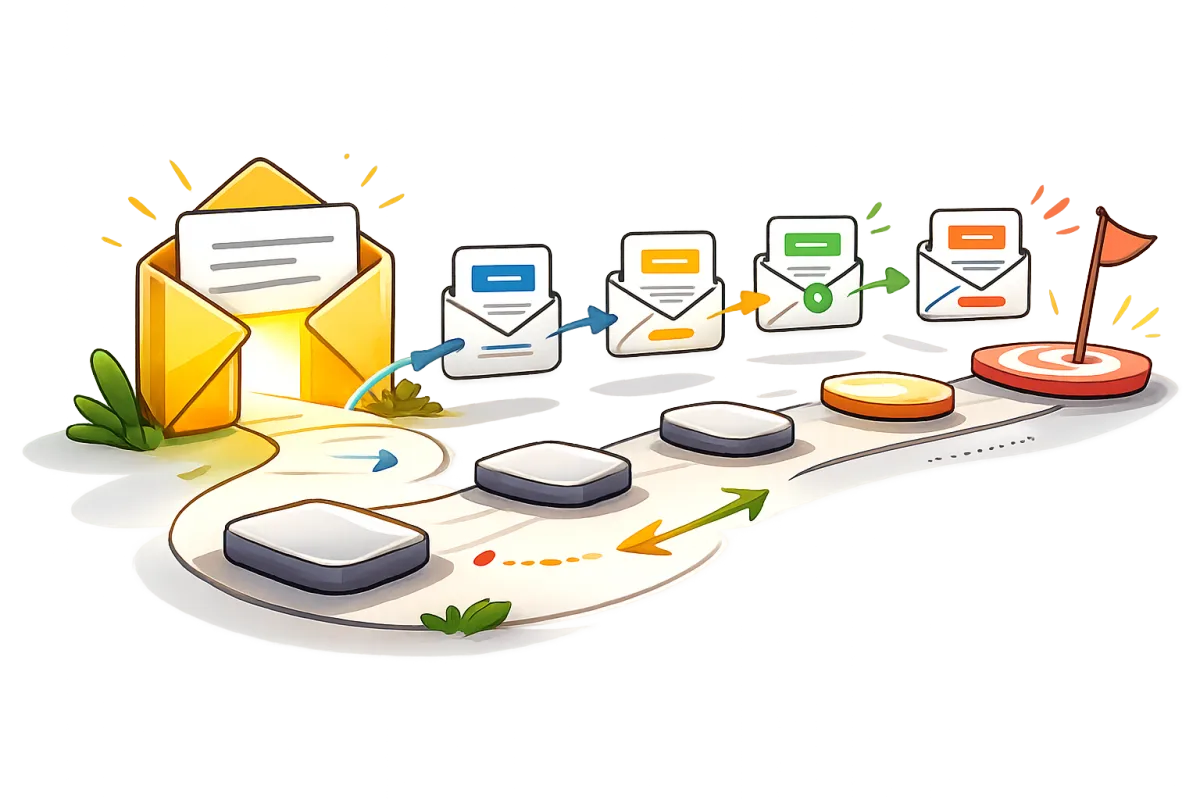
The 5-Email Welcome Framework
Email 1 — Confirmation & Expectation
Deliver promised lead magnet
Set frequency expectations
Clarify what they will learn
Reinforce positioning
Goal: Establish tone and authority.
Email 2 — Core Belief Shift
Challenge a common misconception.
Reframe how they see the problem.
Position yourself as logical guide.
Goal: Build intellectual authority.
Email 3 — Proof & Credibility
Share:
Case study
Results
Story
Process breakdown
Goal: Reduce doubt.
Email 4 — Tactical Value
Deliver something immediately useful.
Checklist.
Framework.
Short strategy.
Goal: Create reciprocity.
Email 5 — Soft Offer
Introduce:
Product
Service
Call booking
Paid resource
Not aggressive.
Just logical continuation.
REAL TALK
Many welcome sequences are:
“Thanks for joining.”
“Here’s your download.”
Silence.
That wastes the highest-leverage moment in email marketing.
Your welcome sequence is your positioning engine.
Timing & Spacing
Recommended structure:
Day 0 — Email 1
Day 2 — Email 2
Day 4 — Email 3
Day 6 — Email 4
Day 8 — Email 5
Then transition into regular weekly rhythm.
Consistency builds stability.
COFFEE CUP TIP ☕
Write the sequence before driving traffic aggressively.
Scaling traffic without a structured onboarding flow leaks revenue.
STORY TIME
A consultant had:
2-email welcome sequence
No offer
No positioning
We implemented the 5-email framework.
Within 30 days:
18% of new subscribers clicked through to service page
6% booked calls
No additional traffic.
Same list.
Better structure.
FAQ QUICK FIX
If building from scratch:
1. Define one core positioning message
2. Outline 5 logical steps toward your offer
3. Assign one objective per email
4. Write for clarity, not cleverness
5. Automate before scaling traffic
Structure before volume.
QUICK RECAP
Welcome sequences shape perception
Early attention is highest
Use 5 structured emails
Build authority before selling
Transition into weekly rhythm
COMMON MISTAKES
Mistake: Only delivering the freebie
Fix: Add authority-building emails
Mistake: Selling too aggressively in email 1
Fix: Build belief first
Mistake: No transition into regular cadence
Fix: Blend into weekly emails after sequence
FAQ
Q: Should every business have a welcome sequence?
Yes. It improves onboarding and monetisation.
Q: Can it be shorter than 5 emails?
Yes, but ensure positioning and offer are included.
Q: Should I include a sales pitch?
Yes, softly. Buying behaviour should be introduced early.
Q: How long should each email be?
Length depends on clarity and objective — see Email Length article.
TRY THIS TODAY
Map your current subscriber journey.
Ask:
“What happens after someone joins?”
If the answer is vague, fix it this week.
NEXT STEP
Now we refine revenue mechanics:
This is where monetisation becomes intentional.
→ How to Structure Sales Emails That Convert
RELATED ARTICLES
→ Email Segmentation: When and How to Segment Your List
→ How to Increase Email Engagement and Click-Through Rates
→ How to Structure Email CTAs for Higher Conversions
If you're starting a business, return to the Business pillar to strengthen your offer foundation.