
What Should I Improve Before Trying To Scale?
TL;DR
Before trying to scale a business, improve the parts that already determine whether it works: your offer, conversion, customer acquisition, delivery, margins and systems.
Scaling doesn't repair weaknesses. It usually makes them bigger.
If your offer is difficult to sell, more traffic can mean more people rejecting it. If fulfilment is already chaotic, more customers can create more problems. If your margins are too thin, increasing sales may increase workload faster than profit.
The goal is to make the business stable and repeatable enough to handle growth before deliberately increasing volume.
IN SHORT
Scaling sounds like a traffic problem.
"How do I get more customers?"
But before asking that, ask:
"What happens if I get more customers?"
Would the business cope?
Could you fulfil more orders?
Would customer support become overwhelmed?
Would the extra sales actually produce worthwhile profit?
Could your current systems handle twice the activity?
Growth is much easier to manage when you're strengthening something that already works.
Before pressing the accelerator, make sure the wheels aren't falling off.
REAL TALK
There's a temptation to think the next stage of every business is simply more.
More traffic.
More leads.
More products.
More advertising.
More customers.
More staff.
But adding volume to an inefficient business doesn't necessarily create a better business.
Sometimes it creates a larger inefficient business.
Before you try to scale, look for the weaknesses that additional volume would expose.
Fixing those first can make growth simpler, safer and more profitable.
Key Definition: What Does Scaling A Business Mean?
Scaling means increasing the amount of business you can generate without costs, complexity and workload increasing at exactly the same rate.
That's different from simply growing.
Imagine your business produces $5,000 per month and requires 40 hours of your time.
If reaching $10,000 requires 80 hours doing exactly the same work, you've grown revenue, but the underlying model hasn't necessarily become more scalable.
A more scalable improvement might allow revenue to increase while using:
Better Systems
Automation
Delegation
Improved Conversion
Higher Customer Value
More Efficient Delivery
The objective isn't merely to make the business bigger.
It's to make growth increasingly manageable.
Improve The Offer First
Your offer is one of the first things to examine.
Ask:
Is the customer clear?
Is the problem clear?
Is the outcome clear?
Is the value easy to understand?
Is the price sensible?
Are people actually buying?
If the offer is difficult to explain or consistently fails to convert, sending more traffic towards it may simply increase wasted traffic.
You want evidence that the market responds to the offer before trying to multiply exposure to it.
Improve Your Positioning
Sometimes the product is fine but the positioning is weak.
Potential customers may not immediately understand:
Who it's for
Why they need it
What makes it relevant
Why they should choose it
What problem it solves
Clearer positioning can improve performance without changing the product itself.
That's useful before scaling because you want to amplify a message that already makes sense to the market.
Improve Conversion Before Buying More Traffic
Suppose 1,000 visitors produce 10 customers.
Before trying to attract 10,000 visitors, ask whether the current page can perform better.
Perhaps visitors aren't buying because:
The headline is unclear
Benefits are weak
Trust is missing
Important objections aren't answered
Pricing is confusing
The CTA is difficult to find
The checkout creates friction
Improving conversion can make every future visitor more valuable.
That means the same traffic can produce more customers before you spend time or money acquiring more of it.
Understand Where Customers Come From
A business becomes difficult to scale when customer acquisition is unpredictable.
You don't necessarily need dozens of traffic sources.
In fact, trying to build too many at once can create unnecessary complexity.
But you should understand what's currently bringing people into the business.
For example:
Search
Email
Referrals
Partnerships
Paid Advertising
Content
Affiliates
Look for channels that are showing evidence of working.
Scaling a proven acquisition method is very different from increasing activity everywhere and hoping something happens.
Improve Your Numbers
Before increasing volume, understand the basic economics.
At minimum, you should have a reasonable idea of:
Revenue
Costs
Profit
Average Order Value
Refunds
Customer Acquisition Costs where applicable
Repeat Purchases
Recurring Revenue where applicable
You don't need a complicated financial dashboard.
But you should know whether increased sales are likely to improve the business financially.
Revenue can grow while profit barely moves.
That's not the sort of scaling you're looking for.
Improve Your Margins
Thin margins leave little room for mistakes.
Imagine a $100 sale leaves only $10 after all relevant costs.
You don't have much flexibility.
An increase in:
Advertising Cost
Refunds
Support
Software
Payment Fees
Fulfilment
can quickly reduce the remaining profit.
Better margins give the business more breathing room.
That doesn't automatically mean raising prices.
You could also improve margins through:
More Efficient Delivery
Lower Unnecessary Costs
Better Product Mix
Higher Average Order Value
Reduced Refunds
Strengthening the economics before increasing volume makes growth more resilient.
Improve Customer Value
Getting more customers isn't the only way to grow.
You can also improve the value generated from the customers you already acquire.
That might involve:
Relevant Upsells
Order Bumps
Additional Products
Memberships
Subscriptions
Repeat Purchases
This can make customer acquisition more sustainable because each customer potentially becomes more valuable to the business.
You don't need to add everything.
One logical additional offer can be more useful than building a complicated funnel containing six of them.
Improve Customer Delivery
Ask yourself:
What happens after someone buys?
Is the process smooth?
Do customers know:
How to access the product?
Where to start?
What to do next?
How to get support?
Small delivery problems can become large problems when customer numbers increase.
If five customers create two support questions, that's manageable.
If 500 customers create 200 similar support questions, you've created a support job.
Fix repeated problems before increasing volume.
Reduce Refundable Problems
Refunds aren't always avoidable.
But repeated refunds for the same reason can signal a weakness.
Perhaps:
The sales page creates the wrong expectation
The product isn't delivering what was promised
Customers don't understand how to use it
Onboarding is weak
The offer attracts the wrong buyer
Fixing those issues can improve both customer experience and profitability.
Scaling an offer with a persistent refund problem simply multiplies the problem.
Improve Your Systems
Look for tasks that happen repeatedly.
For example:
New customer buys → payment confirmed → access delivered → welcome email sent → customer receives instructions.
If you're manually completing every step, increasing sales means increasing your workload.
A system makes the process more repeatable.
That might involve:
Templates
Checklists
Automation
Standard Procedures
Saved Responses
CRM Workflows
The aim isn't to automate everything.
It's to stop repeatedly rebuilding processes that should already be predictable.
Document What Works
If an important task exists only in your head, it can become a bottleneck.
You don't need a 200-page operations manual.
Start with simple documentation for recurring activities.
For example:
Publishing a blog post
Draft article.
Edit article.
Add internal links.
Create featured image.
Add SEO details.
Publish.
Check page.
Submit or monitor indexing where appropriate.
Now the process can be repeated more consistently.
Documentation also makes future delegation easier.
Identify What Depends On You
One of the biggest barriers to scale can be the business owner.
If every decision, task and customer issue requires your personal involvement, growth eventually reaches a limit.
List everything you currently do.
Then ask:
Does this genuinely require me?
Some tasks may.
Others could eventually be:
Automated
Delegated
Templated
Simplified
Removed
You don't need a team before you scale.
But you should understand where you are the bottleneck.
Remove Unnecessary Complexity
Businesses often try to scale by adding things.
Sometimes the better preparation is removing them.
You might have:
Products that barely sell
Software you rarely use
Traffic channels that consume time without producing results
Complicated funnels that add little value
Manual processes that could be simplified
Each extra moving part creates something else to manage.
Before scaling, ask:
What can I simplify first?
A simpler business is usually easier to grow.
Improve Customer Support Before Volume Increases
Look at the questions customers repeatedly ask.
Could you answer them through:
Better Instructions
An FAQ
A Welcome Email
A Tutorial
Improved Product Navigation
A Saved Support Response
Every recurring support problem you solve before scaling reduces future workload.
The best support improvement is sometimes preventing the question from being necessary.
Improve Your Email Follow-Up
Not every visitor buys immediately.
If you're attracting traffic but have no sensible way to continue the relationship, potential customers may simply disappear.
Email can help you:
Continue educating prospects
Build familiarity
Answer objections
Make relevant offers
Introduce additional products
Maintain customer relationships
This means your existing traffic can potentially become more valuable before you focus heavily on increasing it.
Make Sure Success Can Be Repeated
One successful promotion is encouraging.
But scaling becomes more sensible when you understand why something worked.
Ask:
Where did the customers come from?
Which offer did they respond to?
What message worked?
What price worked?
What conversion process worked?
Can I repeat it?
You don't need absolute certainty.
Business rarely provides that.
But repeatability is stronger evidence than a single unexplained spike in sales.
Don't Try To Fix Everything Before Scaling
Preparation can become another form of procrastination.
Your business doesn't need to be perfect.
You don't need:
Perfect Automation
Perfect Conversion
Perfect Documentation
Perfect Margins
Perfect Customer Support
You need the major parts of the business to work well enough that increasing volume won't immediately break them.
There will always be improvements to make.
The goal is readiness, not perfection.
What Should I Improve First?
Start with the biggest constraint.
If traffic is strong but sales are weak:
Improve the offer or conversion.
If sales are strong but fulfilment is chaotic:
Improve delivery and systems.
If customers buy once and disappear:
Look at customer value and follow-up.
If every new customer creates more manual work:
Improve processes and automation.
If the business works but everything depends on you:
Document, simplify and consider delegation.
Don't optimise everything equally.
Find the constraint that's most likely to make growth difficult.
Practical Example
Imagine a digital product business making $5,000 per month.
The owner decides the next target is $10,000.
The obvious reaction might be:
Double the traffic.
But a review reveals:
The sales page converts poorly
Customers repeatedly ask the same setup question
Product delivery involves manual work
There is no follow-up offer
Several unused software subscriptions increase costs
Instead of immediately chasing twice as much traffic, the owner:
Improves the sales page
Creates clearer onboarding
Automates product delivery
Adds one relevant follow-up offer
Removes unnecessary software
Now the business is better prepared for additional customers.
The owner hasn't scaled yet.
They've made the business more scalable.
Common Mistakes
Mistake: Assuming scaling simply means getting more traffic.
Fix: Improve the complete system that turns traffic into profitable customers.
Mistake: Scaling an offer that hasn't been proven.
Fix: Look for evidence that customers understand and buy the offer first.
Mistake: Ignoring margins.
Fix: Understand what additional sales actually contribute after costs.
Mistake: Adding complexity in the name of growth.
Fix: Simplify before adding more moving parts.
Mistake: Automating broken processes.
Fix: Improve the process first, then automate the parts worth repeating.
Mistake: Waiting until everything is perfect.
Fix: Focus on the weaknesses most likely to prevent manageable growth.
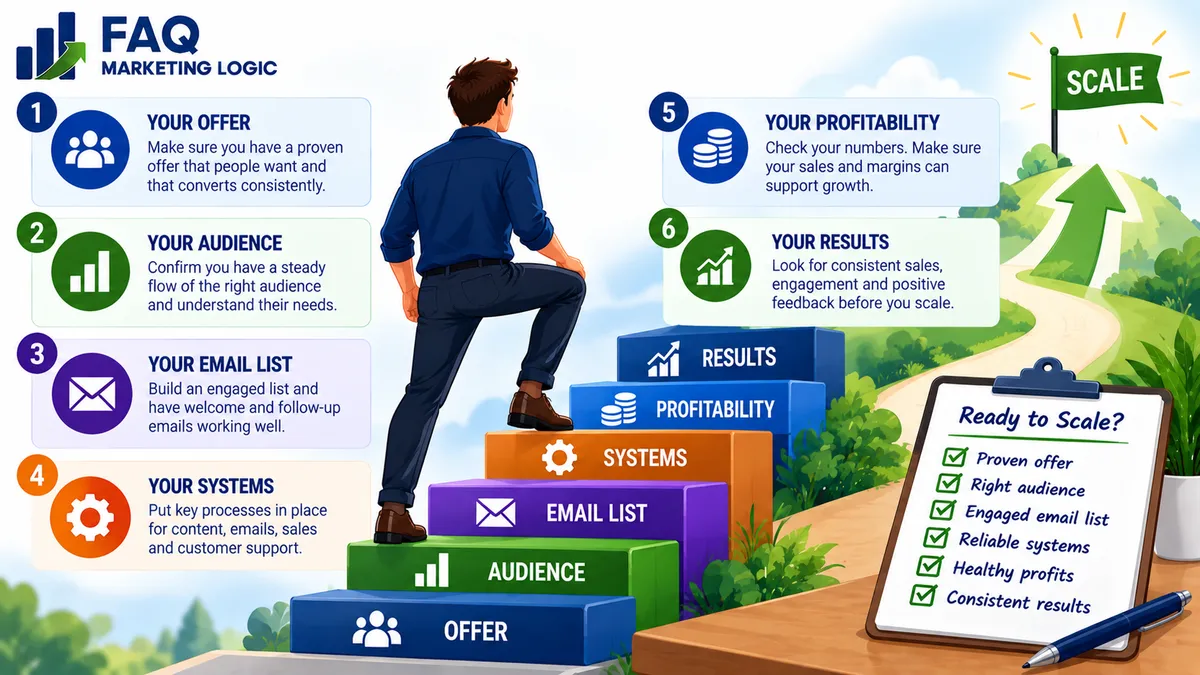
FAQ QUICK FIX
Before trying to scale, give your business a quick six-part check.
1. OFFER
Are people buying it?
2. CONVERSION
Does the sales process turn a reasonable proportion of suitable prospects into customers?
3. ECONOMICS
Do you understand the revenue, costs and margins?
4. DELIVERY
Can you handle more customers without service falling apart?
5. SYSTEMS
Are repeated processes organised and repeatable?
6. CUSTOMER VALUE
Is there a sensible way to generate more value beyond the first transaction?
Any obvious weakness doesn't necessarily mean you can't grow.
It tells you where improvement may have the greatest impact before you deliberately increase volume.
FAQ
Does My Business Need To Be Perfect Before I Scale?
No. You need sufficient stability and repeatability, not perfection. Focus on major weaknesses that would become more serious with additional volume.
Should I Improve Conversion Before Increasing Traffic?
Often, yes. If you're already receiving meaningful traffic but conversion is weak, improving the offer and conversion process can make future traffic more valuable.
Do I Need Automation Before Scaling?
Not everywhere. Automation is most useful for repetitive, predictable processes where manual work would become a bottleneck as volume increases.
Do I Need A Team Before I Scale?
Not necessarily. Many businesses can grow substantially through simplification, systems and automation before hiring. The important thing is identifying tasks that genuinely require your involvement.
How Do I Know What To Improve First?
Look for the biggest constraint. Ask which weakness would cause the most difficulty if customer numbers increased significantly tomorrow.
Can I Scale A Business That Is Still Changing?
Businesses are always changing. You don't need everything permanently fixed. You need enough evidence that the core offer, economics and delivery process are working consistently enough to support increased volume.
TRY THIS TODAY
Ask yourself one question:
"What would break first if my sales doubled next month?"
Would it be:
Customer Support?
Product Delivery?
Your Time?
Cash Flow?
Fulfilment?
Email Follow-Up?
Technology?
Conversion?
Profit Margin?
Your answer gives you a strong clue about what to improve next.
Then ask:
"What could I change now that would make twice the volume easier to handle?"
That is the kind of improvement that prepares a business for scale.
RELATED ARTICLES
→ How Do I Scale Without Losing Simplicity?
→ How Do I Grow Without Increasing Complexity?
QUICK RECAP
Before scaling, strengthen the business you're about to grow.
Make sure the offer is working.
Improve positioning and conversion.
Understand where customers come from.
Know your basic numbers.
Strengthen margins where possible.
Increase customer value.
Improve fulfilment and onboarding.
Reduce recurring support problems.
Build repeatable systems.
Document important processes.
Identify where you are the bottleneck.
Remove unnecessary complexity.
Don't wait for perfection.
Scaling should amplify something that already works.
If you're not confident what will happen when sales increase, the best next move may not be more traffic.
It may be making the existing business easier to grow.
NEXT STEP
Once the major weaknesses have been addressed, the next question is whether the business is genuinely ready to move from improvement into deliberate growth.
→ When Is A Business Ready For Serious Growth?
Ready To Move Beyond Simply Keeping The Business Running?
Once your foundations are working, the next challenge is building a business capable of producing stronger and more consistent revenue without adding unnecessary complexity.
Serious About Six Figures is designed for business owners who want to think more deliberately about that next stage of growth.