
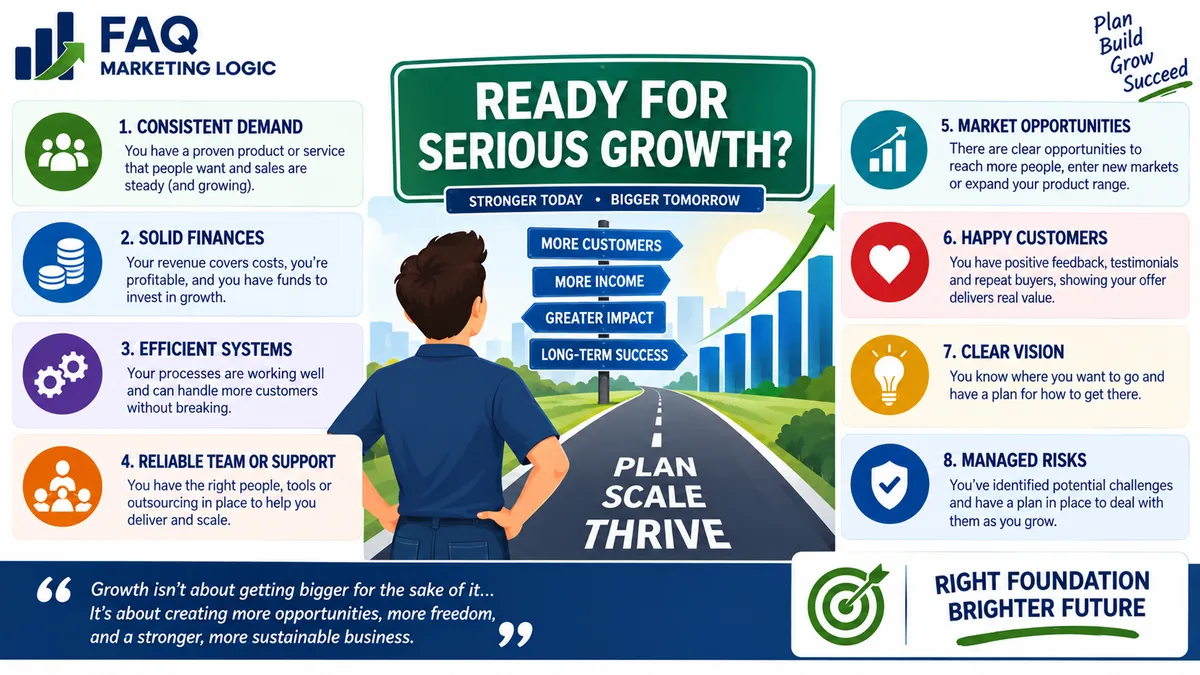
When Is A Business Ready For Serious Growth?
TL;DR
A business is ready for serious growth when it has moved beyond simply proving that someone will buy.
You should ideally have a clear offer, evidence of customer demand, workable profit margins, a repeatable way to attract customers and systems capable of handling more activity.
Growth doesn't fix a weak business. It usually magnifies whatever is already happening.
If the foundations are working, growth can multiply the results. If they're unstable, trying to grow too quickly can multiply the problems.
IN SHORT
It's natural to want a business to grow.
More customers.
More sales.
More products.
More revenue.
But there's an important question that comes before all of those:
Is the business actually ready for more?
A business with five customers can sometimes operate through improvisation.
A business with fifty or five hundred customers usually can't.
Serious growth puts pressure on:
Marketing
Customer acquisition
Fulfilment
Support
Cash flow
Systems
Time
Team capacity
Profit margins
Before trying to increase the volume, make sure the basic business works well enough to cope with that volume.
REAL TALK
Growth sounds exciting when you imagine the extra revenue.
It can look rather different when you imagine:
three times as many customer emails, three times as many orders, three times as many support requests and three times as many things that could go wrong.
That's why growth isn't simply about getting more customers.
It's about building a business capable of serving more customers without everything becoming harder at exactly the same rate.
The aim isn't:
more activity.
It's:
more productive activity supported by a stronger business.
Key Definition: What Does Serious Business Growth Mean?
Serious business growth means deliberately increasing the size, reach, customer base or revenue of a business after establishing foundations capable of supporting that expansion.
That might involve:
Increasing customer acquisition
Selling more to existing customers
Raising prices
Adding products
Entering new markets
Hiring people
Delegating work
Increasing advertising
Building partnerships
Improving systems
Automating repeatable processes
Growth doesn't necessarily mean turning a small business into a huge company.
It means moving beyond experimentation and building a more substantial, repeatable business.
If you've already established the foundations and are thinking seriously about taking your online business further, you can explore the Six Figures approach here.
Have You Proven That People Will Buy?
This is one of the first signs to look for.
There's a major difference between:
"I think people will buy this."
and:
"People are already buying this."
Actual customers give you evidence.
They can tell you:
Whether the offer attracts interest
Whether people understand the value
Which objections occur
What customers like
What they struggle with
Why they buy
Whether they recommend it
Whether they buy again
You don't necessarily need thousands of sales.
But serious expansion is easier to justify when you have real evidence of demand rather than assumptions.
Is Your Offer Clear?
Growth becomes difficult when the business still struggles to explain what it sells.
A strong offer should make it reasonably easy for the right customer to understand:
What they're getting
Who it's for
What problem it solves
Why it matters
What it costs
What they should do next
If you're constantly changing the product, audience, price and promise, you may still be in the validation and refinement stage.
That's not a failure.
It's simply a different stage of business development.
Get the offer clearer before trying to send dramatically more people towards it.
Can You Acquire Customers Repeatably?
One successful promotion isn't necessarily a growth system.
Perhaps a social media post unexpectedly generated twenty sales.
That's excellent.
But can you reproduce it?
Serious growth becomes more realistic when you understand where customers come from.
That might include:
Search traffic
Email
Paid advertising
Affiliates
Joint ventures
Content marketing
Referrals
Social media
Partnerships
You don't necessarily need every traffic source.
In fact, one dependable acquisition channel can be more useful than six channels you barely understand.
The important word is:
repeatable.
Do You Know Your Numbers?
Growth can create more revenue while producing surprisingly little additional profit.
Before increasing marketing spend or operational costs, understand the basic economics.
Depending on your business, useful numbers may include:
Revenue
Gross profit
Net profit
Average order value
Customer acquisition cost
Conversion rate
Refund rate
Recurring revenue
Customer retention
Advertising return
You don't need a complicated financial dashboard to begin.
But you should know whether selling more actually makes the business financially stronger.
Are Your Profit Margins Healthy Enough?
Suppose you sell a $50 product.
It can be tempting to think:
100 sales = $5,000.
But revenue isn't profit.
There may be:
Advertising costs
Affiliate commissions
Payment processing fees
Software
Contractors
Refunds
Customer support
Taxes
Product delivery costs
Growth often introduces additional expenses.
If the economics are already tight, increasing volume can put even more pressure on the business.
Before scaling sales, understand what is left after the costs associated with generating and serving those sales.
What Happens If Sales Double Next Month?
This is a useful test.
Imagine your current number of customers suddenly doubles.
Ask:
Can orders still be fulfilled?
Can customers get help?
Can your website handle the traffic?
Can payments be processed reliably?
Can you deliver what you've promised?
Can you maintain quality?
Can you handle the additional administration?
If doubling sales would create chaos, you've identified something that may need strengthening before aggressive growth.
The solution could be:
Automation
Better documentation
Different software
Delegation
Improved processes
Additional capacity
You don't need a perfect system.
You need one that doesn't collapse as soon as the business becomes busier.
Are You Still Doing Everything Yourself?
In the early stages, this is normal.
You might:
Create the product
Write the emails
Build the pages
Answer support
Handle administration
Create content
Manage customers
Do the marketing
Eventually, your own time can become the bottleneck.
If every additional customer creates additional work that only you can perform, growth has a natural ceiling.
This doesn't mean you immediately need employees.
You might first:
Automate repetitive tasks
Create templates
Document processes
Use specialist freelancers
Outsource occasional work
Eliminate unnecessary tasks
The objective is to stop the business depending on you personally for every routine action.
Have You Built Repeatable Systems?
A system doesn't need to be complicated.
It might simply be a documented sequence such as:
New customer buys → payment confirmed → access provided → welcome email sent → follow-up begins → support instructions provided.
When that process happens automatically or consistently, more customers don't necessarily create the same increase in manual work.
Look particularly at activities you repeat:
Customer onboarding
Email follow-up
Order fulfilment
Support
Content publishing
Lead management
Reporting
Promotions
If you're repeatedly solving the same operational problem manually, there's probably an opportunity to create a system.
Is Customer Experience Still Good?
Don't grow at the expense of the people already paying you.
Warning signs can include:
Slower support
More complaints
Increasing refunds
Missed deadlines
Lower product quality
Confusing communication
Unresolved technical problems
Growth that damages customer experience can eventually undermine the very business you're trying to expand.
Your existing customers provide useful evidence about whether the business is ready for more.
Do Existing Customers Have Anything Else To Buy?
Growth doesn't always require finding more new customers.
Sometimes there is more opportunity inside the customer base you already have.
You could potentially increase revenue through:
Complementary products
Upsells
Bundles
Memberships
Premium services
Additional support
Higher-value offers
A customer who already trusts you may be easier to serve again than a complete stranger.
This is why serious growth should consider both:
customer acquisition
and:
customer value.
Are You Growing Because The Business Is Ready Or Because You're Impatient?
This question is worth asking.
Online business makes it easy to compare yourself with people talking about:
Six-figure businesses
Huge email lists
Thousands of customers
Large launches
That can create pressure to grow before you've established the foundations.
But there's nothing wrong with spending time improving:
The offer
The conversion process
Customer experience
Email follow-up
Systems
Profitability
A smaller business that works reliably can be a much stronger foundation than a larger business held together by constant improvisation.
What Should I Strengthen Before Growing?
Look for bottlenecks.
For example:
Lots of traffic but few sales?
Work on conversion before buying more traffic.
Sales are good but fulfilment is becoming difficult?
Improve delivery systems before increasing promotions.
Customers buy once but never return?
Look at customer experience and follow-on offers.
Everything requires your personal involvement?
Start documenting, automating or delegating repeatable tasks.
Growth becomes easier when you strengthen the part of the business that would otherwise limit the next stage.
How Fast Should A Business Grow?
There isn't a universal speed.
Some businesses can increase rapidly because digital delivery allows them to serve additional customers with relatively little additional cost.
Others require:
More staff
More inventory
More support
More infrastructure
More capital
The appropriate pace depends on the business.
Rather than asking:
"How quickly can I grow?"
ask:
"How quickly can I grow while maintaining profitability, quality and control?"
Practical Example
Imagine an online business selling a $67 digital training product.
It has been generating regular sales from an email list and search traffic.
The owner has:
A clear offer
Evidence that customers buy
Automated product delivery
A working follow-up sequence
Positive customer feedback
A profitable sales process
A related follow-on product
The business now wants to introduce paid advertising and affiliate partners.
That could be a logical next growth step because the business isn't trying to use growth to discover whether the offer works.
The offer already has evidence behind it.
Now the owner is attempting to put a proven process in front of more suitable prospects.
Compare that with a business that hasn't yet made consistent sales but immediately spends heavily on advertising.
More traffic may simply expose the same unresolved problems to a larger audience.
Common Mistakes
Mistake: Trying to scale before proving the offer.
Fix: Look for real evidence that customers understand and buy the offer.
Mistake: Focusing on revenue rather than profit.
Fix: Understand what remains after the costs of generating and serving additional customers.
Mistake: Adding more marketing to a weak conversion process.
Fix: Strengthen the bottleneck before increasing volume.
Mistake: Assuming growth means more new customers.
Fix: Consider increasing the value created for existing customers as well.
Mistake: Keeping every task dependent on the owner.
Fix: Document, automate or delegate repeatable work as the business develops.
Mistake: Sacrificing customer experience for faster growth.
Fix: Treat quality, fulfilment and support as part of the growth strategy.
FAQ QUICK FIX
Before trying to grow substantially, ask these seven questions:
Are people already buying consistently?
Is the offer clear and reasonably stable?
Do I know where customers are coming from?
Do I understand the basic economics?
Could my systems cope with more customers?
Can I maintain the customer experience?
Do I know what currently limits growth?
If several answers are no, don't abandon the idea of growth.
Use the answers to identify what needs strengthening first.
FAQ
How Many Customers Do I Need Before Scaling?
There isn't a fixed number. The more useful question is whether you have enough real customer evidence to understand whether the offer, pricing, fulfilment and marketing are working.
Do I Need A Team Before Growing?
Not necessarily. Automation, better processes and specialist freelancers can increase capacity before a business needs permanent employees.
Should I Use Paid Advertising To Grow Faster?
Paid advertising can increase reach, but it can also increase losses if the offer or conversion process isn't working. Understand the economics and test carefully before increasing spending.
Does A Business Need Multiple Products Before It Can Grow?
No. A business can grow around a strong core offer. Additional products can create further revenue opportunities, but adding products isn't automatically the best growth strategy.
Is Increasing Revenue The Same As Scaling?
Not necessarily. Revenue can increase simply because you're doing proportionally more work. Scaling generally involves increasing results without costs, complexity and workload rising at exactly the same rate.
Can A One-Person Business Reach The Serious Growth Stage?
Yes. The important issue isn't the number of employees. It's whether the business has a workable model, sufficient capacity and processes capable of supporting additional activity.
TRY THIS TODAY
Give your business a simple growth readiness check.
Write down these five areas:
Offer
Customers
Marketing
Numbers
Systems
Under each one, write:
Working
Needs Improvement
or:
Not Yet Proven
Don't try to make every category perfect.
Instead, identify the single weakest area most likely to cause problems if sales increased significantly.
That's probably where your attention should go before trying to accelerate growth.
Ready To Take Your Business Beyond The Starting Stage?
There comes a point when the question changes from:
"Can I make this work?"
to:
"How far can I take this?"
If you've already established the foundations and you're serious about building a larger information publishing business, Serious About Six Figures explores the next stage of developing that business.
→ Discover The Serious About Six Figures Approach
RELATED ARTICLES
→ How Do I Scale Without Losing Simplicity?
→ How Do I Grow Without Increasing Complexity?
QUICK RECAP
A business is ready for serious growth when the foundations are strong enough to support more activity.
Look for:
Evidence that customers already buy.
A clear and stable offer.
Repeatable customer acquisition.
Healthy business economics.
Systems that can cope with increased volume.
A customer experience that remains strong.
Opportunities to increase customer value.
Less dependence on the owner for every routine task.
Growth doesn't automatically make a business better.
It magnifies the business you already have.
Strengthen what's working, fix the major bottlenecks and then increase the volume from a much stronger foundation.
NEXT STEP
Once the business is ready to grow, the next question is deciding when to begin increasing capacity rather than simply adding more activity.
→ When Should I Start Scaling My Business?