
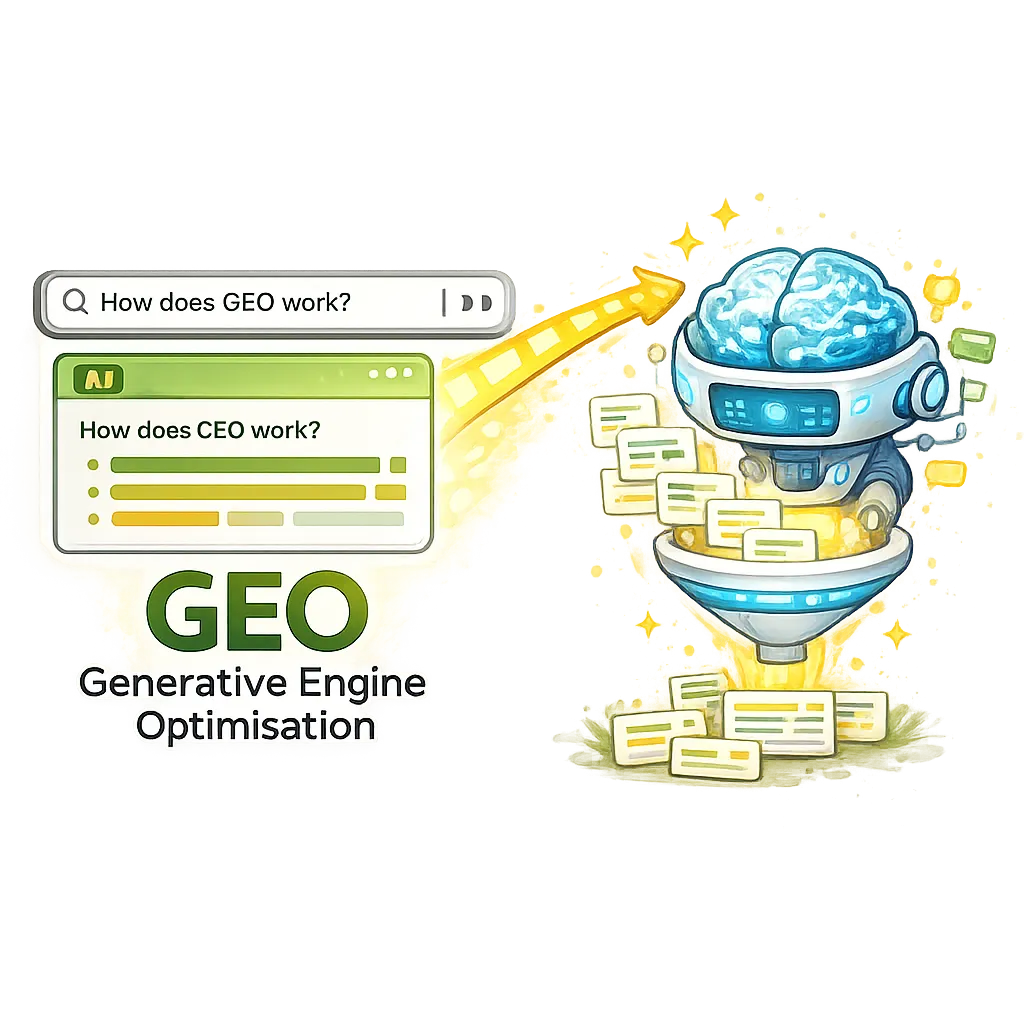
What Is GEO and How Does It Affect My Content?
TL;DR
GEO is optimisation for AI-driven search systems.
It rewards structured, authoritative, and clearly segmented content.
Search is no longer just links.
It is synthesis.
IN SHORT
GEO (Generative Engine Optimisation) means:
Optimising content so AI systems can extract, summarise, and reference it accurately.
This requires:
Clear structure
Direct answers
Topical depth
Logical formatting
Strong internal linking
SEO ranks pages.
GEO gets quoted by AI.
WHY THIS WORKS
Traditional SEO model:
User → Search query → Click → Website.
AI search model:
User → Query → AI summary → Cited sources.
Cause → AI systems interpret multiple sources.
Effect → They extract structured answers.
Result → Your content is referenced — or ignored.
If your content is vague, bloated, or poorly structured, it becomes invisible in AI summaries.
SEO vs GEO
SEO gets traffic.
GEO builds presence inside AI responses.
Both matter.
What Makes Content GEO-Ready?
1. Direct Answer Blocks
Use:
TL;DR
In Short
FAQ sections
AI systems prefer extractable summaries.
2. Clear Hierarchy
Use:
Structured headings
Logical progression
Clean formatting
Confusion reduces extractability.
3. Topical Clusters
One article is weak.
A cluster is authoritative.
AI systems favour:
Depth
Interconnected articles
Clear subject ownership
We build this vertically per pillar.
4. Precision Over Fluff
AI summarises substance.
Fluff gets filtered.
Write:
Clear statements
Defined terms
Logical progression
Avoid vague motivational language.
REAL TALK
Many businesses are still optimising for 2015 SEO.
Keyword density.
Long filler paragraphs.
Surface-level guides.
AI search systems reward clarity, not length.
If your content cannot be summarised easily, it will not be cited.
Why GEO Increases Authority
When AI references your content:
Brand visibility increases
Perceived authority increases
Indirect traffic increases
Trust improves
Even if the user does not click immediately.
Presence shapes perception.
COFFEE CUP TIP ☕
Before publishing, ask:
“Can this article be summarised cleanly in 5 bullet points?”
If not, structure needs refinement.
STORY TIME
A founder ranked #6 on Google for a key term.
Traffic was stable.
But AI summaries never referenced their content.
We restructured:
Added clear answer blocks
Tightened headings
Improved topical links
Within 8 weeks, their content began appearing in AI-generated summaries.
Same topic.
Better structure.
FAQ QUICK FIX
To improve GEO readiness:
1. Add a clear TL;DR section
2. Include structured answer blocks
3. Tighten subhead hierarchy
4. Remove filler paragraphs
5. Strengthen internal linking
6. Implement Schema Markup Use FAQSchema and Article schema. This is the "API" that allows AI crawlers to read your logic without guessing.
Structure is the optimisation layer.
QUICK RECAP
GEO = AI search optimisation
AI extracts structured answers
Clarity increases citation
Topical clusters increase authority
Structure matters more than length
COMMON MISTAKES
Mistake: Writing long but unstructured posts
Fix: Use extractable answer blocks
Mistake: Ignoring internal linking
Fix: Build pillar clusters
Mistake: Chasing keywords only
Fix: Optimise for clarity and authority
FAQ
Q: Is GEO replacing SEO?
No. It complements it.
Q: Do backlinks still matter?
Yes, but clarity and authority are increasingly influential.
Q: Should I rewrite old posts for GEO?
Yes, especially high-performing ones.
Q: Is AI search reducing clicks?
Sometimes — but visibility and authority still matter.
TRY THIS TODAY
Open your highest-traffic article.
Add:
A TL;DR section
Clear subheadings
A structured FAQ
Then republish with improved formatting.
NEXT STEP
Now we go deeper:
We’ll break down the structural elements AI systems prioritise.
→ What Makes Content AI-Referencable?
RELATED ARTICLES
→ Should I Focus on SEO or Social Media First?