
How Do I Know If My Business Is Growing Profitably?
TL;DR
Your business is growing profitably when revenue increases without your costs rising so quickly that the additional sales produce little or no extra profit.
More customers, higher sales and increased website traffic can all look encouraging. But if you're spending more on advertising, software, delivery and support than the growth is worth, the business may be getting bigger without becoming financially stronger.
The key is to measure what you keep, not simply what you earn.
IN SHORT
To know whether your business is growing profitably, compare changes in revenue with changes in expenses, profit margins and cash flow.
A business generating $10,000 in monthly revenue isn't necessarily performing better than one generating $6,000. The result depends on how much each business spends to generate and deliver those sales.
Profitable growth means that additional business activity produces worthwhile financial returns without creating costs or operational pressures that undermine the business.
You don't need complicated financial reporting to begin. A few consistently measured figures can reveal whether growth is genuinely improving your position.
WHY THIS WORKS
Revenue Growth Doesn't Always Mean Profit Growth
Revenue is the total amount your business earns from sales before expenses are deducted. Profit is what remains after the relevant business costs have been accounted for.
That distinction becomes particularly important when you're trying to grow.
Imagine your business generates $5,000 in monthly revenue and incurs $3,000 in expenses. That leaves $2,000 in profit.
You increase your marketing activity and sales rise to $8,000. That sounds like significant progress, but your monthly expenses have also increased to $6,500.
You're now generating more revenue but keeping only $1,500.
The business has grown in size while becoming less profitable.
This is why sales figures should never be considered in isolation. You need to understand what it costs to produce those sales and whether the additional activity is worthwhile.
Understand Your Profit Margin
Profit margin helps you see how much of your revenue remains after expenses.
For example, if your business generates $4,000 in revenue and records $1,000 in profit, its profit margin is 25%.
If revenue increases to $6,000 but profit remains at $1,000, the margin falls to approximately 16.7%.
You're handling more business without increasing the amount you keep.
A falling margin isn't always a sign that something is wrong. You might be investing in equipment, developing a new product or temporarily increasing marketing expenditure.
However, you should understand why the margin is changing and whether the additional spending is expected to produce a worthwhile return.
The aim isn't necessarily to achieve the highest possible margin. It's to maintain a healthy relationship between revenue, costs and the resources needed to operate the business.
Track The Cost Of Acquiring Customers
One of the easiest ways to make growth expensive is to spend too much attracting each new customer.
Suppose you sell a digital product for $49.
If advertising costs $35 to acquire a customer, that leaves $14 before payment processing, product delivery, support and other expenses.
The sale may contribute very little towards profit.
Now imagine you improve your marketing and reduce the acquisition cost to $15.
The same product produces a much larger contribution towards your operating costs and profit.
Customer acquisition cost isn't the only figure that matters, particularly when customers make repeat purchases. But it helps you understand whether your marketing is becoming more or less efficient.
For businesses relying on organic content, customer acquisition still involves resources. Writing articles, maintaining a website and producing marketing materials all require time or money.
The costs may be less obvious than advertising expenditure, but they shouldn't be ignored.
Look At The Profitability Of Individual Offers
Not every product contributes equally to your business.
A $97 digital guide with relatively low delivery costs may produce a higher profit contribution than a $197 service requiring several hours of personal attention.
Similarly, a membership generating recurring revenue may provide predictable income, but it also creates ongoing costs for content, software, customer support and administration.
You need to understand what each offer contributes after its direct costs.
That doesn't mean every product must generate the same margin. An introductory product may be designed to attract new customers who later purchase other suitable offers.
However, those expectations should be supported by actual customer behaviour rather than assumptions about future purchases.
If a product consistently costs more to sell and deliver than it generates, you need a clear reason for continuing to offer it.
Watch For Costs That Increase As You Grow
Some business expenses remain relatively stable as sales increase. Others rise with every additional customer or transaction.
For example, a website subscription may cost the same whether you make ten sales or fifty. Payment processing charges, affiliate commissions and certain fulfilment costs usually increase with sales volume.
Other costs rise in stages.
You may need additional software, customer support or outside assistance once the business reaches a particular size.
These changes can affect profitability even when revenue continues to increase.
Before expanding a successful promotion or introducing another product, consider what additional costs the growth will create.
The question isn't simply whether you can generate more sales. It's whether those sales will leave enough additional profit to justify the extra work and expense.
Keep An Eye On Cash Flow
A business can report a profit and still experience cash shortages.
For example, you might pay for advertising, contractors and software before receiving all the revenue associated with a campaign.
You may also have refunds, delayed payments or annual expenses that don't appear evenly throughout the year.
Cash flow shows when money actually enters and leaves the business.
That makes it different from profit, which measures financial performance over a particular period.
Both matter.
A profitable business needs enough available cash to pay its bills, meet its obligations and continue operating while revenue is collected.
For a small online business, regularly reviewing the bank balance alongside expected income and upcoming expenses can help prevent unpleasant surprises.
Measure Growth Without Creating Unnecessary Complexity
You don't need a complicated dashboard containing dozens of measurements.
Start with a small set of figures that help you make decisions.
For many online businesses, those include:
Total revenue.
Total expenses.
Profit.
Profit margin.
Customer acquisition costs, where measurable.
Available cash and upcoming commitments.
You may also want to track sales by product, refunds and recurring revenue if those figures are relevant to your business model.
Compare results over several months rather than relying on one particularly good or bad week.
If revenue rises, investigate what caused the increase. If profit falls, identify which expenses changed.
The purpose of measuring isn't to collect more numbers. It's to understand what needs improving before you invest further in growth.
PRACTICAL EXAMPLE
Imagine you run a small information publishing business selling digital guides and training products.
At the beginning of the year, your average monthly figures are:
Revenue: $4,000
Expenses: $2,200
Profit: $1,800
Profit margin: 45%
You decide to increase advertising and introduce another product.
Three months later, your monthly revenue has risen to $6,500.
However, your expenses have increased to $4,900, leaving $1,600 in profit.
Your revenue has increased by 62.5%, but your profit has fallen.
You examine the figures and discover that customer acquisition costs have risen sharply. The new product also requires more customer support than expected.
Rather than increasing advertising again, you improve the sales process, review the product's delivery requirements and concentrate on the marketing channels producing the best returns.
Over time, you manage to reduce monthly expenses to $4,000 while maintaining revenue at $6,500.
Profit increases to $2,500, giving you a margin of approximately 38.5%.
The business is now generating more profit than before the expansion, even though its margin remains below the original 45%.
That's a more useful result than revenue growth alone.
REAL TALK
Growing a business can become surprisingly expensive when every increase in sales seems to require another subscription, another campaign or another person to manage the workload.
It's easy to celebrate revenue because it's the most visible number.
But revenue doesn't pay your personal bills. The money remaining after business expenses, taxes and other obligations is what ultimately matters.
A business producing $100,000 in annual sales with very little profit isn't automatically more successful than a smaller operation that generates a healthy return with fewer demands on its owner.
That doesn't mean you should avoid investment or refuse to spend money on growth.
It means you should know what you're spending, why you're spending it and what results you expect.
Growth should improve the business rather than simply make it busier.
FAQ QUICK FIX
Want to know whether your business is growing profitably?
Compare your figures for the last three complete months.
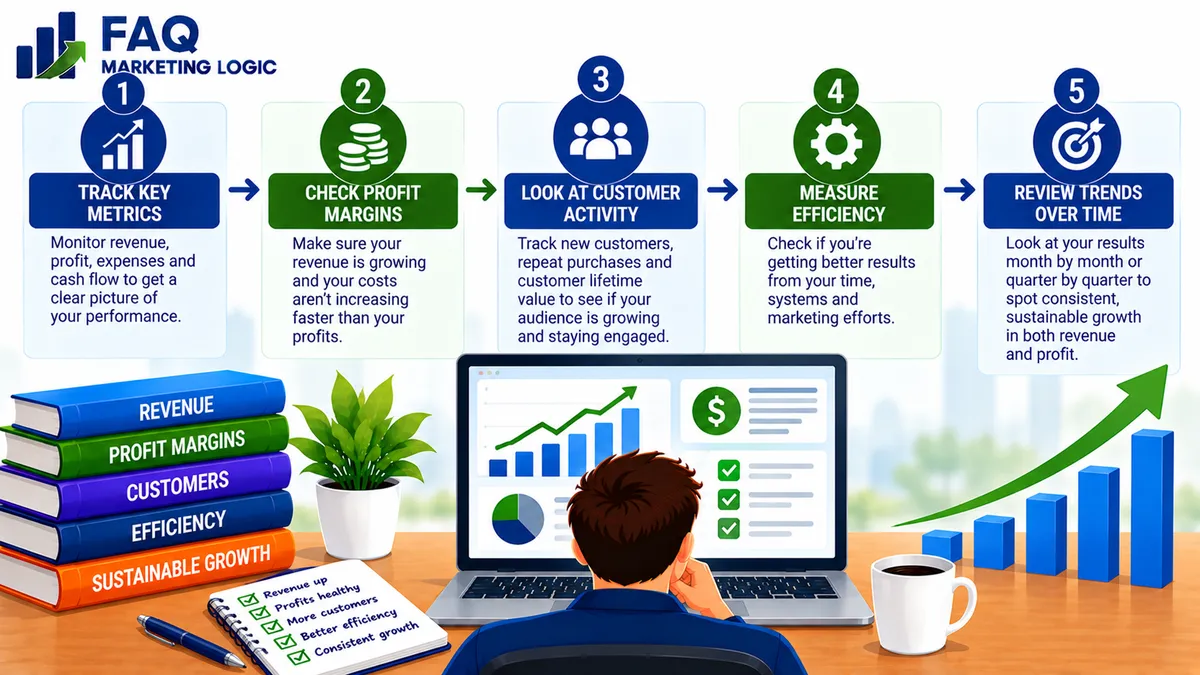
Then work through these five checks.
1. Compare revenue.
Are total sales increasing, remaining stable or declining?
2. Review expenses.
Have your costs increased faster than revenue, and can you explain why?
3. Calculate profit.
How much remains after accounting for the business expenses associated with each month?
4. Check your profit margin.
Are you keeping a similar or larger proportion of revenue, or is your margin shrinking?
5. Examine your cash position.
Do you have enough available cash to meet upcoming expenses and continue operating comfortably?
Look at the overall pattern rather than judging the business by one figure.
A rise in revenue is encouraging, but it becomes more meaningful when profit and cash flow support the same conclusion.
FAQ
Can My Business Grow While Profit Falls?
Yes. Revenue can increase while profit declines if the additional sales require disproportionately higher spending on advertising, fulfilment, software or other business expenses.
What Is A Good Profit Margin For An Online Business?
There's no universal figure. Profit margins vary according to the business model, pricing, delivery costs and operating structure. Compare your results with your own previous performance and the requirements of your particular business.
Should I Focus On Revenue Or Profit?
Both matter, but they answer different questions. Revenue shows how much you're selling, while profit indicates how much remains after expenses. A sustainable business needs sufficient revenue and a worthwhile return from generating it.
Is Recurring Revenue Always More Profitable?
No. Recurring revenue can improve income predictability, but subscriptions and memberships may involve ongoing fulfilment, software, support and customer retention costs. Profitability depends on the actual numbers.
How Often Should I Review Business Profitability?
A monthly review is a practical starting point for many small businesses. More frequent checks may be useful when you're running paid advertising, managing tight cash flow or making significant changes.
Can A Business Be Profitable But Have Poor Cash Flow?
Yes. Profit and cash flow measure different things. A business may record a profit while struggling to meet payments because money is tied up in receivables, inventory or expenses paid before revenue arrives.
TRY THIS TODAY
Take your business figures for the last three complete months.
Create a simple table with four columns:
Month.
Revenue.
Expenses.
Profit.
Subtract expenses from revenue to calculate the profit for each month.
Then divide profit by revenue and multiply by 100 to calculate the profit margin.
Look at how the figures have changed.
Ask yourself:
Is revenue increasing?
Is profit increasing alongside it?
Are expenses growing faster than sales?
Which costs have changed most?
Are particular products or promotions becoming less profitable?
Do I have enough cash for upcoming commitments?
What could I improve before spending more on growth?
Choose one cost, product or marketing activity that deserves closer attention.
You don't need to solve everything today.
The objective is to identify whether your current growth is strengthening the business or simply increasing the amount of activity.
Want To Take Your Business Growth Further?
Once you understand whether your business is growing profitably, the next challenge is deciding how to build on that progress without allowing costs and complexity to undermine your results.
That means looking beyond individual sales and considering how your offers, marketing and business systems can support more sustainable growth.
If you're ready to explore that next stage, Serious About Six Figures introduces a broader approach to developing and growing an online business.
→ Discover Serious About Six Figures
RELATED ARTICLES
→ When Should I Start Scaling My Business?
→ How Do I Increase Average Order Value?
→ What Should I Improve Before Trying To Scale?
QUICK RECAP
Profitable growth means increasing the financial strength of your business, not simply generating more sales.
Measure revenue and expenses together.
Track profit rather than relying on sales figures.
Monitor changes in profit margins.
Understand what it costs to acquire customers.
Review the profitability of individual offers.
Watch for costs that increase with sales volume.
Keep enough cash available for upcoming commitments.
Compare results across several months.
Investigate why profitability changes.
Improve efficiency before increasing expenditure.
Avoid expanding activities that aren't producing worthwhile returns.
A growing business should give you more opportunities, not simply more expenses and responsibilities.
The real measure of growth is whether the business becomes financially stronger as it gets bigger.
NEXT STEP
Once you understand whether your business is growing profitably, the next decision is identifying which activities deserve more investment and which should remain unchanged.