How Do I Sell Information If I Don't Have An Audience Yet?
12 October 2026
How Do I Sell Information If I Don't Have An Audience Yet?
TL;DR
You don't need thousands of followers or a large email list to start selling information products. What you need is a problem people want solved, a useful product that addresses it, and a practical way to reach potential customers.
Rather than building an audience before making an offer, start by finding out where your potential buyers already spend time. Research their questions, test a focused product idea and build your audience as you begin attracting customers.
IN SHORT
You can sell information without an existing audience by identifying a specific customer problem, creating or licensing a suitable product, and reaching potential buyers through search engines, online communities, partnerships or other relevant channels.
The important distinction is between having an audience and having access to a market. You may have no followers of your own, but there are already people looking for information that helps them solve problems.
Your first task is to connect a useful solution with those people.
WHY THIS WORKS
An Audience And A Market Are Not The Same Thing
An audience consists of people who already follow your content or receive your communications. A market consists of people who share a particular problem, interest or need.
You might have no email subscribers or social media followers, but that doesn't mean there are no potential customers for your product. People are already searching for answers, reading reviews, buying courses and looking for practical guidance.
The advantage of starting with an existing market is that you don't have to create interest from nothing. Instead, you concentrate on understanding what people want and finding a sensible way to reach them.
Start With A Problem Worth Solving
When you're selling to people who don't know you, a clear offer matters more than a complicated product.
Consider the difference between a general guide to online business and a practical workbook that helps beginners choose their first digital product idea. The workbook addresses a recognisable problem and offers a specific outcome.
Look for questions that appear repeatedly in search results, specialist forums, Quora discussions and product reviews. Then investigate whether people are already paying for related solutions.
Existing competition can be useful evidence of demand, although it doesn't guarantee that your particular product will sell.
The aim is to find a problem that's important enough for someone to want help solving it.
Choose A Simple Information Product
Your first product doesn't need to be an enormous course or a 200-page manual. A focused guide, workbook, template or short training programme may be more suitable, particularly while you're testing demand.
The value comes from helping customers understand something, make a decision or complete a task. A shorter product that delivers a useful result can be more attractive than a larger product filled with unnecessary information.
You also have a choice about how the product is developed. You can create it from your own knowledge, work with someone who has relevant expertise or obtain suitable material through a legitimate licensing arrangement.
If you're still exploring how information products can form the basis of an online business, Six Figures A Year In Info Publishing provides an introduction to the business model.
Whichever approach you choose, the product still needs to be accurate, useful and appropriate for its intended customers.
Find Customers Where They Already Spend Time
Without an established audience, your first marketing activity should focus on reaching people who are already interested in the subject.
Search engines offer one opportunity. Someone searching for an answer to a specific question may discover a useful article and then follow a relevant link to your product.
Online communities provide another possibility. By answering genuine questions and contributing helpful information, you can begin establishing credibility with potential customers. The emphasis should be on helping rather than dropping promotional links into discussions.
Partnerships can also work. A business with an established audience may be interested in recommending a complementary product through an affiliate arrangement, newsletter recommendation or joint promotion.
You don't need to pursue every channel. Start with one or two that suit your product and the people you're trying to reach.
Test Your Offer Before Investing Too Much
One of the biggest mistakes beginners make is spending months creating a product without checking whether anyone wants it.
A better approach is to describe the proposed solution clearly and look for genuine interest. You might discuss the problem with potential customers, publish an article, share a sample or invite people to register their interest.
Where appropriate, a clearly explained pilot or preorder can provide stronger evidence, provided customers understand exactly what is available and when it will be delivered.
The purpose is to discover whether the offer appeals to potential buyers before committing substantial time or money.
A handful of meaningful responses won't prove that you've found a profitable business, but they can help you make better decisions.
Keep The Sales Process Simple
You don't need an elaborate funnel to make your first sale.
A straightforward process can begin with useful content or a relevant recommendation that brings someone to a sales page. The page explains who the product is for, what problem it addresses, what customers receive and how much it costs.
From there, the customer can purchase and receive the product.
You can introduce email follow-up, additional offers and more sophisticated marketing systems as the business develops. Initially, clarity and reliability matter more than complexity.
An email list is worth building alongside this process, but you don't need hundreds of subscribers before you can begin selling. Even a small list of genuinely interested people gives you an opportunity to develop relationships and learn what your market needs.
Learn From Your First Customers
Your earliest customers can tell you a great deal about the strength of your offer.
Find out why they purchased, what nearly stopped them, which benefits attracted their attention and whether the product delivered what they expected. Their feedback can help you improve both the product and the way you explain it.
Don't judge the entire business by the results of one promotion. Look for patterns and concentrate on the activities that bring suitable prospects towards your offer.
Over time, those customers, subscribers and readers can become the foundation of your own audience.
PRACTICAL EXAMPLE
Imagine you're planning to sell a $27 guide about starting a paid newsletter.
You have no existing email list or social media following. Rather than spending six months building an audience, you begin by researching the questions people ask about paid newsletters.
You discover that beginners are particularly concerned about choosing a subject, setting subscription prices and finding their first paying readers.
You use those findings to develop a focused product outline, discuss the idea with potential customers and test whether the proposed guide attracts interest.
Once you've gathered useful feedback, you create a simple sales page and begin publishing content that answers related questions. You also explore opportunities to contribute to relevant communities and work with complementary businesses.
Suppose your first month produces three sales. That's $81 in revenue before expenses, which certainly isn't a thriving business.
However, you've made actual sales, learned something about your customers and established a starting point for improvement.
That's more useful than spending months collecting followers without knowing whether anyone wants to buy your product.
REAL TALK
Building an audience can feel like progress because follower counts and subscriber numbers are easy to measure. But attention doesn't automatically translate into sales.
You could spend months publishing content and attracting visitors without ever discovering whether people want the product you're planning to create.
That doesn't mean audience building is unimportant. It means you shouldn't confuse building an audience with validating a business.
Start by finding a problem people care about and developing a useful solution. Then work on reaching the right people, improving the offer and building relationships.
You don't need to be well known to make your first sale. You need to give someone a convincing reason to buy.
FAQ QUICK FIX
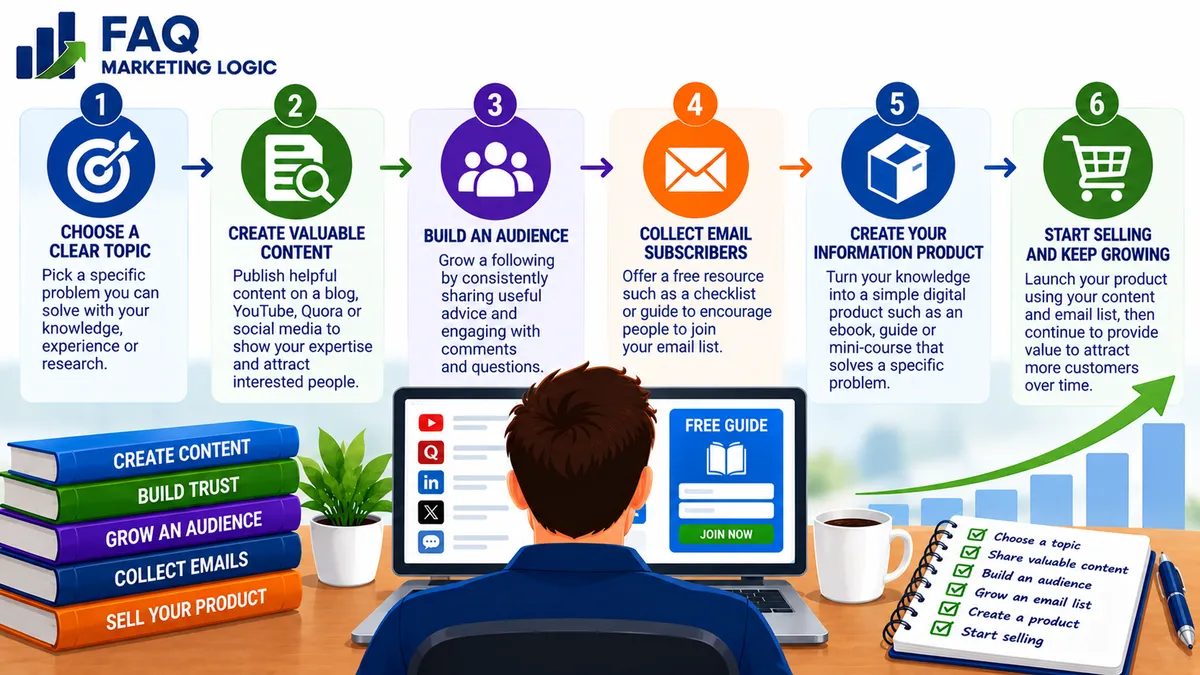
If you're starting without an audience, follow these five steps:
Identify one specific problem. Choose something potential customers are already trying to solve.
Research existing demand. Look at questions, competing products, customer reviews and evidence of buying behaviour.
Develop a focused offer. Explain who the product helps, what it provides and why it's useful.
Choose one discovery channel. Start with search content, relevant communities, partnerships or another suitable way to reach buyers.
Test and improve. Measure meaningful interest, listen to feedback and refine the product before expanding your marketing.
The objective isn't to reach everybody. It's to find a practical way to reach people who may genuinely benefit from your product.
QUICK RECAP
Selling information without an audience is possible because potential customers already exist in established markets.
Start with a recognisable customer problem.
Look for evidence that people buy related solutions.
Create or license a focused, useful product.
Test the offer before investing heavily.
Reach potential buyers through suitable discovery channels.
Keep the sales and delivery process straightforward.
Use early customer feedback to improve your approach.
Your audience can grow alongside your business rather than being a requirement for starting it.
COMMON MISTAKES
Mistake: Waiting until you have thousands of followers before making an offer.
Fix: Research demand and begin testing a focused product while your audience is still small.
Mistake: Creating a large product before checking whether anyone wants it.
Fix: Start with a manageable solution and validate the offer before committing substantial resources.
Mistake: Choosing a subject simply because it's popular.
Fix: Identify a specific problem and look for evidence that customers are willing to pay for help.
Mistake: Trying to promote on every available platform.
Fix: Concentrate on the channels most likely to reach suitable potential customers.
Mistake: Assuming your first few sales prove the business will succeed.
Fix: Treat early results as useful evidence and continue testing whether sales can be generated consistently.
FAQ
Can I Sell Digital Products With No Followers?
Yes. You can reach potential customers through search engines, relevant communities, referrals, partnerships and other marketing channels without having an established following of your own.
Do I Need An Email List Before Selling Information Products?
No. A clear sales page and reliable checkout can be enough to begin. However, building an email list can help you maintain contact with interested prospects who aren't ready to purchase immediately.
What's The Easiest Information Product To Start With?
A focused guide, workbook, checklist or template can be simpler to develop than a comprehensive course. The best format depends on the customer's problem and the type of help they need.
How Do I Find Customers Without Paying For Advertising?
You can explore search content, helpful contributions to relevant communities, referrals and suitable partnerships. These methods still require time and effort, and results aren't guaranteed.
Should I Build An Audience Or Create A Product First?
You can work on both, but it's sensible to validate the problem and proposed offer early. Don't assume you must build a large following before discovering whether customers want your product.
TRY THIS TODAY
Choose one information product idea and find five genuine questions people are asking about the subject.
Look at search results, online discussions or customer reviews. Identify the underlying problem behind each question and consider whether a focused information product could help solve it.
Then choose one practical way to reach people asking those questions.
By the end of the exercise, you should have a clearer idea of both the potential product and where its first customers might come from.
NEXT STEP
Once you've identified a problem and a potential product, the next step is checking whether people are genuinely interested before investing in full development.
→ How Can I Test An Offer Without Creating It First?
If you'd like to explore the wider information publishing business model, take a look at Six Figures A Year In Info Publishing. It introduces how useful information can be turned into products and offers a starting point for beginners.
The physical book is offered free, with a shipping and handling charge.
RELATED QUESTIONS
→ How Do I Choose The Right Online Business Model To Start With?
→ How Do I Validate An Online Business Idea Before Building It?