Do I Need To Be An Expert To Sell Information Online?
TL;DR
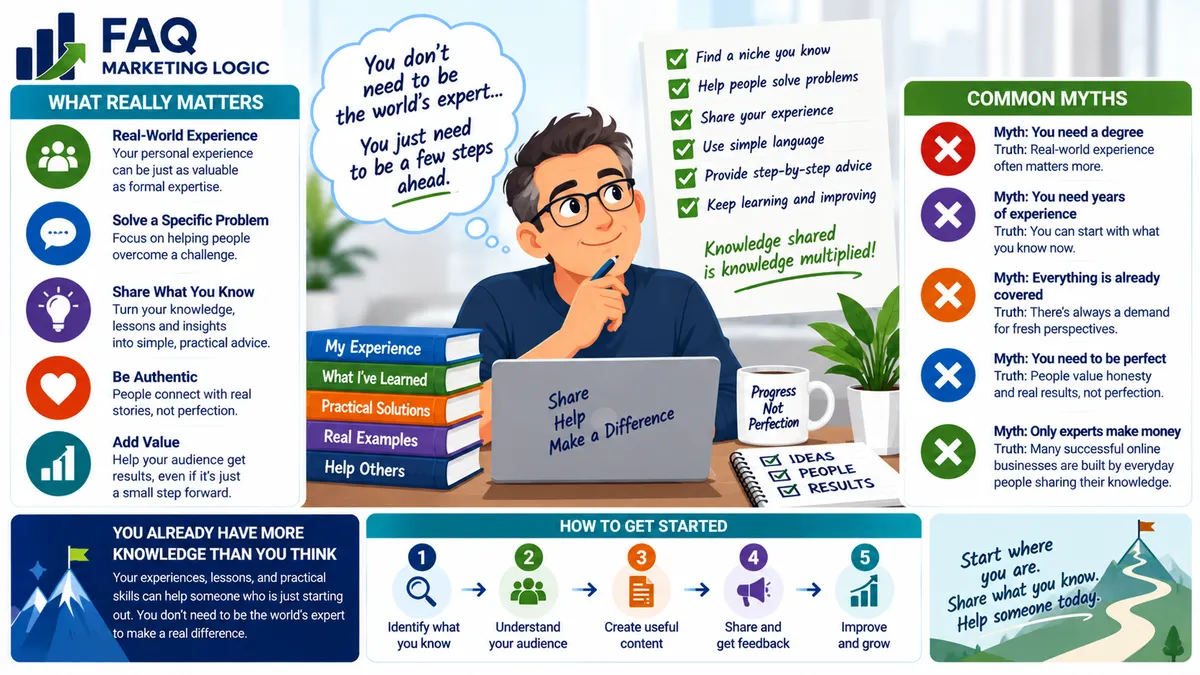
No. You don't need to be the world's leading expert to sell information online.
You do need to know enough to help a particular audience solve a particular problem, and you need to provide information that is useful, accurate and presented in a way they can understand and apply.
In many markets, being a few steps ahead of the person you're helping can be enough, provided you're honest about your experience and don't pretend to have qualifications or expertise you don't possess.
IN SHORT
One of the biggest things that stops people from creating an information-based business is the belief that they aren't qualified enough.
They think:
"Why would anybody listen to me?"
But information businesses aren't reserved for professors, bestselling authors or people with decades of experience.
People pay for information because it helps them:
Solve a problem
Learn a skill
Save time
Avoid mistakes
Make a decision
Follow a clearer process
Achieve a particular outcome
You don't have to know everything about a subject.
You need to know something useful for a specific person who needs it.
REAL TALK
There will nearly always be somebody who knows more than you.
If you wait until you know more than everybody else before creating something, you'll probably never start.
Imagine somebody who has successfully grown vegetables at home for five years.
They're unlikely to know as much as a professional horticulturist.
But could they create a useful beginner's guide explaining how to grow tomatoes in a small garden?
Absolutely.
The beginner buying that guide isn't necessarily looking for the world's greatest authority on horticulture.
They're looking for somebody who can help them grow their first tomatoes without making all the usual beginner mistakes.
That's an important distinction.
Key Definition: What Is An Information Business?
An information business makes money by packaging useful knowledge, experience, research, instruction or expertise into something other people can access or buy.
That might include:
Books
Reports
Guides
Courses
Workshops
Newsletters
Memberships
Templates
Checklists
Digital downloads
Coaching or consulting
The information can come from your existing expertise, your experience, structured research or a combination of these.
The business isn't based on knowing everything.
It's based on identifying useful information that a particular audience values and presenting it in a form they can use.
If you're interested in seeing how information can be turned into an online business, you can explore the information publishing approach here.
How Much Do You Need To Know Before You Can Teach Something?
Enough to provide genuine value.
That's deliberately different from saying you need to be an expert.
Suppose you've spent two years learning how to restore old furniture as a hobby.
During that time you've learned:
Which basic tools beginners need
How to prepare different surfaces
Which mistakes damage furniture
How to choose suitable finishes
How to complete several straightforward restoration projects
You may not be qualified to teach advanced conservation techniques.
But you could potentially create:
A Beginner's Guide To Restoring Your First Piece Of Furniture.
The scope of the product matches the scope of your knowledge.
That's the key.
What If Other People Know More Than I Do?
That's normal.
Your job isn't to know more than everybody else.
Your job is to help your intended customer.
Two people can understand the same subject but teach it very differently.
One might create an enormous technical manual.
Another might turn the same broad subject into a simple seven-step beginner's process.
For a beginner, the second product could actually be more useful.
Expertise matters, but so do:
Clarity
Organisation
Relevance
Simplicity
Practical application
Understanding the audience
Knowing something is one skill.
Explaining it clearly is another.
Can I Create Information Products From My Experience?
Yes.
Experience can be extremely valuable because you've encountered the problems that beginners haven't faced yet.
Think about things you've:
Learned to do
Improved at
Done professionally
Done as a hobby
Helped other people with
Researched extensively
Developed a process for
Made mistakes with and subsequently learned from
You may already possess useful knowledge that feels ordinary to you simply because you've known it for years.
To somebody encountering the problem for the first time, that knowledge may be far from ordinary.
Can I Sell Information Based On Research?
Potentially, yes.
You don't necessarily have to originate every fact or idea in an information product.
Writers, journalists and publishers routinely research subjects and organise information for their audiences.
But research doesn't mean copying somebody else's work.
You need to:
Use reliable sources
Check important claims
Understand what you're writing about
Organise the information yourself
Explain it in your own words
Respect copyright
Credit sources where appropriate
Avoid presenting uncertain information as established fact
The value you add can come from researching, filtering, organising and explaining information that would otherwise take the reader considerable time to find and understand.
Where Does AI Fit Into This?
AI can make research, brainstorming, outlining and drafting considerably faster.
But it doesn't remove your responsibility for what you publish.
AI can:
Suggest questions
Help organise research
Generate outlines
Explain difficult concepts
Help improve wording
Identify gaps in a draft
It can also produce incorrect or misleading information.
If your name or business is on the finished product, you should be comfortable standing behind what it says.
Use AI as an assistant, not as a substitute for judgement.
When Do You Actually Need An Expert?
Some subjects require considerably more care.
If you're providing information involving areas such as:
Medicine
Mental health
Law
Tax
Financial advice
Safety
Regulated professional services
then qualifications, professional standards and legal restrictions may matter considerably.
You shouldn't imply that you possess credentials you don't have.
And you shouldn't turn a few hours of internet research into advice that could seriously affect somebody's health, finances, legal position or safety.
Choosing an appropriate subject and staying within the limits of your knowledge are part of being a responsible publisher.
What If I Don't Feel Qualified Enough?
This is where narrowing the subject can help.
Don't try to create:
The Complete Guide To Photography
when you're really qualified to create:
How To Take Better Product Photos With Your Smartphone
Don't create:
Everything You Need To Know About Gardening
when your real experience is:
How To Grow Herbs In A Small Apartment
A narrower promise makes it easier to:
Define the customer
Know what to include
Stay within your knowledge
Create something practical
Explain the value
You don't need to solve every problem.
Solve one useful problem well.
Do I Need Qualifications To Sell Information Online?
It depends on the subject.
Many everyday educational subjects don't require formal qualifications.
Someone teaching:
Photography
Crafts
Gardening
Productivity
Software skills
Cooking techniques
Writing
Hobbies
may be selling practical knowledge based on experience rather than formal credentials.
But don't confuse not needing a certificate with not needing competence.
Customers still deserve useful and accurate information.
And regulated or high-stakes subjects may have specific professional or legal requirements.
Why Would Someone Pay When Free Information Exists?
Because free information and useful information aren't always the same thing.
A person might be able to find everything they need through:
Google
YouTube
Blogs
Podcasts
Social media
AI tools
But that can mean spending hours sorting through contradictory advice.
A good information product can provide:
selection + organisation + explanation + sequence + convenience.
Instead of asking:
"Can someone find this information free?"
ask:
"Can I make this easier to understand and use?"
That's often where the value lies.
Practical Example
Imagine someone has spent several years creating handmade candles.
They've learned how to:
Choose basic equipment
Work with different waxes
Select suitable containers
Add fragrance
Avoid common beginner mistakes
Produce a consistent finished candle
They aren't a chemist.
They aren't claiming to be the world's leading candle maker.
But they could potentially create:
Your First Five Homemade Candles: A Beginner's Step-By-Step Guide
Their experience matches the promise.
They aren't teaching advanced chemistry or industrial manufacturing.
They're helping a beginner get from:
"I don't know where to start"
to:
"I've made my first candles."
That's useful information.
Common Mistakes
Mistake: Waiting until you know everything.
Fix: Define one problem you're genuinely capable of helping someone solve.
Mistake: Pretending to have expertise you don't possess.
Fix: Be accurate about your knowledge, experience and credentials.
Mistake: Choosing a subject that's far too broad.
Fix: Narrow the audience, problem or desired outcome.
Mistake: Assuming information has no value because it's available free elsewhere.
Fix: Add value through organisation, clarity, convenience and practical application.
Mistake: Publishing AI-generated information without checking it.
Fix: Review and verify important information before putting your name on it.
FAQ QUICK FIX
If you're wondering whether you know enough to create an information product, complete this sentence:
"I can help __________ understand how to __________."
For example:
"I can help first-time vegetable gardeners understand how to grow tomatoes in containers."
Then ask:
Have I actually done or properly researched this?
Can I explain it clearly?
Can I help a beginner avoid mistakes?
Is the subject within the limits of my knowledge?
Would the finished information save somebody time, confusion or effort?
If the answers are yes, you may already have the foundations of an information product.
FAQ
Do I Have To Call Myself An Expert?
No.
You don't need to label yourself an expert to share useful knowledge. Your experience, content and ability to help the reader can demonstrate what you know.
Can A Beginner Sell An Information Product?
A complete beginner shouldn't pretend to teach something they don't understand. But somebody who has already learned a skill or solved a problem may be capable of helping someone who is at an earlier stage.
Do I Need A Degree To Sell A Course?
Not for many ordinary educational subjects. However, regulated professions and high-stakes advice may involve qualifications, restrictions or professional obligations.
What If My Information Is Already Available Online?
That doesn't automatically remove its value. People often pay for information because it has been selected, organised and presented as a clear process.
Can I Create A Product About Something I Learned As A Hobby?
Yes, provided you have enough genuine knowledge to deliver what the product promises.
Do I Need A Huge Audience Before Selling Information?
No. A smaller audience with a clearly defined problem can be more useful than a large but poorly targeted audience. You still need a practical way to reach the right people.
TRY THIS TODAY
Write down five things you know how to do.
They can come from:
Work
Hobbies
Business
Personal projects
Skills you've developed
Subjects you've researched deeply
Now turn each one into a beginner question.
Instead of:
"I know about photography."
write:
"How can a beginner take better product photographs using a smartphone?"
Instead of:
"I know about gardening."
write:
"How can someone grow vegetables when they only have a small patio?"
You'll often discover that the potential product isn't hidden in being an expert.
It's hidden in finding the specific problem your knowledge can solve.
Want To See How Knowledge Can Become An Online Business?
You don't have to know everything before you start.
What matters is understanding how useful knowledge can be packaged, published and turned into something people are willing to buy.
Six Figures A Year In Info Publishing explores the information publishing business model and how knowledge and ideas can become the foundation of an online business.
→ Discover The Information Publishing Approach
RELATED ARTICLES
→ How Do I Choose the Right Online Business Model to Start With?
→ How Do I Validate an Online Business Idea Before Building It?
→ How Do I Turn Skills Into A Sellable Offer?
QUICK RECAP
You don't need to be the world's leading expert to sell information online.
You need enough knowledge to provide genuine value.
Match the scope of the product to the scope of your knowledge.
Experience can be just as useful as formal qualifications in many subjects.
Research can form part of an information product, but research isn't permission to copy.
AI can assist you, but you remain responsible for what you publish.
Don't claim credentials or expertise you don't possess.
Narrow subjects are often easier to teach and sell than enormous ones.
Free information doesn't eliminate the value of organisation, clarity and convenience.
You don't have to know everything.
You need to know enough to help the person you're serving take the next useful step.
NEXT STEP
Once you've identified knowledge that could help somebody else, the next step is turning that knowledge into a clear offer people can understand.