What Is The Biggest Funnel Mistake Beginners Make?
TL;DR
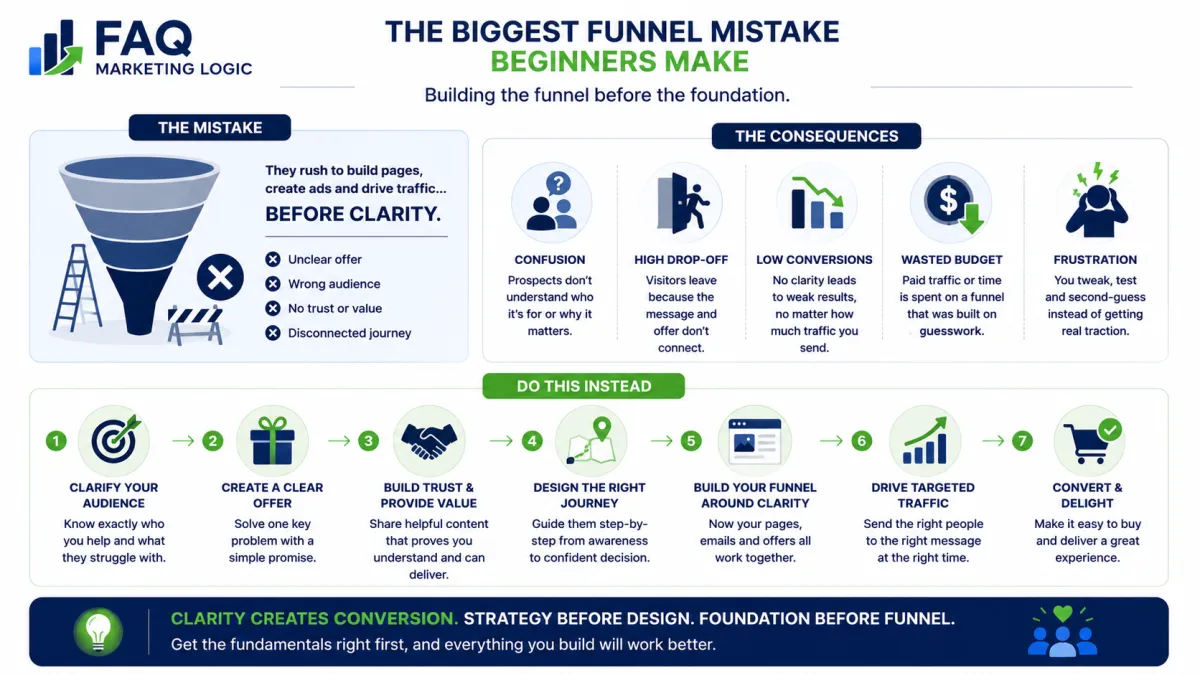
The biggest funnel mistake beginners make is trying to sell too early instead of building trust and guiding prospects through a logical customer journey.
IN SHORT
Many beginners believe that building a funnel simply means connecting a landing page to a sales page.
But a successful funnel is much more than a series of pages.
It's a process that helps people move from curiosity to confidence.
When businesses focus only on making sales, they often overlook the steps that help prospects feel ready to buy.
REAL TALK
It's easy to become excited about selling your product.
After all, making sales is the goal.
But if visitors don't yet trust your business, understand your offer, or believe you can solve their problem, asking for a purchase too soon usually pushes them away.
The strongest funnels don't pressure people.
They educate, reassure, and build confidence before presenting an offer.
Key Definition
A marketing funnel is a structured journey that guides potential customers from discovering your business to becoming paying customers.
Each stage of the funnel has a specific purpose, helping prospects move naturally towards making a buying decision.
Focus On The Customer Journey
Your funnel should answer a series of questions.
For example:
What problem does the visitor have?
Why does it matter?
Can I trust this business?
Will this solution help me?
What's the next step?
Every stage should make the following stage easier.
Don't Skip The Trust-Building Stage
One of the biggest reasons funnels fail is because businesses rush from awareness straight to selling.
Instead, spend time building trust through:
Helpful content
Educational emails
Customer testimonials
Practical advice
Consistent communication
Trust is often the bridge between interest and action.
Keep The Funnel Simple
Many beginners believe more pages create better funnels.
In reality, unnecessary complexity often reduces conversions.
A simple funnel might include:
A useful article or advert
A lead magnet
A welcome email sequence
Helpful follow-up emails
A relevant offer
Simple funnels are easier to build, understand, and improve.
Measure And Improve
No funnel is perfect the first time.
Monitor how people move through each stage.
Ask questions like:
Where are visitors leaving?
Which emails receive the most clicks?
Which offers convert best?
Where are people becoming confused?
Small improvements over time usually produce the biggest long-term results.
Example
Imagine two businesses launching the same digital product.
The first sends visitors directly from an advert to a sales page and immediately asks for the purchase.
The second offers a free guide, follows up with a welcome email sequence, shares useful articles that answer common questions, and then introduces the paid product as the logical next step.
Although both businesses are selling the same product, the second funnel is far more likely to convert because it builds trust before asking for the sale.
Common Mistake
Mistake: Treating your funnel as a sales machine instead of a relationship-building process.
Fix: Build each stage around helping your audience understand, trust, and feel confident before asking them to buy.
Successful funnels guide people—they don't rush them.
FAQ Quick Fix
To build a stronger funnel:
Start with your customer's problem.
Build trust before selling.
Keep the journey simple.
Guide every next step clearly.
Measure and improve over time.
RELATED ARTICLES
→ What Happens After Someone Joins My List?
→ How Do I Move Prospects Toward A Purchase?
→ What Builds Trust Fastest Online?
QUICK RECAP
The best funnels:
Build trust
Educate consistently
Stay simple
Guide prospects logically
Improve continuously
People rarely buy because they're pressured.
They buy because they feel confident.
NEXT STEP
You've now completed the Conversion pillar and understand how to guide visitors from first impressions through to becoming customers.
The next stage is learning how to build sustainable growth systems that continue generating results as your business expands.
Read: