
What’s the Right Time to Launch?
TL;DR
Launch when demand signals are present and systems are stable — not when you “feel ready.”
Timing amplifies leverage.
Poor timing magnifies weakness.
IN SHORT
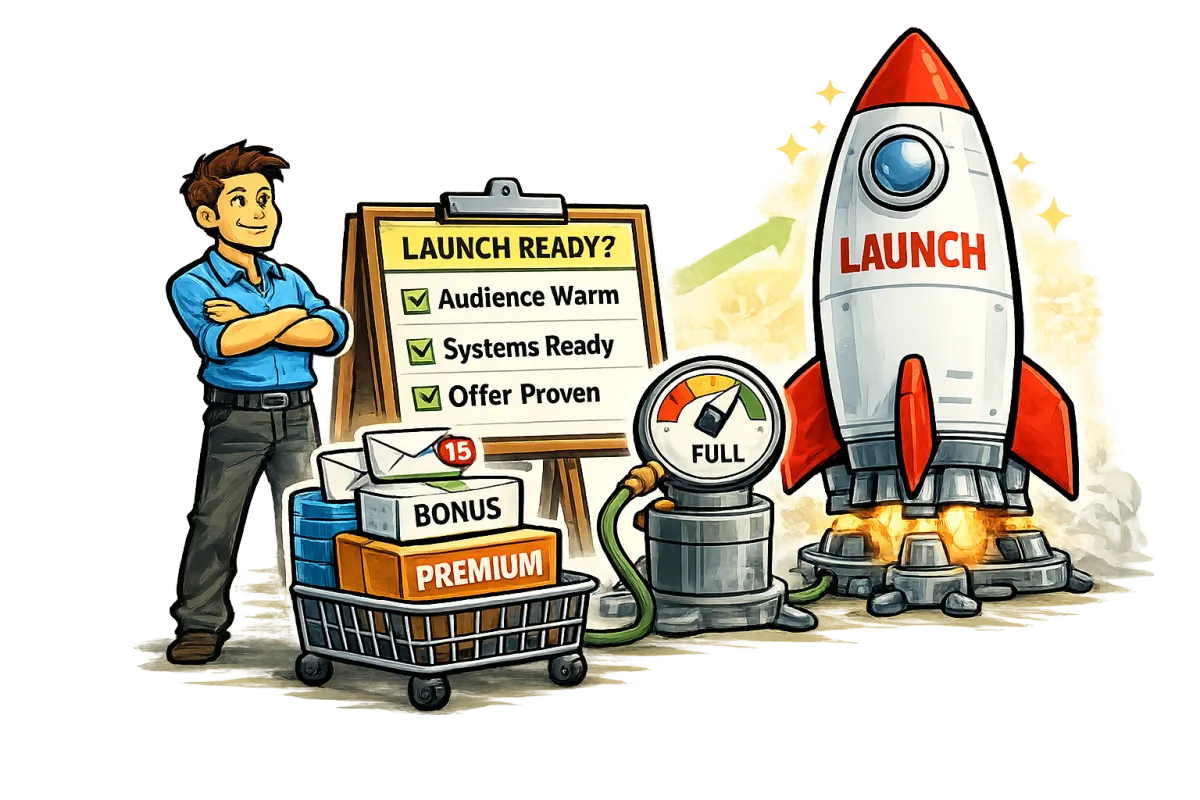
The right time to launch is when:
Your audience is warm.
Your offer has proof.
Your systems can handle volume.
You have pre-sold attention.
Capacity is available.
Do not launch to test demand.
Validate first. Then accelerate.
Scale uses launches to compress revenue cycles.
WHY THIS WORKS
A launch is force applied to a system.
If:
Traffic is steady,
Email is engaged,
Conversion systems are optimised,
Then a launch multiplies results.
If those are weak:
A launch simply exposes weakness.
Launch timing works because:
Attention + urgency + structure = compressed revenue.
But compression only works when the container is strong.
(If fulfilment or automation is unstable, stabilise Systems first.)
REAL TALK
Most founders launch for emotional reasons:
“It’s been a while.”
“Revenue dipped.”
“I need cash.”
Desperation launches damage positioning.
Strong launches feel calm.
Pre-framed.
Pre-sold.
Pre-warmed.
Revenue then feels predictable — not dramatic.
COFFEE CUP TIP ☕
Measure engagement before announcing.
If email open rates and clicks are declining, warm first.
If they’re rising, momentum exists.
Launch into momentum.
STORY TIME
Two identical offers.
Founder A launched after 3 quiet months.
Founder B warmed audience for 4 weeks:
Case studies
Value emails
Soft mentions
Founder A: £18k
Founder B: £52k
Offer was the same.
Momentum was different.
FAQ QUICK FIX
1. Check engagement metrics.
Opens. Clicks. Replies.
2. Review conversion data.
Is your sales page converting consistently?
3. Confirm operational capacity.
Support. Delivery. Payment systems.
4. Warm audience for 2–4 weeks.
Stories. Results. Objections handled.
5. Set a defined launch window.
Open → nurture → close.
QUICK RECAP
Launch when:
Audience is warm.
Systems are strong.
Offer is proven.
Momentum is visible.
Launches amplify what already exists.
They do not create strength.
COMMON MISTAKES
Mistake: Launching to fix revenue dips.
Fix: Diagnose underlying weakness first.
Mistake: Launching without pre-framing.
Fix: Warm the audience beforehand.
Mistake: Overcomplicating launch structure.
Fix: Simple open-cart window.
Mistake: Ignoring fulfilment load.
Fix: Capacity plan before promotion.
FAQ
Q: Should I launch quarterly?
Only if audience growth and engagement justify it.
Q: Evergreen or launch model?
Evergreen stabilises revenue. Launch compresses revenue.
Q: Can I launch with a small list?
Yes — if engagement is high.
Q: How long should a launch last?
Typically 5–10 days for digital offers.
TRY THIS TODAY
Look at your last 30 days of audience engagement.
Is attention rising, stable, or declining?
If declining — warm first.
If rising — prepare structure.
NEXT STEP
Final article in the Scale sequence:
→ How Do I Scale Without Losing Simplicity?
Because complexity is the silent growth killer.
RELATED ARTICLES
→ When Should I Raise My Prices Again?